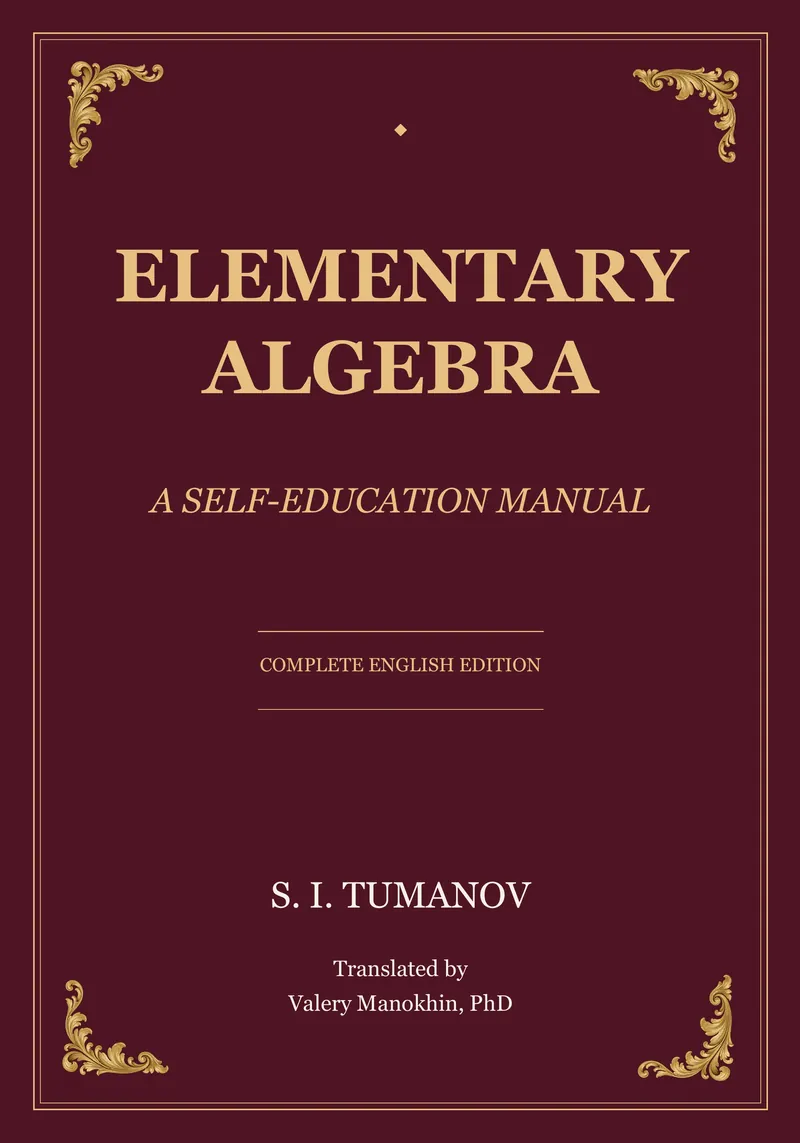
Álgebra Elementar de Tumanov
por S. I. Tumanov
Traduzido por Valery Manokhin, PhD
Edição em inglês
Ainda não vai comprar? Experimente um problema por dia, grátis (em inglês) →
A Álgebra elementar de Tumanov é um curso completo de álgebra escrito para um leitor que não tem professor: 41 capítulos em um único volume de 681 páginas, com 241 exercícios numerados e suas respostas.
A maioria dos livros de álgebra conta com um professor que explique cada regra em aula. O manual de autoinstrução de Savely Ivanovich Tumanov não conta com ninguém: explica por que cada regra vale, mostra aonde cada ideia leva e traz exemplos resolvidos e exercícios com respostas, para que o leitor confira o próprio progresso. Uma única tiragem chegou a 130.000 exemplares. Primeira tradução fiel para o inglês a partir da edição original russa.
A Parte I vai dos números positivos e negativos às identidades e à fatoração, às frações algébricas, às equações e aos sistemas de equações, aos números irracionais, às equações do segundo grau e às funções e seus gráficos. A Parte II trata de desigualdades, limites, sequências e séries, logaritmos, números complexos, o teorema de Bézout, equações de grau superior, indução matemática, combinatória e o binômio de Newton, o número e e a fórmula de Euler, e uma primeira exposição da derivada, da diferencial e da integral. Termina com ensaios sobre condições necessárias e suficientes, a ampliação do conceito de número e o método axiomático, e uma breve história da matemática.
Para as séries 8–12 dos EUA: Álgebra 1 e Álgebra 2, chegando ao Pré-Cálculo e a um primeiro contato com o cálculo. Serve às famílias que ensinam em casa e querem um só livro para o curso inteiro, aos adultos que revisam a álgebra escolar desde o início e aos estudantes que vão cursar matemática, ciências ou engenharia na universidade.
41 capítulos· 281 artigos numerados· 241 exercícios· 681 páginas
Onde se encaixa na escola — EUA, Reino Unido e Canadá ↓Adultos e autodidatas são bem-vindos — a grande matemática não tem limite de idade.
Onde se encaixa na escola
Não sabe se este é o primeiro livro certo? Comece aqui →Currículo completo: todos os livros por ano escolar →| Estados Unidos | 8–12 | Algebra 1 through Algebra 2, running into Precalculus and a first look at calculus |
|---|---|---|
| Inglaterra | Years 9–13 | KS3 → GCSE Higher → A-level Pure |
| Canadá (Ontário) | Ontario 8–12 | MTH1W → MPM2D → MCR3U → MHF4U |
Não coberto neste livro
estatística e tratamento de dados · probabilidade
Estes blocos precisam vir de outro material. Faltam no livro, não nesta descrição.
Onde este livro se encaixa
Ver a sequência completa →Estudar antes
- Aritmética de Kiselev$44.95
Cobre grande parte do mesmo conteúdo
O volume único de Kiselev são 292 páginas de exposição, sem exercícios e sem funções nem gráficos. Este livro são 681 páginas, com 241 exercícios numerados e suas respostas e um capítulo sobre funções e seus gráficos.
O de Malinin e Burenin são 458 páginas e 429 artigos numerados, com mais de 3.300 problemas e 2.698 respostas, enquanto este livro tem 241 exercícios numerados. Não traz funções nem gráficos, que este livro trata em capítulo próprio.
Há forte sobreposição. Cada nota diz o que aquele livro traz e este não — são essas diferenças que decidem.
Problemas para trabalhar em paralelo
- Álgebra de Barsukov$54.95
O que vem depois
- Cálculo de Kiselev$54.95
Sumário
281 seções — o sumário completo do livro impresso.
Translator's Preface
To Students About Mathematics3 seções
- Roman Numerals
- Latin Alphabet
- Greek Alphabet
ALGEBRA1 seção
- What Algebra Is, or the Subject Matter of Algebra
Part I
Chapter I. Positive and Negative Numbers8 seções
- § 1. Initial Concepts
- § 2. The Four Operations on Positive and Negative Numbers
- § 3. The Concepts “Greater” and “Less” as Applied to Positive and Negative Numbers
- § 4. The Number Axis
- § 5. Geometric Interpretation of Multiplication
- § 6. Change of Quantities
- § 7. On Expressions of the Form +(+5); +(−5); −(+5); −(−5) and the Like
- Exercises for Chapter I
Chapter II. Using Letters to Denote Numbers (Letter Symbols)4 seções
- § 1. Initial Concepts
- § 2. Algebraic Expression
- § 3. Relationships Between Quantities
- Exercises for Chapter II
Chapter III. Simplest Algebraic Expressions and Operations on Them13 seções
- § 1. Power
- § 2. Coefficient
- § 3. Raising a Product, a Quotient, and a Power to a Power
- § 4. Classification of Algebraic Expressions
- § 5. Numerical Value of an Algebraic Expression
- § 6. Algebraic Sum
- § 7. Like Monomials and Their Combination
- § 8. Addition, Subtraction, and Multiplication of Monomials
- § 9. Addition, Subtraction, and Multiplication of Polynomials
- § 10. Removing Parentheses and Enclosing in Parentheses
- § 11. Basic Multiplication Formulas
- § 12. Absolute Value of a Number
- Exercises for Chapter III
Chapter IV. Equations Solved Using Only the Properties of the First Four Operations5 seções
- § 1. Preparatory Examples
- § 2. Equation and Its Root
- § 3. Examples of Equations Solved Using Only the Properties of the First Four Operations
- § 4. Solving Problems by Means of Equations
- Exercises for Chapter IV
Chapter V. Identities and Identical Transformations4 seções
- § 1. Identities
- § 2. Transformation of an Algebraic Expression
- § 3. Completing the Square in a Quadratic Polynomial
- Exercises for Chapter V
Chapter VI. Practical and Theoretical Applications of Transformations5 seções
- § 1. Solving Problems by Means of Transformations
- § 2. The Least and Greatest Value of Expressions of the Form ax² + c
- § 3. Applications of Transformations to Solving Problems on Finding the Least and Greatest Values of Expressions
- § 4. Applications of Transformations to the Solution of Theoretical Questions
- Exercises for Chapter VI
Chapter VII. Subsequent Rules of Operations on Algebraic Expressions5 seções
- § 1. Division of Powers and Monomials
- § 2. Greatest Common Divisor
- § 3. Division of a Polynomial by a Monomial
- § 4. Factorization of Polynomials
- Exercises for Chapter VII
Chapter VIII. Multiplication and Division of Arranged Polynomials6 seções
- § 1. A Polynomial of the nth Degree
- § 2. Multiplication of Arranged Polynomials
- § 3. Division of Arranged Polynomials
- § 4. Finding the Greatest Common Divisor of Polynomials by Factoring These Polynomials into Irreducible Factors
- § 5. The Euclidean Algorithm for Finding the Greatest Common Divisor of Two Polynomials
- Exercises for Chapter VIII
Chapter IX. Algebraic Fractions9 seções
- § 1. Initial Concepts and Propositions
- § 2. Least Common Multiple
- § 3. Addition and Subtraction of Fractions
- § 4. Multiplication and Division of Fractions
- § 5. Simplification of a Fraction Whose Numerator and Denominator Are Algebraic Sums of Fractions
- § 6. General Transformation of Rational Expressions
- § 7. Extraction of the Integral Part of an Improper Rational Fraction
- § 8. On the Symbols a⁰ and a⁻ⁿ
- Exercises for Chapter IX
Chapter X. Proportions. A Series of Equal Ratios5 seções
- § 1. Proportions
- § 2. Derived Proportions
- § 3. Determining an Unknown Term of a Proportion
- § 4. A Series of Equal Ratios
- Exercises for Chapter X
Chapter XI. Proportionality—Direct and Inverse4 seções
- § 1. Direct Proportionality
- § 2. Inverse Proportionality
- § 3. Proportional Division
- Exercises for Chapter XI
Chapter XII. Beginnings of the Theory of Equations5 seções
- § 1. An Equation as a Mathematical Expression of the Condition of a Problem
- § 2. General Concepts
- § 3. Classification of Equations
- § 4. Equivalent Equations
- Exercises for Chapter XII
Chapter XIII. Solution of First-Degree Equations with One Unknown7 seções
- § 1. Illustration by Examples
- § 2. Rule for Solving Equations of the First Degree with One Unknown
- § 3. Some Special Cases of Equations with Numerical Coefficients
- § 4. Fractional Equations*
- § 5. Equations Whose Right-Hand Side Is Zero and Whose Left-Hand Side Is a Product of Expressions Depending on the Unknown
- § 6. Equations Whose Left-Hand and Right-Hand Sides Are Products Having a Common Factor Depending on the Unknown
- Exercises for Chapter XIII
Chapter XIV. Systems of Linear Equations9 seções
- § 1. A System of Equations as a Mathematical Expression of Several Conditions of a Problem
- § 2. One Equation with Two Unknowns
- § 3. One Equation with Three Unknowns
- § 4. Methods for Solving a Linear System of Two Equations with Two Unknowns Given in Normal Form
- § 5. Solving a System of Three Linear Equations with Three Unknowns Given in Normal Form
- § 6. Some Examples of Systems of Equations Whose Solution Is Conveniently Carried Out by Means of Artificial Techniques
- § 7. Solving a System of Two Linear Equations by Means of Determinants
- § 8. Solving a System of Three Linear Equations by Means of Determinants
- Exercises for Chapter XIV
Chapter XV. Solving Problems by Means of Equations5 seções
- § 1. General Information
- § 2. Solving Problems by Means of One Equation with One Unknown
- § 3. Solving Problems by Means of Systems of Equations
- § 4. Further Examples of Problems on Setting Up Equations and Some General Instructions
- Exercises for Chapter XV
Chapter XVI. Arithmetic Square Root and Incommensurable Segments5 seções
- § 1. Arithmetic Square Root
- § 2. Theorem on the Exact Value of √2
- § 3. Incommensurable Segments
- § 4. Theorem on the Existence of Incommensurable Line Segments
- § 5. On the Length of a Segment Incommensurable with a Segment Taken as the Unit of Length
Chapter XVII. Rational Numbers and Their Basic Properties6 seções
- § 1. Some Preliminary Remarks
- § 2. The Rational Number Domain
- § 3. Finite and Infinite Decimal Fractions
- § 4. On the Possibility of Representing Every Rational Number as an Infinite Decimal Fraction
- § 5. The Fundamental Theorem on Rational Numbers
- § 6. Rational Points of the Number Axis
Chapter XVIII. Irrational Numbers and Their Basic Properties7 seções
- § 1. On the Necessity of Extending the Rational Number Domain
- § 2. Existence on the Number Axis of Points That Are Not Rational
- § 3. The Concept of Irrational Number
- § 4. Comparison of Irrational Numbers
- § 5. Addition and Multiplication of Irrational Numbers
- § 6. Some Concepts and Propositions of Elementary Set Theory
- Exercises for Chapter XVIII
Chapter XIX. Arithmetic Roots and Operations on Them9 seções
- § 1. Initial Information About Roots
- § 2. The Fundamental Property of the Arithmetic Root
- § 3. Operations on Arithmetic Roots
- § 4. Some Important Transformations
- § 5. Normal Form of a Root
- § 6. Like Roots and Their Addition
- § 7. Transformation of a Compound Root
- § 8. On the Possibility of Finding the Value of Any Arithmetic Root to Any Degree of Accuracy
- Exercises for Chapter XIX
Chapter XX. Quadratic Equations12 seções
- § 1. Preliminary Information
- § 2. Solving Incomplete Quadratic Equations
- § 3. Solving the Complete Quadratic Equation
- § 4. Examples of Problems Reducible to a Quadratic Equation
- § 5. Quadratic Equation of the Form ax² + 2kx + c = 0
- § 6. Reduced Quadratic Equation
- § 7. Properties of the Roots of a Quadratic Equation
- § 8. Root of a Polynomial
- § 9. Factoring the Polynomial ax² + bx + c into Factors
- § 10. Forming a Quadratic Equation from Its Roots
- § 11. The Condition Under Which the Trinomial Ax² + Bx + C Represents an Exact Square
- Exercises for Chapter XX
Chapter XXI. Equations with Numerical Coefficients Reducible to Quadratic Equations4 seções
- § 1. The Biquadratic Equation
- § 2. Equations That Are Quadratic with Respect to an Expression Containing the Unknown
- § 3. Reciprocal Equations of the 3rd and 4th Degree
- Exercises for Chapter XXI
Chapter XXII. Irrational Equations6 seções
- § 1. Basic Information
- § 2. Irrational Equations Containing Only One Radical
- § 3. Equations Containing Two Square Radicals
- § 4. Some Artificial Techniques for Solving Irrational Equations
- § 5. Method for Solving an Irrational Equation by Means of a System of Rational Equations
- Exercises for Chapter XXII
Chapter XXIII. Functions and Their Graphs15 seções
- § 1. Variable Quantities
- § 2. Function of One Argument
- § 3. Graphical Representation of a Function of One Argument
- § 4. Graphical Method of Finding Approximate Values of the Roots of an Equation
- § 5. Coordinates on the Plane
- § 6. The Geometric Image of an Equation
- § 7. Geometric Interpretation of the Solution of a System of Two Linear Equations with Two Unknowns
- § 8. The Equation of Uniform Motion
- § 9. The Graph of Uniform Motion
- § 10. Train Movement Chart
- § 11. Graph of a Polynomial of Degree 2, i.e., of the Function y = ax² + bx + c, where a ≠ 0
- § 12. Ways of Specifying a Function
- § 13. The Domain of Definition of a Function
- § 14. Functions Not Analytically Expressible
- Exercises for Chapter XXIII
Chapter XXIV. Algebraic and Graphical Methods of Solving Systems of Equations of Degree Higher Than the First5 seções
- § 1. The Algebraic Method
- § 2. Graphical Method for Solving Systems of Equations with Two Unknowns
- § 3. Applications of the Analytical Method of Solving Systems to Finding the Points of Intersection of Simplest Lines
- § 4. Systems of Three Equations with Three Unknowns
- Exercises for Chapter XXIV
Part II
Chapter XXV. Inequalities8 seções
- § 1. Basic Propositions
- § 2. Proving Inequalities
- § 3. Inequalities with One Unknown
- § 4. Solving First-Degree Inequalities with One Unknown
- § 5. Solving Systems of First-Degree Inequalities
- § 6. Solving Inequalities of the Second Degree
- § 7. Examples
- Exercises for Chapter XXV
Chapter XXVI. Limits12 seções
- § 1. The Origin of the Concept of Limit
- § 2. Definition of the Concept of Limit
- § 3. Various Types of Tendency to a Limit
- § 4. The Weierstrass Test
- § 5. Infinitesimals
- § 6. Properties of Infinitely Small Quantities
- § 7. Properties of Limits
- § 8. Infinitely Large Quantities
- § 9. Examples of Computing Limits
- § 10. Theorems on the Limits of Aⁿ for A > 1 and of qⁿ for |q| < 1 as n → +∞
- § 11. The Dirichlet Function
- Exercises for Chapter XXVI
Chapter XXVII. Sequences5 seções
- § 1. Examples and Definitions
- § 2. Arithmetic Progression
- § 3. Geometric Progression
- § 4. The Concept of the Limit of a Sequence of Numbers
- Exercises for Chapter XXVII
Chapter XXVIII. Convergent and Divergent Series5 seções
- § 1. The Origin of the Concept of a Series
- § 2. The Concept of a Series
- § 3. Examples of Calculating Sums of Convergent Series
- § 4. Infinitely Decreasing Geometric Progression and Its Sum
- § 5. Examples of Divergent Series
Chapter XXIX. Generalized Power, Exponential Function and Exponential Equations5 seções
- § 1. Generalized Power
- § 2. Degree of a Monomial and Homogeneous Polynomials
- § 3. Exponential Function
- § 4. Exponential Equations
- Exercises for Chapter XXIX
Chapter XXX. Logarithms15 seções
- § 1. The Concept of Logarithm
- § 2. General Properties of Logarithms
- § 3. Fundamental Theorems
- § 4. Taking Logarithms of a Product, Quotient, Power, and Root
- § 5. The Practical Importance of Logarithms
- § 6. Properties of Common Logarithms*
- § 7. Bradis' Table of Four-Place Common Logarithms
- § 8. Bradis' Table of Four-Digit Antilogarithms
- § 9. Examples of Calculations Using Tables of Logarithms
- § 10. Conversion from Natural Logarithms to Decimal Logarithms and Back
- § 11. Some Frequently Used Formulas Containing Logarithms
- § 12. Potentiation
- § 13. Logarithmic Equations
- § 14. Graphs of Logarithmic Functions
- Exercises for Chapter XXX
Chapter XXXI. Complex Numbers16 seções
- § 1. The Origin of Expressions of the Form a + b√−1
- § 2. The Origin of the Complex Number
- § 3. Basic Concepts
- § 4. The Four Operations on Complex Numbers Written in Algebraic Form
- § 5. Affixes of Complex Numbers
- § 6. Vectors in the Plane as Representations of Complex Numbers
- § 7. Modulus and Argument of a Complex Number
- § 8. Expression of the Modulus and Argument of a Complex Number in Terms of the Components and Expression of the Components in Terms of the Modulus and Argument
- § 9. Trigonometric Form of a Complex Number
- § 10. Multiplication and Division of Complex Numbers Given in Trigonometric Form
- § 11. Raising to a Power
- § 12. General Definition of a Root and Extraction of a Root of a Complex Number
- § 13. Correspondence Between Addition and Subtraction of Complex Numbers and Addition and Subtraction of Vectors
- § 14. Problems
- § 15. Complex Numbers as Representations of Physical Quantities
- Exercises for Chapter XXXI
Chapter XXXII. Bézout's Theorem and Its Applications4 seções
- § 1. Illustration of Bézout's Theorem with Examples
- § 2. Statement and Proof of Bézout's Theorem
- § 3. Applications of Bézout's Theorem
- Exercises for Chapter XXXII
Chapter XXXIII. Gauss's Theorem and Properties of an Integral Rational Function4 seções
- § 1. Gauss's Theorem
- § 2. Properties of an Integral Rational Function
- § 3. Examples of the Decomposition of an Integral Rational Function with Real Coefficients of Degree Higher Than the Second into Real Irreducible Factors
- § 4. Viète's Formulas
Chapter XXXIV. Equations of Higher Degrees with One Unknown7 seções
- § 1. The Biquadratic Equation
- § 2. Reciprocal Equation of the 4th Degree
- § 3. Binomial Equations
- § 4. Trinomial Equations
- § 5. Entire Algebraic Equation
- § 6. Finding Rational Roots of an Entire Algebraic Equation with Integer Coefficients
- § 7. On Solving Equations of the 3rd and 4th Degree in General Form
Chapter XXXV. Some Systems of Equations of Higher Degrees, Solved by Artificial Means
Chapter XXXVI. Study of Equations5 seções
- § 1. General Information
- § 2. Study of an Equation of the First Degree with One Unknown
- § 3. Investigation of a System of Two Equations of the 1st Degree with Two Unknowns
- § 4. Investigation of the Quadratic Equation
- § 5. Examples
Chapter XXXVII. Mathematical Induction3 seções
- § 1. Theoretical Information
- § 2. Applications of the Method of Mathematical Induction
- § 3. Proof of the Inequality Between the Geometric and Arithmetic Means of n Numbers
Chapter XXXVIII. Configurations (Combinatorics)5 seções
- § 1. Arrangements
- § 2. Permutations
- § 3. Combinations
- § 4. Configurations with Repetitions
- Exercises for Chapter XXXVIII
Chapter XXXIX. Newton's Binomial6 seções
- § 1. Derivation of the Formula of Newton's Binomial
- § 2. Properties of the Binomial Expansion
- § 3. Properties of the Binomial Coefficients
- § 4. Arithmetic Triangle or Pascal's Triangle
- § 5. Examples on the Binomial of Newton
- Exercises for Chapter XXXIX
Chapter XL. The Number e and Its Simplest Applications5 seções
- § 1. The Origin of the Number e
- § 2. Simplest Applications of the Number e
- § 3. Euler's Formula eᵇⁱ = cos b + i sin b
- § 4. Consequences of Euler's Formula
- Exercises for Chapter XL
Chapter XLI. Derivative, Differential, Integral and Their Simplest Applications5 seções
- § 1. Derivative
- § 2. Differential
- § 3. The Integral
- § 4. Maximum and Minimum of a Function
- Exercises for Chapter XLI
On Necessary and Sufficient Conditions
On the Extension of the Concept of Number
On the Axiomatic Method in Mathematics4 seções
- § 1. The Experiential Origin of Mathematics
- § 2. On Proofs in Mathematics
- § 3. The Origin of the Axiomatic Method in Mathematics
- § 4. Shortcomings of the Former Axiomatic Method and the Essence of the Modern One
Conclusions
Brief Historical Information
Answers and Instructions
Formatos e edições
Edição em inglês
- Comprar →
Brochura · $79.95
Amazon
ISBN 978-1-80910-082-5
- Comprar →
Capa dura, Volume I · $99.95
Somente a Parte I: capítulos I–XXIV, 377 páginas. O Volume II ainda não foi publicado; a brochura é o curso completo.
Amazon
ISBN 978-1-80910-083-2
| Formato | Preço de tabela (USD) | ISBN-13 | Onde | Comprar |
|---|---|---|---|---|
| Brochura | $79.95 | 978-1-80910-082-5 | Amazon | Comprar → |
| Capa dura, Volume ISomente a Parte I: capítulos I–XXIV, 377 páginas. O Volume II ainda não foi publicado; a brochura é o curso completo. | $99.95 | 978-1-80910-083-2 | Amazon | Comprar → |
Preço de tabela: o preço de tabela da editora nos EUA, em USD, apenas como referência. A Amazon define o próprio preço em cada loja — veja o preço atual na Amazon. O preço do Gumroad é o preço cobrado.
Detalhes do produto
- Editora
- Northern Star Academic Press
- Idioma
- English
- Tradutor
- Valery Manokhin, PhD
- Extensão
- 681 páginas
- Primeira publicação
- 2026-11-23
Dúvidas? Veja as perguntas frequentes →
Publicado por Northern Star Academic Press · Primeira tradução fiel da edição original russa
Mais Desta Série

1001 Problemas de Rachinsky
por S. A. Rachinsky
Séries 4–8 (EUA) · Years 5–9 (RU)
1.001 problemas para resolver de cabeça, do professor de aldeia cujos alunos Bogdanov-Belsky pintou em «Cálculo mental» (1895). Em inglês pela primeira vez.

Aritmética Recreativa
por Ya. I. Perelman
Séries 4+ (EUA) · Year 5+ (RU)
A Aritmética recreativa de Yakov Perelman, o clássico da divulgação matemática russa, em inglês: charadas, truques e curiosidades numéricas que fazem da aritmética um prazer.

Markov: Probabilidades
por Andrei A. Markov
Séries 12 and university (EUA) · Year 13 and university (RU)
O Cálculo das probabilidades (1900) de Andrei Markov, em inglês: a teoria da probabilidade desde os seus primeiros princípios, do matemático cujo nome está nas cadeias de Markov.