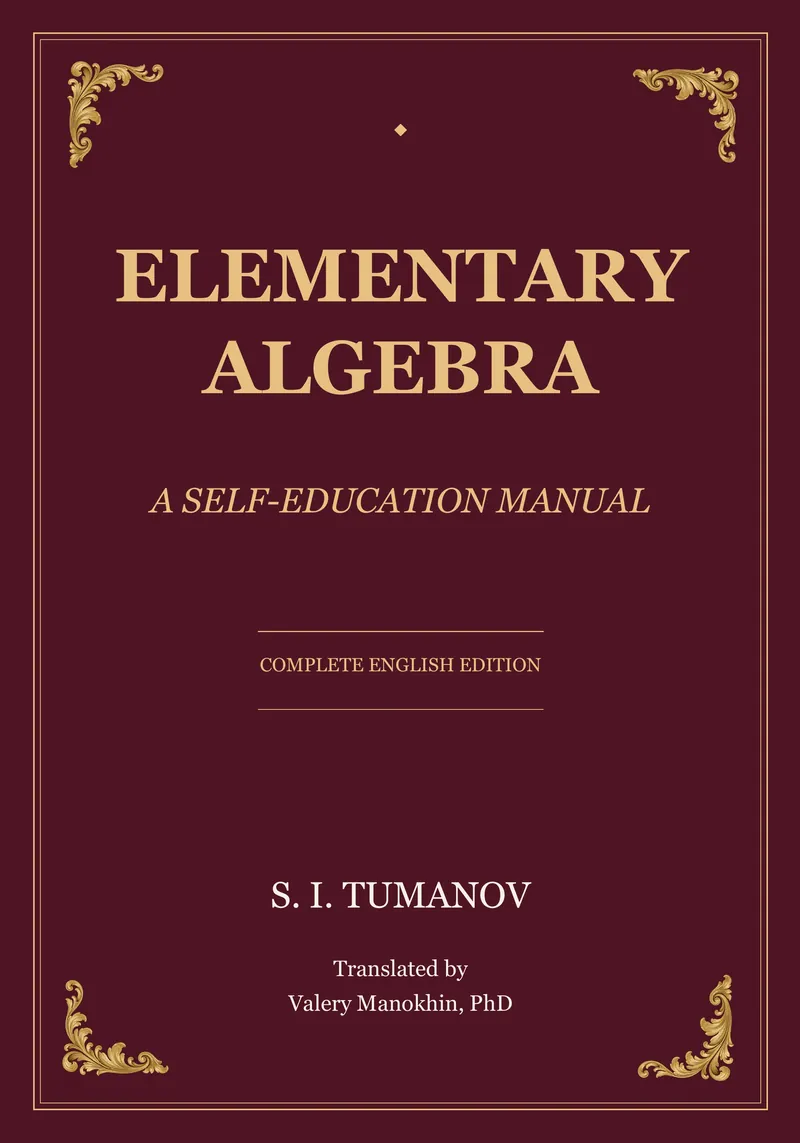
Tumanov's Elementary Algebra
by S. I. Tumanov
Translated by Valery Manokhin, PhD
Not ready to buy? Try one problem a day, free →
Tumanov's Elementary Algebra is a complete algebra course written for a reader who has no teacher: 41 chapters in one 681-page volume, with 241 numbered exercises and their answers.
Most algebra textbooks rely on a teacher to explain each rule in class. Savely Ivanovich Tumanov's self-education manual relies on no one: it explains why each rule holds, shows where each idea leads, and gives worked examples and exercises with answers, so that readers can check their own progress. A single printing ran to 130,000 copies. First faithful English translation from the original Russian edition.
Part I runs from positive and negative numbers through identities and factoring, algebraic fractions, equations and systems of equations, irrational numbers, quadratic equations, and functions and their graphs. Part II covers inequalities, limits, sequences and series, logarithms, complex numbers, Bézout's theorem, equations of higher degree, mathematical induction, combinatorics and Newton's binomial, the number e and Euler's formula, and a first account of the derivative, the differential and the integral. It closes with essays on necessary and sufficient conditions, the extension of the concept of number and the axiomatic method, and a short history of mathematics.
For US grades 8–12: Algebra 1 and Algebra 2, running into Precalculus and a first look at calculus. It suits homeschooling families who want one book for the whole course, adults revising school algebra from the ground up, and students heading for university mathematics, science or engineering.
41 chapters· 281 numbered articles· 241 exercises· 681 pages
Where this fits in school — US, UK and Canada ↓Adults and self-learners welcome — great mathematics has no age limit.
Where this fits in school
Not sure this is the right first book? Start here →Full curriculum table — every book by school year →| United States | 8–12 | Algebra 1 through Algebra 2, running into Precalculus and a first look at calculus |
|---|---|---|
| England | Years 9–13 | KS3 → GCSE Higher → A-level Pure |
| Canada (Ontario) | Ontario 8–12 | MTH1W → MPM2D → MCR3U → MHF4U |
Not covered in this book
statistics and data handling · probability
Source these strands elsewhere. They are missing from the book, not from this description.
How this book fits
See the whole sequence →Work through first
- Kiselev's Arithmetic$44.95
Covers much of the same ground
Kiselev's single volume is 292 pages of exposition, with no exercises and no functions or graphs. This book is 681 pages, with 241 numbered exercises and their answers and a chapter on functions and their graphs.
Malinin and Burenin's is 458 pages and 429 numbered articles, with more than 3,300 problems and 2,698 answers where this book has 241 numbered exercises. It has no functions or graphs, which this book treats in a chapter of their own.
These overlap heavily. Each note says what that book has which this one does not — the differences are what decide between them.
Problems to work alongside it
- Barsukov's Algebra$54.95
- Math Circle Problems$44.95
What comes next
- Kiselev's Calculus$54.95
- Rashevsky's Trigonometry$39.95
Table of contents
281 section headings — the printed contents page in full.
Translator's Preface
To Students About Mathematics3 sections
- Roman Numerals
- Latin Alphabet
- Greek Alphabet
ALGEBRA1 section
- What Algebra Is, or the Subject Matter of Algebra
Part I
Chapter I. Positive and Negative Numbers8 sections
- § 1. Initial Concepts
- § 2. The Four Operations on Positive and Negative Numbers
- § 3. The Concepts “Greater” and “Less” as Applied to Positive and Negative Numbers
- § 4. The Number Axis
- § 5. Geometric Interpretation of Multiplication
- § 6. Change of Quantities
- § 7. On Expressions of the Form +(+5); +(−5); −(+5); −(−5) and the Like
- Exercises for Chapter I
Chapter II. Using Letters to Denote Numbers (Letter Symbols)4 sections
- § 1. Initial Concepts
- § 2. Algebraic Expression
- § 3. Relationships Between Quantities
- Exercises for Chapter II
Chapter III. Simplest Algebraic Expressions and Operations on Them13 sections
- § 1. Power
- § 2. Coefficient
- § 3. Raising a Product, a Quotient, and a Power to a Power
- § 4. Classification of Algebraic Expressions
- § 5. Numerical Value of an Algebraic Expression
- § 6. Algebraic Sum
- § 7. Like Monomials and Their Combination
- § 8. Addition, Subtraction, and Multiplication of Monomials
- § 9. Addition, Subtraction, and Multiplication of Polynomials
- § 10. Removing Parentheses and Enclosing in Parentheses
- § 11. Basic Multiplication Formulas
- § 12. Absolute Value of a Number
- Exercises for Chapter III
Chapter IV. Equations Solved Using Only the Properties of the First Four Operations5 sections
- § 1. Preparatory Examples
- § 2. Equation and Its Root
- § 3. Examples of Equations Solved Using Only the Properties of the First Four Operations
- § 4. Solving Problems by Means of Equations
- Exercises for Chapter IV
Chapter V. Identities and Identical Transformations4 sections
- § 1. Identities
- § 2. Transformation of an Algebraic Expression
- § 3. Completing the Square in a Quadratic Polynomial
- Exercises for Chapter V
Chapter VI. Practical and Theoretical Applications of Transformations5 sections
- § 1. Solving Problems by Means of Transformations
- § 2. The Least and Greatest Value of Expressions of the Form ax² + c
- § 3. Applications of Transformations to Solving Problems on Finding the Least and Greatest Values of Expressions
- § 4. Applications of Transformations to the Solution of Theoretical Questions
- Exercises for Chapter VI
Chapter VII. Subsequent Rules of Operations on Algebraic Expressions5 sections
- § 1. Division of Powers and Monomials
- § 2. Greatest Common Divisor
- § 3. Division of a Polynomial by a Monomial
- § 4. Factorization of Polynomials
- Exercises for Chapter VII
Chapter VIII. Multiplication and Division of Arranged Polynomials6 sections
- § 1. A Polynomial of the nth Degree
- § 2. Multiplication of Arranged Polynomials
- § 3. Division of Arranged Polynomials
- § 4. Finding the Greatest Common Divisor of Polynomials by Factoring These Polynomials into Irreducible Factors
- § 5. The Euclidean Algorithm for Finding the Greatest Common Divisor of Two Polynomials
- Exercises for Chapter VIII
Chapter IX. Algebraic Fractions9 sections
- § 1. Initial Concepts and Propositions
- § 2. Least Common Multiple
- § 3. Addition and Subtraction of Fractions
- § 4. Multiplication and Division of Fractions
- § 5. Simplification of a Fraction Whose Numerator and Denominator Are Algebraic Sums of Fractions
- § 6. General Transformation of Rational Expressions
- § 7. Extraction of the Integral Part of an Improper Rational Fraction
- § 8. On the Symbols a⁰ and a⁻ⁿ
- Exercises for Chapter IX
Chapter X. Proportions. A Series of Equal Ratios5 sections
- § 1. Proportions
- § 2. Derived Proportions
- § 3. Determining an Unknown Term of a Proportion
- § 4. A Series of Equal Ratios
- Exercises for Chapter X
Chapter XI. Proportionality—Direct and Inverse4 sections
- § 1. Direct Proportionality
- § 2. Inverse Proportionality
- § 3. Proportional Division
- Exercises for Chapter XI
Chapter XII. Beginnings of the Theory of Equations5 sections
- § 1. An Equation as a Mathematical Expression of the Condition of a Problem
- § 2. General Concepts
- § 3. Classification of Equations
- § 4. Equivalent Equations
- Exercises for Chapter XII
Chapter XIII. Solution of First-Degree Equations with One Unknown7 sections
- § 1. Illustration by Examples
- § 2. Rule for Solving Equations of the First Degree with One Unknown
- § 3. Some Special Cases of Equations with Numerical Coefficients
- § 4. Fractional Equations*
- § 5. Equations Whose Right-Hand Side Is Zero and Whose Left-Hand Side Is a Product of Expressions Depending on the Unknown
- § 6. Equations Whose Left-Hand and Right-Hand Sides Are Products Having a Common Factor Depending on the Unknown
- Exercises for Chapter XIII
Chapter XIV. Systems of Linear Equations9 sections
- § 1. A System of Equations as a Mathematical Expression of Several Conditions of a Problem
- § 2. One Equation with Two Unknowns
- § 3. One Equation with Three Unknowns
- § 4. Methods for Solving a Linear System of Two Equations with Two Unknowns Given in Normal Form
- § 5. Solving a System of Three Linear Equations with Three Unknowns Given in Normal Form
- § 6. Some Examples of Systems of Equations Whose Solution Is Conveniently Carried Out by Means of Artificial Techniques
- § 7. Solving a System of Two Linear Equations by Means of Determinants
- § 8. Solving a System of Three Linear Equations by Means of Determinants
- Exercises for Chapter XIV
Chapter XV. Solving Problems by Means of Equations5 sections
- § 1. General Information
- § 2. Solving Problems by Means of One Equation with One Unknown
- § 3. Solving Problems by Means of Systems of Equations
- § 4. Further Examples of Problems on Setting Up Equations and Some General Instructions
- Exercises for Chapter XV
Chapter XVI. Arithmetic Square Root and Incommensurable Segments5 sections
- § 1. Arithmetic Square Root
- § 2. Theorem on the Exact Value of √2
- § 3. Incommensurable Segments
- § 4. Theorem on the Existence of Incommensurable Line Segments
- § 5. On the Length of a Segment Incommensurable with a Segment Taken as the Unit of Length
Chapter XVII. Rational Numbers and Their Basic Properties6 sections
- § 1. Some Preliminary Remarks
- § 2. The Rational Number Domain
- § 3. Finite and Infinite Decimal Fractions
- § 4. On the Possibility of Representing Every Rational Number as an Infinite Decimal Fraction
- § 5. The Fundamental Theorem on Rational Numbers
- § 6. Rational Points of the Number Axis
Chapter XVIII. Irrational Numbers and Their Basic Properties7 sections
- § 1. On the Necessity of Extending the Rational Number Domain
- § 2. Existence on the Number Axis of Points That Are Not Rational
- § 3. The Concept of Irrational Number
- § 4. Comparison of Irrational Numbers
- § 5. Addition and Multiplication of Irrational Numbers
- § 6. Some Concepts and Propositions of Elementary Set Theory
- Exercises for Chapter XVIII
Chapter XIX. Arithmetic Roots and Operations on Them9 sections
- § 1. Initial Information About Roots
- § 2. The Fundamental Property of the Arithmetic Root
- § 3. Operations on Arithmetic Roots
- § 4. Some Important Transformations
- § 5. Normal Form of a Root
- § 6. Like Roots and Their Addition
- § 7. Transformation of a Compound Root
- § 8. On the Possibility of Finding the Value of Any Arithmetic Root to Any Degree of Accuracy
- Exercises for Chapter XIX
Chapter XX. Quadratic Equations12 sections
- § 1. Preliminary Information
- § 2. Solving Incomplete Quadratic Equations
- § 3. Solving the Complete Quadratic Equation
- § 4. Examples of Problems Reducible to a Quadratic Equation
- § 5. Quadratic Equation of the Form ax² + 2kx + c = 0
- § 6. Reduced Quadratic Equation
- § 7. Properties of the Roots of a Quadratic Equation
- § 8. Root of a Polynomial
- § 9. Factoring the Polynomial ax² + bx + c into Factors
- § 10. Forming a Quadratic Equation from Its Roots
- § 11. The Condition Under Which the Trinomial Ax² + Bx + C Represents an Exact Square
- Exercises for Chapter XX
Chapter XXI. Equations with Numerical Coefficients Reducible to Quadratic Equations4 sections
- § 1. The Biquadratic Equation
- § 2. Equations That Are Quadratic with Respect to an Expression Containing the Unknown
- § 3. Reciprocal Equations of the 3rd and 4th Degree
- Exercises for Chapter XXI
Chapter XXII. Irrational Equations6 sections
- § 1. Basic Information
- § 2. Irrational Equations Containing Only One Radical
- § 3. Equations Containing Two Square Radicals
- § 4. Some Artificial Techniques for Solving Irrational Equations
- § 5. Method for Solving an Irrational Equation by Means of a System of Rational Equations
- Exercises for Chapter XXII
Chapter XXIII. Functions and Their Graphs15 sections
- § 1. Variable Quantities
- § 2. Function of One Argument
- § 3. Graphical Representation of a Function of One Argument
- § 4. Graphical Method of Finding Approximate Values of the Roots of an Equation
- § 5. Coordinates on the Plane
- § 6. The Geometric Image of an Equation
- § 7. Geometric Interpretation of the Solution of a System of Two Linear Equations with Two Unknowns
- § 8. The Equation of Uniform Motion
- § 9. The Graph of Uniform Motion
- § 10. Train Movement Chart
- § 11. Graph of a Polynomial of Degree 2, i.e., of the Function y = ax² + bx + c, where a ≠ 0
- § 12. Ways of Specifying a Function
- § 13. The Domain of Definition of a Function
- § 14. Functions Not Analytically Expressible
- Exercises for Chapter XXIII
Chapter XXIV. Algebraic and Graphical Methods of Solving Systems of Equations of Degree Higher Than the First5 sections
- § 1. The Algebraic Method
- § 2. Graphical Method for Solving Systems of Equations with Two Unknowns
- § 3. Applications of the Analytical Method of Solving Systems to Finding the Points of Intersection of Simplest Lines
- § 4. Systems of Three Equations with Three Unknowns
- Exercises for Chapter XXIV
Part II
Chapter XXV. Inequalities8 sections
- § 1. Basic Propositions
- § 2. Proving Inequalities
- § 3. Inequalities with One Unknown
- § 4. Solving First-Degree Inequalities with One Unknown
- § 5. Solving Systems of First-Degree Inequalities
- § 6. Solving Inequalities of the Second Degree
- § 7. Examples
- Exercises for Chapter XXV
Chapter XXVI. Limits12 sections
- § 1. The Origin of the Concept of Limit
- § 2. Definition of the Concept of Limit
- § 3. Various Types of Tendency to a Limit
- § 4. The Weierstrass Test
- § 5. Infinitesimals
- § 6. Properties of Infinitely Small Quantities
- § 7. Properties of Limits
- § 8. Infinitely Large Quantities
- § 9. Examples of Computing Limits
- § 10. Theorems on the Limits of Aⁿ for A > 1 and of qⁿ for |q| < 1 as n → +∞
- § 11. The Dirichlet Function
- Exercises for Chapter XXVI
Chapter XXVII. Sequences5 sections
- § 1. Examples and Definitions
- § 2. Arithmetic Progression
- § 3. Geometric Progression
- § 4. The Concept of the Limit of a Sequence of Numbers
- Exercises for Chapter XXVII
Chapter XXVIII. Convergent and Divergent Series5 sections
- § 1. The Origin of the Concept of a Series
- § 2. The Concept of a Series
- § 3. Examples of Calculating Sums of Convergent Series
- § 4. Infinitely Decreasing Geometric Progression and Its Sum
- § 5. Examples of Divergent Series
Chapter XXIX. Generalized Power, Exponential Function and Exponential Equations5 sections
- § 1. Generalized Power
- § 2. Degree of a Monomial and Homogeneous Polynomials
- § 3. Exponential Function
- § 4. Exponential Equations
- Exercises for Chapter XXIX
Chapter XXX. Logarithms15 sections
- § 1. The Concept of Logarithm
- § 2. General Properties of Logarithms
- § 3. Fundamental Theorems
- § 4. Taking Logarithms of a Product, Quotient, Power, and Root
- § 5. The Practical Importance of Logarithms
- § 6. Properties of Common Logarithms*
- § 7. Bradis' Table of Four-Place Common Logarithms
- § 8. Bradis' Table of Four-Digit Antilogarithms
- § 9. Examples of Calculations Using Tables of Logarithms
- § 10. Conversion from Natural Logarithms to Decimal Logarithms and Back
- § 11. Some Frequently Used Formulas Containing Logarithms
- § 12. Potentiation
- § 13. Logarithmic Equations
- § 14. Graphs of Logarithmic Functions
- Exercises for Chapter XXX
Chapter XXXI. Complex Numbers16 sections
- § 1. The Origin of Expressions of the Form a + b√−1
- § 2. The Origin of the Complex Number
- § 3. Basic Concepts
- § 4. The Four Operations on Complex Numbers Written in Algebraic Form
- § 5. Affixes of Complex Numbers
- § 6. Vectors in the Plane as Representations of Complex Numbers
- § 7. Modulus and Argument of a Complex Number
- § 8. Expression of the Modulus and Argument of a Complex Number in Terms of the Components and Expression of the Components in Terms of the Modulus and Argument
- § 9. Trigonometric Form of a Complex Number
- § 10. Multiplication and Division of Complex Numbers Given in Trigonometric Form
- § 11. Raising to a Power
- § 12. General Definition of a Root and Extraction of a Root of a Complex Number
- § 13. Correspondence Between Addition and Subtraction of Complex Numbers and Addition and Subtraction of Vectors
- § 14. Problems
- § 15. Complex Numbers as Representations of Physical Quantities
- Exercises for Chapter XXXI
Chapter XXXII. Bézout's Theorem and Its Applications4 sections
- § 1. Illustration of Bézout's Theorem with Examples
- § 2. Statement and Proof of Bézout's Theorem
- § 3. Applications of Bézout's Theorem
- Exercises for Chapter XXXII
Chapter XXXIII. Gauss's Theorem and Properties of an Integral Rational Function4 sections
- § 1. Gauss's Theorem
- § 2. Properties of an Integral Rational Function
- § 3. Examples of the Decomposition of an Integral Rational Function with Real Coefficients of Degree Higher Than the Second into Real Irreducible Factors
- § 4. Viète's Formulas
Chapter XXXIV. Equations of Higher Degrees with One Unknown7 sections
- § 1. The Biquadratic Equation
- § 2. Reciprocal Equation of the 4th Degree
- § 3. Binomial Equations
- § 4. Trinomial Equations
- § 5. Entire Algebraic Equation
- § 6. Finding Rational Roots of an Entire Algebraic Equation with Integer Coefficients
- § 7. On Solving Equations of the 3rd and 4th Degree in General Form
Chapter XXXV. Some Systems of Equations of Higher Degrees, Solved by Artificial Means
Chapter XXXVI. Study of Equations5 sections
- § 1. General Information
- § 2. Study of an Equation of the First Degree with One Unknown
- § 3. Investigation of a System of Two Equations of the 1st Degree with Two Unknowns
- § 4. Investigation of the Quadratic Equation
- § 5. Examples
Chapter XXXVII. Mathematical Induction3 sections
- § 1. Theoretical Information
- § 2. Applications of the Method of Mathematical Induction
- § 3. Proof of the Inequality Between the Geometric and Arithmetic Means of n Numbers
Chapter XXXVIII. Configurations (Combinatorics)5 sections
- § 1. Arrangements
- § 2. Permutations
- § 3. Combinations
- § 4. Configurations with Repetitions
- Exercises for Chapter XXXVIII
Chapter XXXIX. Newton's Binomial6 sections
- § 1. Derivation of the Formula of Newton's Binomial
- § 2. Properties of the Binomial Expansion
- § 3. Properties of the Binomial Coefficients
- § 4. Arithmetic Triangle or Pascal's Triangle
- § 5. Examples on the Binomial of Newton
- Exercises for Chapter XXXIX
Chapter XL. The Number e and Its Simplest Applications5 sections
- § 1. The Origin of the Number e
- § 2. Simplest Applications of the Number e
- § 3. Euler's Formula eᵇⁱ = cos b + i sin b
- § 4. Consequences of Euler's Formula
- Exercises for Chapter XL
Chapter XLI. Derivative, Differential, Integral and Their Simplest Applications5 sections
- § 1. Derivative
- § 2. Differential
- § 3. The Integral
- § 4. Maximum and Minimum of a Function
- Exercises for Chapter XLI
On Necessary and Sufficient Conditions
On the Extension of the Concept of Number
On the Axiomatic Method in Mathematics4 sections
- § 1. The Experiential Origin of Mathematics
- § 2. On Proofs in Mathematics
- § 3. The Origin of the Axiomatic Method in Mathematics
- § 4. Shortcomings of the Former Axiomatic Method and the Essence of the Modern One
Conclusions
Brief Historical Information
Answers and Instructions
Formats and editions
- Buy →
Paperback · $79.95
Amazon
ISBN 978-1-80910-082-5
- Buy →
Hardcover, Volume I · $99.95
Part I only: Chapters I–XXIV, 377 pages. Volume II is not yet published; the paperback is the complete course.
Amazon
ISBN 978-1-80910-083-2
| Format | List price (USD) | ISBN-13 | Where | Buy |
|---|---|---|---|---|
| Paperback | $79.95 | 978-1-80910-082-5 | Amazon | Buy → |
| Hardcover, Volume IPart I only: Chapters I–XXIV, 377 pages. Volume II is not yet published; the paperback is the complete course. | $99.95 | 978-1-80910-083-2 | Amazon | Buy → |
List price: the US publisher list price in USD, shown for reference. Amazon sets its own price in each store — see the current price on Amazon. The Gumroad price is the price charged.
Product details
- Publisher
- Northern Star Academic Press
- Language
- English
- Translator
- Valery Manokhin, PhD
- Print length
- 681 pages
- First published
- 2026-11-23
Published by Northern Star Academic Press · First faithful English translation from the original Russian edition
More in This Series

Rachinsky's 1001 Problems
by S. A. Rachinsky
US grades 4–8 · UK Years 5–9
1,001 problems to solve in the head, from the village schoolmaster whose pupils Bogdanov-Belsky painted in "Mental Arithmetic" (1895). In English for the first time.

Perelman's Entertaining Arithmetic
by Ya. I. Perelman
US grades 4+ · UK Year 5+
Yakov Perelman's Entertaining Arithmetic, the classic of Russian popular mathematics, in English: number puzzles, tricks and curiosities that make arithmetic a pleasure.

Markov: Probabilities
by Andrei A. Markov
US grades 12 and university · UK Year 13 and university
Andrei Markov's The Calculus of Probabilities (1900), in English: probability theory from its first principles, by the mathematician whose name is on Markov chains.