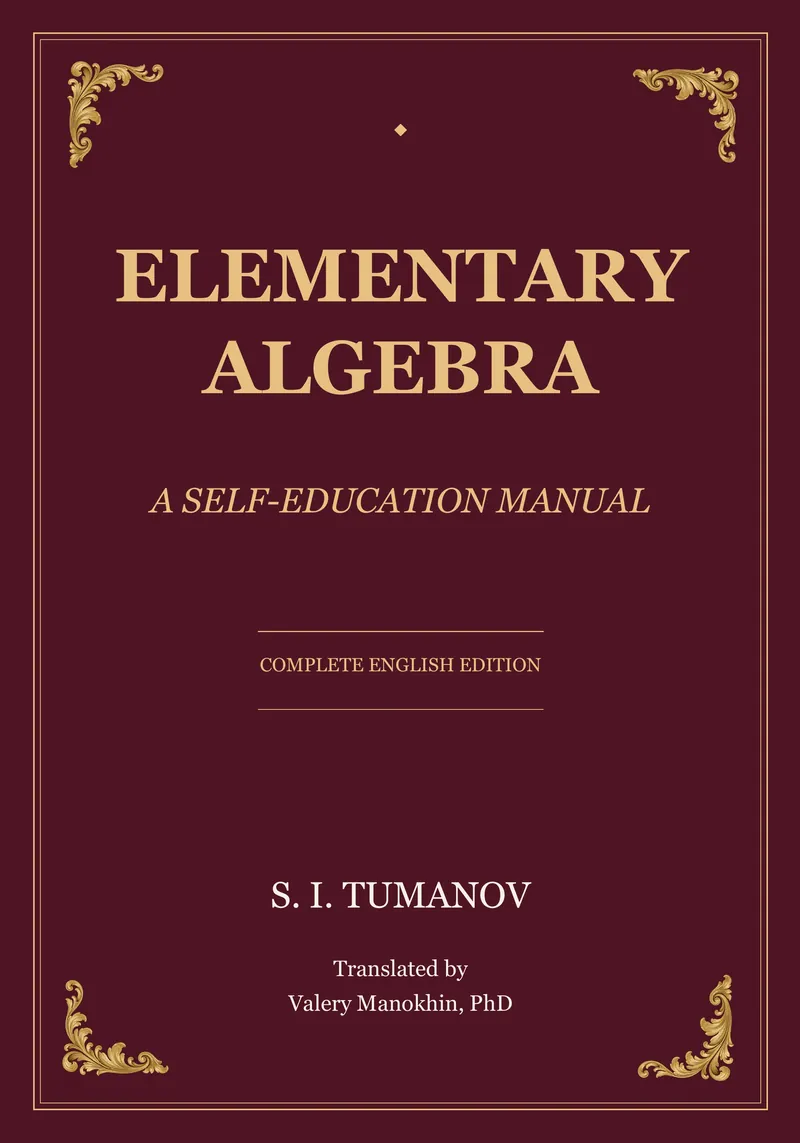
Álgebra Elemental de Tumanov
por S. I. Tumanov
Traducido por Valery Manokhin, PhD
Edición en inglés
¿Aún no te decides a comprar? Prueba un problema al día, gratis (en inglés) →
El Álgebra elemental de Tumanov es un curso completo de álgebra escrito para un lector que no tiene profesor: 41 capítulos en un solo volumen de 681 páginas, con 241 ejercicios numerados y sus respuestas.
La mayoría de los manuales de álgebra cuentan con un profesor que explique cada regla en clase. El manual de autoaprendizaje de Savely Ivánovich Tumanov no cuenta con nadie: explica por qué se cumple cada regla, muestra adónde conduce cada idea y ofrece ejemplos resueltos y ejercicios con respuestas, para que el lector compruebe su propio avance. Una sola tirada alcanzó los 130.000 ejemplares. Primera traducción fiel al inglés a partir de la edición original rusa.
La Parte I va de los números positivos y negativos a las identidades y la factorización, las fracciones algebraicas, las ecuaciones y los sistemas de ecuaciones, los números irracionales, las ecuaciones de segundo grado y las funciones y sus gráficas. La Parte II trata las desigualdades, los límites, las sucesiones y las series, los logaritmos, los números complejos, el teorema de Bézout, las ecuaciones de grado superior, la inducción matemática, la combinatoria y el binomio de Newton, el número e y la fórmula de Euler, y una primera exposición de la derivada, la diferencial y la integral. Termina con ensayos sobre las condiciones necesarias y suficientes, la ampliación del concepto de número y el método axiomático, y una breve historia de las matemáticas.
Para los grados 8–12 de EE. UU.: Álgebra 1 y Álgebra 2, hasta Precálculo y un primer contacto con el cálculo. Sirve a las familias que educan en casa y quieren un solo libro para todo el curso, a los adultos que repasan el álgebra escolar desde el principio y a los estudiantes que van a cursar matemáticas, ciencias o ingeniería en la universidad.
41 capítulos· 281 artículos numerados· 241 ejercicios· 681 páginas
Dónde encaja en el curso escolar — EE. UU., Reino Unido y Canadá ↓Adultos y autodidactas bienvenidos — las grandes matemáticas no tienen límite de edad.
Dónde encaja en el curso escolar
¿No sabe si este es el primer libro adecuado? Empiece aquí →Plan de estudios completo: todos los libros por curso →| Estados Unidos | 8–12 | Algebra 1 through Algebra 2, running into Precalculus and a first look at calculus |
|---|---|---|
| Inglaterra | Years 9–13 | KS3 → GCSE Higher → A-level Pure |
| Canadá (Ontario) | Ontario 8–12 | MTH1W → MPM2D → MCR3U → MHF4U |
No incluido en este libro
estadística y tratamiento de datos · probabilidad
Estos bloques habrá que cubrirlos con otro material. Faltan en el libro, no en esta descripción.
Dónde encaja este libro
Ver la secuencia completa →Estudiar antes
- Aritmética de Kiselev$44.95
Cubre gran parte del mismo temario
El volumen único de Kiselev son 292 páginas de exposición, sin ejercicios y sin funciones ni gráficas. Este libro son 681 páginas, con 241 ejercicios numerados y sus respuestas y un capítulo sobre las funciones y sus gráficas.
El de Malinin y Burenin son 458 páginas y 429 artículos numerados, con más de 3.300 problemas y 2.698 respuestas, mientras que este libro tiene 241 ejercicios numerados. No trae funciones ni gráficas, que este libro trata en un capítulo propio.
Se solapan en gran medida. Cada nota indica qué trae ese libro que este no — esas diferencias son las que deciden.
Problemas para trabajar en paralelo
- Álgebra de Barsukov$54.95
Qué viene después
- Cálculo de Kiselev$54.95
Índice
281 secciones — el índice completo del libro impreso.
Translator's Preface
To Students About Mathematics3 secciónes
- Roman Numerals
- Latin Alphabet
- Greek Alphabet
ALGEBRA1 sección
- What Algebra Is, or the Subject Matter of Algebra
Part I
Chapter I. Positive and Negative Numbers8 secciónes
- § 1. Initial Concepts
- § 2. The Four Operations on Positive and Negative Numbers
- § 3. The Concepts “Greater” and “Less” as Applied to Positive and Negative Numbers
- § 4. The Number Axis
- § 5. Geometric Interpretation of Multiplication
- § 6. Change of Quantities
- § 7. On Expressions of the Form +(+5); +(−5); −(+5); −(−5) and the Like
- Exercises for Chapter I
Chapter II. Using Letters to Denote Numbers (Letter Symbols)4 secciónes
- § 1. Initial Concepts
- § 2. Algebraic Expression
- § 3. Relationships Between Quantities
- Exercises for Chapter II
Chapter III. Simplest Algebraic Expressions and Operations on Them13 secciónes
- § 1. Power
- § 2. Coefficient
- § 3. Raising a Product, a Quotient, and a Power to a Power
- § 4. Classification of Algebraic Expressions
- § 5. Numerical Value of an Algebraic Expression
- § 6. Algebraic Sum
- § 7. Like Monomials and Their Combination
- § 8. Addition, Subtraction, and Multiplication of Monomials
- § 9. Addition, Subtraction, and Multiplication of Polynomials
- § 10. Removing Parentheses and Enclosing in Parentheses
- § 11. Basic Multiplication Formulas
- § 12. Absolute Value of a Number
- Exercises for Chapter III
Chapter IV. Equations Solved Using Only the Properties of the First Four Operations5 secciónes
- § 1. Preparatory Examples
- § 2. Equation and Its Root
- § 3. Examples of Equations Solved Using Only the Properties of the First Four Operations
- § 4. Solving Problems by Means of Equations
- Exercises for Chapter IV
Chapter V. Identities and Identical Transformations4 secciónes
- § 1. Identities
- § 2. Transformation of an Algebraic Expression
- § 3. Completing the Square in a Quadratic Polynomial
- Exercises for Chapter V
Chapter VI. Practical and Theoretical Applications of Transformations5 secciónes
- § 1. Solving Problems by Means of Transformations
- § 2. The Least and Greatest Value of Expressions of the Form ax² + c
- § 3. Applications of Transformations to Solving Problems on Finding the Least and Greatest Values of Expressions
- § 4. Applications of Transformations to the Solution of Theoretical Questions
- Exercises for Chapter VI
Chapter VII. Subsequent Rules of Operations on Algebraic Expressions5 secciónes
- § 1. Division of Powers and Monomials
- § 2. Greatest Common Divisor
- § 3. Division of a Polynomial by a Monomial
- § 4. Factorization of Polynomials
- Exercises for Chapter VII
Chapter VIII. Multiplication and Division of Arranged Polynomials6 secciónes
- § 1. A Polynomial of the nth Degree
- § 2. Multiplication of Arranged Polynomials
- § 3. Division of Arranged Polynomials
- § 4. Finding the Greatest Common Divisor of Polynomials by Factoring These Polynomials into Irreducible Factors
- § 5. The Euclidean Algorithm for Finding the Greatest Common Divisor of Two Polynomials
- Exercises for Chapter VIII
Chapter IX. Algebraic Fractions9 secciónes
- § 1. Initial Concepts and Propositions
- § 2. Least Common Multiple
- § 3. Addition and Subtraction of Fractions
- § 4. Multiplication and Division of Fractions
- § 5. Simplification of a Fraction Whose Numerator and Denominator Are Algebraic Sums of Fractions
- § 6. General Transformation of Rational Expressions
- § 7. Extraction of the Integral Part of an Improper Rational Fraction
- § 8. On the Symbols a⁰ and a⁻ⁿ
- Exercises for Chapter IX
Chapter X. Proportions. A Series of Equal Ratios5 secciónes
- § 1. Proportions
- § 2. Derived Proportions
- § 3. Determining an Unknown Term of a Proportion
- § 4. A Series of Equal Ratios
- Exercises for Chapter X
Chapter XI. Proportionality—Direct and Inverse4 secciónes
- § 1. Direct Proportionality
- § 2. Inverse Proportionality
- § 3. Proportional Division
- Exercises for Chapter XI
Chapter XII. Beginnings of the Theory of Equations5 secciónes
- § 1. An Equation as a Mathematical Expression of the Condition of a Problem
- § 2. General Concepts
- § 3. Classification of Equations
- § 4. Equivalent Equations
- Exercises for Chapter XII
Chapter XIII. Solution of First-Degree Equations with One Unknown7 secciónes
- § 1. Illustration by Examples
- § 2. Rule for Solving Equations of the First Degree with One Unknown
- § 3. Some Special Cases of Equations with Numerical Coefficients
- § 4. Fractional Equations*
- § 5. Equations Whose Right-Hand Side Is Zero and Whose Left-Hand Side Is a Product of Expressions Depending on the Unknown
- § 6. Equations Whose Left-Hand and Right-Hand Sides Are Products Having a Common Factor Depending on the Unknown
- Exercises for Chapter XIII
Chapter XIV. Systems of Linear Equations9 secciónes
- § 1. A System of Equations as a Mathematical Expression of Several Conditions of a Problem
- § 2. One Equation with Two Unknowns
- § 3. One Equation with Three Unknowns
- § 4. Methods for Solving a Linear System of Two Equations with Two Unknowns Given in Normal Form
- § 5. Solving a System of Three Linear Equations with Three Unknowns Given in Normal Form
- § 6. Some Examples of Systems of Equations Whose Solution Is Conveniently Carried Out by Means of Artificial Techniques
- § 7. Solving a System of Two Linear Equations by Means of Determinants
- § 8. Solving a System of Three Linear Equations by Means of Determinants
- Exercises for Chapter XIV
Chapter XV. Solving Problems by Means of Equations5 secciónes
- § 1. General Information
- § 2. Solving Problems by Means of One Equation with One Unknown
- § 3. Solving Problems by Means of Systems of Equations
- § 4. Further Examples of Problems on Setting Up Equations and Some General Instructions
- Exercises for Chapter XV
Chapter XVI. Arithmetic Square Root and Incommensurable Segments5 secciónes
- § 1. Arithmetic Square Root
- § 2. Theorem on the Exact Value of √2
- § 3. Incommensurable Segments
- § 4. Theorem on the Existence of Incommensurable Line Segments
- § 5. On the Length of a Segment Incommensurable with a Segment Taken as the Unit of Length
Chapter XVII. Rational Numbers and Their Basic Properties6 secciónes
- § 1. Some Preliminary Remarks
- § 2. The Rational Number Domain
- § 3. Finite and Infinite Decimal Fractions
- § 4. On the Possibility of Representing Every Rational Number as an Infinite Decimal Fraction
- § 5. The Fundamental Theorem on Rational Numbers
- § 6. Rational Points of the Number Axis
Chapter XVIII. Irrational Numbers and Their Basic Properties7 secciónes
- § 1. On the Necessity of Extending the Rational Number Domain
- § 2. Existence on the Number Axis of Points That Are Not Rational
- § 3. The Concept of Irrational Number
- § 4. Comparison of Irrational Numbers
- § 5. Addition and Multiplication of Irrational Numbers
- § 6. Some Concepts and Propositions of Elementary Set Theory
- Exercises for Chapter XVIII
Chapter XIX. Arithmetic Roots and Operations on Them9 secciónes
- § 1. Initial Information About Roots
- § 2. The Fundamental Property of the Arithmetic Root
- § 3. Operations on Arithmetic Roots
- § 4. Some Important Transformations
- § 5. Normal Form of a Root
- § 6. Like Roots and Their Addition
- § 7. Transformation of a Compound Root
- § 8. On the Possibility of Finding the Value of Any Arithmetic Root to Any Degree of Accuracy
- Exercises for Chapter XIX
Chapter XX. Quadratic Equations12 secciónes
- § 1. Preliminary Information
- § 2. Solving Incomplete Quadratic Equations
- § 3. Solving the Complete Quadratic Equation
- § 4. Examples of Problems Reducible to a Quadratic Equation
- § 5. Quadratic Equation of the Form ax² + 2kx + c = 0
- § 6. Reduced Quadratic Equation
- § 7. Properties of the Roots of a Quadratic Equation
- § 8. Root of a Polynomial
- § 9. Factoring the Polynomial ax² + bx + c into Factors
- § 10. Forming a Quadratic Equation from Its Roots
- § 11. The Condition Under Which the Trinomial Ax² + Bx + C Represents an Exact Square
- Exercises for Chapter XX
Chapter XXI. Equations with Numerical Coefficients Reducible to Quadratic Equations4 secciónes
- § 1. The Biquadratic Equation
- § 2. Equations That Are Quadratic with Respect to an Expression Containing the Unknown
- § 3. Reciprocal Equations of the 3rd and 4th Degree
- Exercises for Chapter XXI
Chapter XXII. Irrational Equations6 secciónes
- § 1. Basic Information
- § 2. Irrational Equations Containing Only One Radical
- § 3. Equations Containing Two Square Radicals
- § 4. Some Artificial Techniques for Solving Irrational Equations
- § 5. Method for Solving an Irrational Equation by Means of a System of Rational Equations
- Exercises for Chapter XXII
Chapter XXIII. Functions and Their Graphs15 secciónes
- § 1. Variable Quantities
- § 2. Function of One Argument
- § 3. Graphical Representation of a Function of One Argument
- § 4. Graphical Method of Finding Approximate Values of the Roots of an Equation
- § 5. Coordinates on the Plane
- § 6. The Geometric Image of an Equation
- § 7. Geometric Interpretation of the Solution of a System of Two Linear Equations with Two Unknowns
- § 8. The Equation of Uniform Motion
- § 9. The Graph of Uniform Motion
- § 10. Train Movement Chart
- § 11. Graph of a Polynomial of Degree 2, i.e., of the Function y = ax² + bx + c, where a ≠ 0
- § 12. Ways of Specifying a Function
- § 13. The Domain of Definition of a Function
- § 14. Functions Not Analytically Expressible
- Exercises for Chapter XXIII
Chapter XXIV. Algebraic and Graphical Methods of Solving Systems of Equations of Degree Higher Than the First5 secciónes
- § 1. The Algebraic Method
- § 2. Graphical Method for Solving Systems of Equations with Two Unknowns
- § 3. Applications of the Analytical Method of Solving Systems to Finding the Points of Intersection of Simplest Lines
- § 4. Systems of Three Equations with Three Unknowns
- Exercises for Chapter XXIV
Part II
Chapter XXV. Inequalities8 secciónes
- § 1. Basic Propositions
- § 2. Proving Inequalities
- § 3. Inequalities with One Unknown
- § 4. Solving First-Degree Inequalities with One Unknown
- § 5. Solving Systems of First-Degree Inequalities
- § 6. Solving Inequalities of the Second Degree
- § 7. Examples
- Exercises for Chapter XXV
Chapter XXVI. Limits12 secciónes
- § 1. The Origin of the Concept of Limit
- § 2. Definition of the Concept of Limit
- § 3. Various Types of Tendency to a Limit
- § 4. The Weierstrass Test
- § 5. Infinitesimals
- § 6. Properties of Infinitely Small Quantities
- § 7. Properties of Limits
- § 8. Infinitely Large Quantities
- § 9. Examples of Computing Limits
- § 10. Theorems on the Limits of Aⁿ for A > 1 and of qⁿ for |q| < 1 as n → +∞
- § 11. The Dirichlet Function
- Exercises for Chapter XXVI
Chapter XXVII. Sequences5 secciónes
- § 1. Examples and Definitions
- § 2. Arithmetic Progression
- § 3. Geometric Progression
- § 4. The Concept of the Limit of a Sequence of Numbers
- Exercises for Chapter XXVII
Chapter XXVIII. Convergent and Divergent Series5 secciónes
- § 1. The Origin of the Concept of a Series
- § 2. The Concept of a Series
- § 3. Examples of Calculating Sums of Convergent Series
- § 4. Infinitely Decreasing Geometric Progression and Its Sum
- § 5. Examples of Divergent Series
Chapter XXIX. Generalized Power, Exponential Function and Exponential Equations5 secciónes
- § 1. Generalized Power
- § 2. Degree of a Monomial and Homogeneous Polynomials
- § 3. Exponential Function
- § 4. Exponential Equations
- Exercises for Chapter XXIX
Chapter XXX. Logarithms15 secciónes
- § 1. The Concept of Logarithm
- § 2. General Properties of Logarithms
- § 3. Fundamental Theorems
- § 4. Taking Logarithms of a Product, Quotient, Power, and Root
- § 5. The Practical Importance of Logarithms
- § 6. Properties of Common Logarithms*
- § 7. Bradis' Table of Four-Place Common Logarithms
- § 8. Bradis' Table of Four-Digit Antilogarithms
- § 9. Examples of Calculations Using Tables of Logarithms
- § 10. Conversion from Natural Logarithms to Decimal Logarithms and Back
- § 11. Some Frequently Used Formulas Containing Logarithms
- § 12. Potentiation
- § 13. Logarithmic Equations
- § 14. Graphs of Logarithmic Functions
- Exercises for Chapter XXX
Chapter XXXI. Complex Numbers16 secciónes
- § 1. The Origin of Expressions of the Form a + b√−1
- § 2. The Origin of the Complex Number
- § 3. Basic Concepts
- § 4. The Four Operations on Complex Numbers Written in Algebraic Form
- § 5. Affixes of Complex Numbers
- § 6. Vectors in the Plane as Representations of Complex Numbers
- § 7. Modulus and Argument of a Complex Number
- § 8. Expression of the Modulus and Argument of a Complex Number in Terms of the Components and Expression of the Components in Terms of the Modulus and Argument
- § 9. Trigonometric Form of a Complex Number
- § 10. Multiplication and Division of Complex Numbers Given in Trigonometric Form
- § 11. Raising to a Power
- § 12. General Definition of a Root and Extraction of a Root of a Complex Number
- § 13. Correspondence Between Addition and Subtraction of Complex Numbers and Addition and Subtraction of Vectors
- § 14. Problems
- § 15. Complex Numbers as Representations of Physical Quantities
- Exercises for Chapter XXXI
Chapter XXXII. Bézout's Theorem and Its Applications4 secciónes
- § 1. Illustration of Bézout's Theorem with Examples
- § 2. Statement and Proof of Bézout's Theorem
- § 3. Applications of Bézout's Theorem
- Exercises for Chapter XXXII
Chapter XXXIII. Gauss's Theorem and Properties of an Integral Rational Function4 secciónes
- § 1. Gauss's Theorem
- § 2. Properties of an Integral Rational Function
- § 3. Examples of the Decomposition of an Integral Rational Function with Real Coefficients of Degree Higher Than the Second into Real Irreducible Factors
- § 4. Viète's Formulas
Chapter XXXIV. Equations of Higher Degrees with One Unknown7 secciónes
- § 1. The Biquadratic Equation
- § 2. Reciprocal Equation of the 4th Degree
- § 3. Binomial Equations
- § 4. Trinomial Equations
- § 5. Entire Algebraic Equation
- § 6. Finding Rational Roots of an Entire Algebraic Equation with Integer Coefficients
- § 7. On Solving Equations of the 3rd and 4th Degree in General Form
Chapter XXXV. Some Systems of Equations of Higher Degrees, Solved by Artificial Means
Chapter XXXVI. Study of Equations5 secciónes
- § 1. General Information
- § 2. Study of an Equation of the First Degree with One Unknown
- § 3. Investigation of a System of Two Equations of the 1st Degree with Two Unknowns
- § 4. Investigation of the Quadratic Equation
- § 5. Examples
Chapter XXXVII. Mathematical Induction3 secciónes
- § 1. Theoretical Information
- § 2. Applications of the Method of Mathematical Induction
- § 3. Proof of the Inequality Between the Geometric and Arithmetic Means of n Numbers
Chapter XXXVIII. Configurations (Combinatorics)5 secciónes
- § 1. Arrangements
- § 2. Permutations
- § 3. Combinations
- § 4. Configurations with Repetitions
- Exercises for Chapter XXXVIII
Chapter XXXIX. Newton's Binomial6 secciónes
- § 1. Derivation of the Formula of Newton's Binomial
- § 2. Properties of the Binomial Expansion
- § 3. Properties of the Binomial Coefficients
- § 4. Arithmetic Triangle or Pascal's Triangle
- § 5. Examples on the Binomial of Newton
- Exercises for Chapter XXXIX
Chapter XL. The Number e and Its Simplest Applications5 secciónes
- § 1. The Origin of the Number e
- § 2. Simplest Applications of the Number e
- § 3. Euler's Formula eᵇⁱ = cos b + i sin b
- § 4. Consequences of Euler's Formula
- Exercises for Chapter XL
Chapter XLI. Derivative, Differential, Integral and Their Simplest Applications5 secciónes
- § 1. Derivative
- § 2. Differential
- § 3. The Integral
- § 4. Maximum and Minimum of a Function
- Exercises for Chapter XLI
On Necessary and Sufficient Conditions
On the Extension of the Concept of Number
On the Axiomatic Method in Mathematics4 secciónes
- § 1. The Experiential Origin of Mathematics
- § 2. On Proofs in Mathematics
- § 3. The Origin of the Axiomatic Method in Mathematics
- § 4. Shortcomings of the Former Axiomatic Method and the Essence of the Modern One
Conclusions
Brief Historical Information
Answers and Instructions
Formatos y ediciones
Edición en inglés
- Comprar →
Tapa blanda · $79.95
Amazon
ISBN 978-1-80910-082-5
- Comprar →
Tapa dura, Volumen I · $99.95
Solo la Parte I: capítulos I–XXIV, 377 páginas. El Volumen II aún no se ha publicado; la edición en tapa blanda es el curso completo.
Amazon
ISBN 978-1-80910-083-2
| Formato | Precio de lista (USD) | ISBN-13 | Dónde | Comprar |
|---|---|---|---|---|
| Tapa blanda | $79.95 | 978-1-80910-082-5 | Amazon | Comprar → |
| Tapa dura, Volumen ISolo la Parte I: capítulos I–XXIV, 377 páginas. El Volumen II aún no se ha publicado; la edición en tapa blanda es el curso completo. | $99.95 | 978-1-80910-083-2 | Amazon | Comprar → |
Precio de lista: el precio de lista del editor en EE. UU., en USD, solo como referencia. Amazon fija su propio precio en cada tienda — consulte el precio actual en Amazon. El precio de Gumroad es el que se cobra.
Detalles del producto
- Editorial
- Northern Star Academic Press
- Idioma
- English
- Traductor
- Valery Manokhin, PhD
- Extensión
- 681 páginas
- Primera publicación
- 2026-11-23
¿Preguntas? Consulta las preguntas frecuentes →
Publicado por Northern Star Academic Press · Primera traducción fiel del original ruso
Más de Esta Serie

1001 Problemas de Rachinsky
por S. A. Rachinsky
Grados 4–8 (EE. UU.) · Years 5–9 (RU)
1.001 problemas para resolver de cabeza, del maestro de aldea cuyos alumnos pintó Bogdanov-Belsky en «Cálculo mental» (1895). En inglés por primera vez.

Aritmética Recreativa
por Ya. I. Perelman
Grados 4+ (EE. UU.) · Year 5+ (RU)
La Aritmética recreativa de Yakov Perelman, el clásico de la divulgación matemática rusa, en inglés: acertijos, trucos y curiosidades numéricas que hacen de la aritmética un placer.

Markov: Probabilidades
por Andrei A. Markov
Grados 12 and university (EE. UU.) · Year 13 and university (RU)
El Cálculo de probabilidades (1900) de Andréi Márkov, en inglés: la teoría de la probabilidad desde sus primeros principios, del matemático cuyo nombre llevan las cadenas de Márkov.