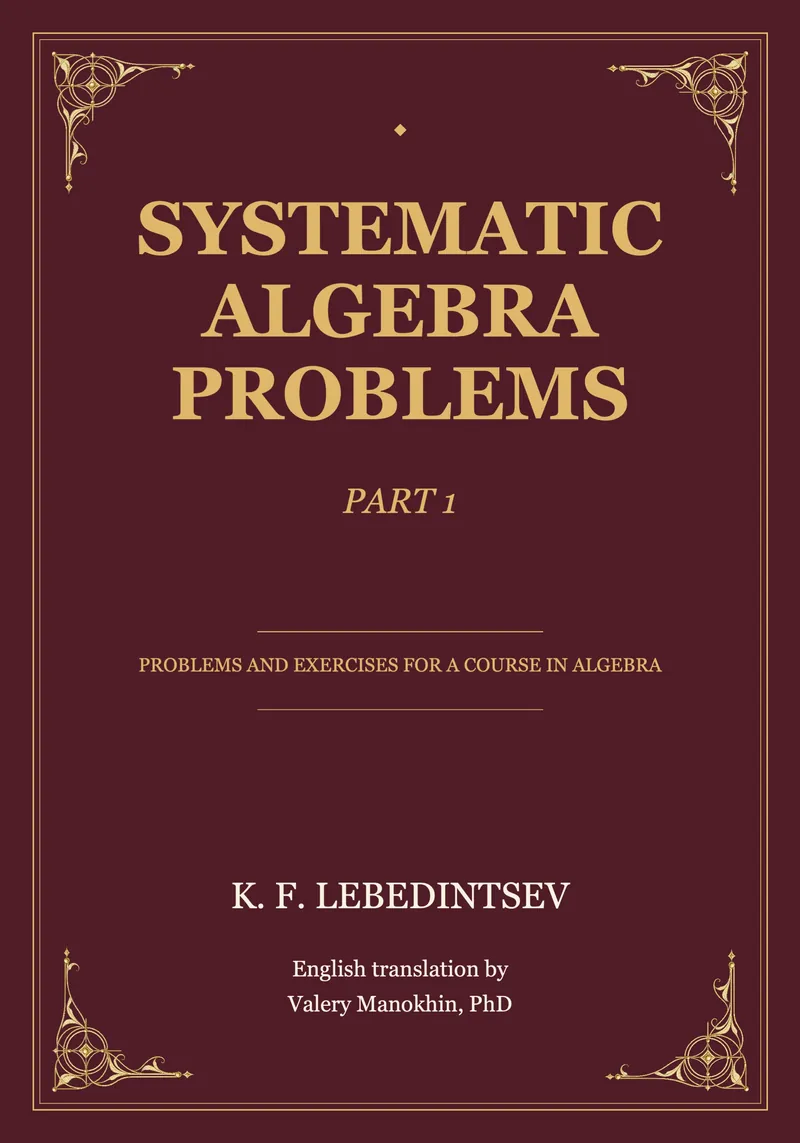
Problemas Sistemáticos de Álgebra de Lebedintsev, Parte I
por K. F. Lebedintsev
Traduzido por Valery Manokhin, PhD
Uma coleção graduada de 1.637 problemas para o primeiro curso de álgebra, na primeira tradução fiel para o inglês a partir da edição russa original. Cinco divisões e sessenta seções numeradas: das fórmulas gerais construídas a partir de problemas aritméticos, coeficientes, expoentes e raízes, aos números negativos, ao zero e às coordenadas sobre uma reta; às operações com expressões inteiras e fracionárias, à fatoração, ao máximo divisor comum e ao mínimo múltiplo comum, e aos expoentes zero e negativos; a equações e inequações do primeiro grau, proporções e sistemas de duas e três incógnitas, com longas séries de problemas de comércio, viagens, trabalho e física; e a pontos e retas no plano de coordenadas, funções de primeira ordem e seus gráficos. Não há respostas impressas: o autor sustentava que o aluno deve conferir o próprio trabalho.
5 capítulos · 60 artigos numerados · 1637 exercícios · 140 páginas
Onde se encaixa na escola — EUA, Reino Unido e Canadá ↓ Adultos e autodidatas são bem-vindos — a grande matemática não tem limite de idade.
Onde se encaixa na escola
Currículo completo: todos os livros por ano escolar →| Estados Unidos | 7–9 | Problem companion to Pre-Algebra → Algebra 1 (linear graphs included; no quadratics) |
|---|---|---|
| Reino Unido | Years 8–10 | KS3 → GCSE Foundation and Higher |
| Canadá | Ontario 7–9 | Grade 7–8 math → MTH1W · BC Math 8–9 · QC Secondary I–III |
Não coberto neste livro
estatística e tratamento de dados · probabilidade · unidades métricas — alguns problemas usam medidas russas antigas (verstas, sajens, archins, puds)
Estes blocos precisam vir de outro material. Faltam no livro, não nesta descrição.
Onde este livro se encaixa
Ver a sequência completa →Problemas para trabalhar em paralelo
- Álgebra Elementar$69.95
- Álgebra I de Kiselev$44.95
Sumário
60 seções — o sumário completo do livro impresso.
Translator's Note
Division I. Introduction7 seções
- § 1. Formation of general formulas from particular ones
- § 2. Formation of general formulas from the conditions of problems, with computation of the numerical values of the results obtained
- § 3. Expression of general truths of arithmetic in the form of formulas
- § 4. Formation of problems for given general formulas
- § 5. Coefficient and exponent
- § 6. The concept of a root
- § 7. Representation and reading of algebraic expressions and formulas in connection with the computation of numerical values
Division II. The first four operations on explicit quantities8 seções
- § 1. The concept of a negative number and of zero
- § 2. Addition of algebraic numbers
- § 3. Subtraction of algebraic numbers
- § 4. Multiplication of algebraic numbers
- § 5. Division of algebraic numbers
- § 6. Raising algebraic numbers to a power
- § 7. Operations with zero
- § 8. The concept of coordinates determining the position of a point on a line. Its application to the calculation of relative distances and intervals of time
Division III. The first four operations on explicit quantities (not containing roots)25 seções
- § 1. Preliminary concepts
- § 2. Addition of monomials
- § 3. Addition of polynomials with monomials and polynomials
- § 4. Subtraction of monomials
- § 5. Subtraction of polynomials
- § 6. Transformation of a polynomial into the sum or difference of two quantities
- § 7. Multiplication of monomials
- § 8. Multiplication of a polynomial by a monomial, and conversely
- § 9. Change of sign of an implicit algebraic quantity
- § 10. Multiplication of a polynomial by a polynomial
- § 11. Division of monomials
- § 12. Division of a polynomial by a monomial
- § 13. Division of a polynomial by a polynomial
- § 14. Special cases of multiplication and division
- § 14a. Exercises on all operations with integral quantities
- § 15. Factoring polynomials
- § 16. The concept of entirely integral, prime, composite, and relatively prime expressions
- § 17. Finding the greatest common divisor and the least common multiple
- § 18. Reduction of the simplest implicit fractions to normal form. Cancellation of fractions
- § 19. Reduction of fractions to a common denominator
- § 20. Addition and subtraction of fractions with each other and with integral quantities
- § 21. Multiplication of fractions with each other and with integral quantities
- § 22. Division of fractions by one another and by integral quantities
- § 23. Reduction of any fraction to normal form. Operations on fractional polynomials
- § 24. Operations on quantities with zero and negative exponents
Division IV. The study of equalities and inequalities of the first degree14 seções
- § 1. The concept of explicit and implicit, conditional and unconditional equalities
- § 2. Formation of the simplest equations from the conditions of problems and their solution (by reasoning)
- § 3. The theory of proportions
- § 4. Classification of equations
- § 5. Solution of equations of the first degree in one unknown
- § 6. Application of equations of the first degree with one unknown to the solution of problems
- § 7. Investigation of the meaning of the results obtained in solving equations of the first degree with one unknown
- § 8. Equations of the first degree with two unknowns
- § 9. Solving problems by setting up a system of equations of the first degree with two unknowns
- § 10. Investigation of the meaning of the results obtained in solving a system of two equations of the first degree with two unknowns
- § 11. Equations with three or more unknowns
- § 12. Application of first-degree equations with three unknowns to the solution of problems
- § 13. Application of the fundamental properties of affirmative inequalities
- § 14. Interrogative inequalities of the first degree with one unknown
Division V. Functions of the first order and their graphical representation6 seções
- § 1. Construction of points on a plane from their given coordinates
- § 2. Construction of straight lines from their given equations, and formation of equations determining given straight lines
- § 3. Graphical representation of the solution of equations of the first degree with one and two unknowns
- § 4. The concept of constant and variable quantities, of independent variables and functions
- § 5. Investigation of the changes of functions of the first order in one independent variable
- § 6. Application of rectilinear graphs to questions concerning uniform change
Formatos e edições
| Formato | Preço | ISBN-13 | Onde | Comprar |
|---|---|---|---|---|
| Brochura | $49.95 | 978-1-919012-96-4 | IngramSpark · direto | Comprar → |
| Brochura | $49.95 | 978-1-919012-96-4 | Amazon (via Ingram) | Comprar → |
| Capa dura | $69.95 | 978-1-80910-052-8 | IngramSpark · direto | Comprar → |
| Capa dura | $69.95 | 978-1-80910-052-8 | Amazon (via Ingram) | Comprar → |
Os preços são os de tabela da editora. A Amazon define o preço final em cada loja.
A IngramSpark imprime e envia os pedidos diretos para EUA, Reino Unido e Austrália. Bibliotecas, escolas e livrarias podem encomendar os mesmos ISBN pela Ingram: pedidos para bibliotecas →
Detalhes do produto
- Editora
- Northern Star Academic Press
- Idioma
- English
- Tradutor
- Valery Manokhin, PhD
- Extensão
- 140 páginas
- Primeira publicação
- 2026-10-12
Publicado por Northern Star Academic Press · Primeira tradução fiel da edição original russa
Mais Desta Série
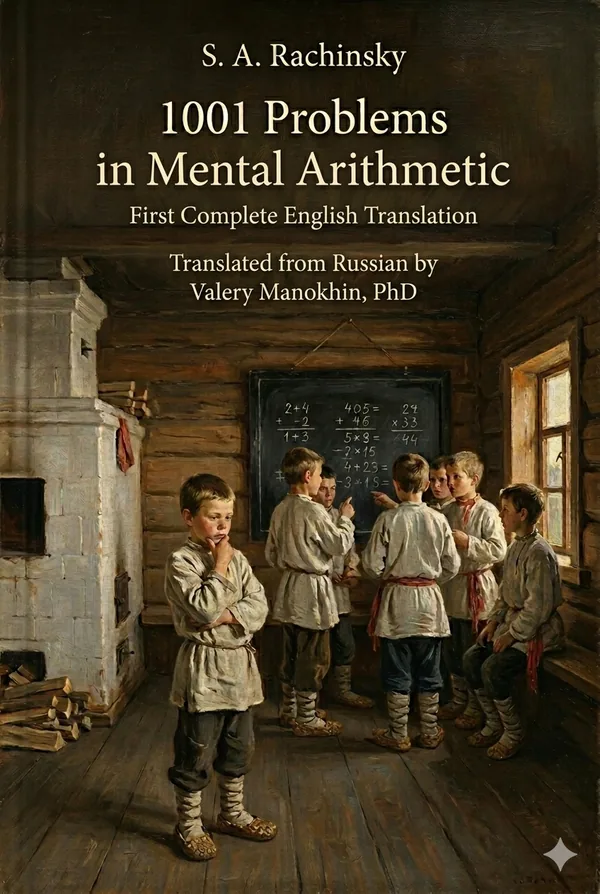
1001 Problemas de Rachinsky
por S. A. Rachinsky
Séries 4–8 (EUA) · Years 5–9 (RU)
1.001 problemas cuidadosamente selecionados do professor rural cujos alunos foram retratados na famosa pintura de 1895 "Aritmética Mental."
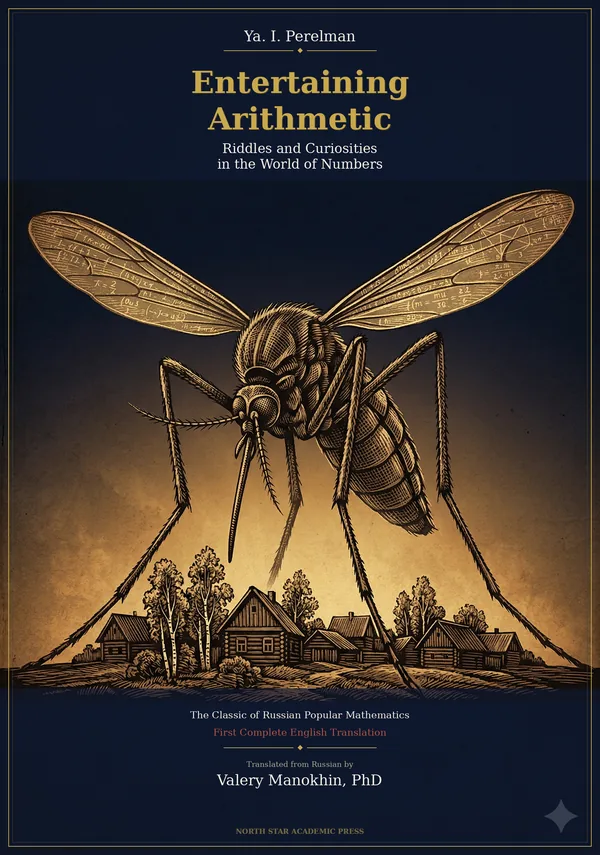
Aritmética Recreativa
por Ya. I. Perelman
Séries 4+ (EUA) · Year 5+ (RU)
O clássico da matemática popular russa. Quebra-cabeças, enigmas e curiosidades que tornam a aritmética verdadeiramente divertida.
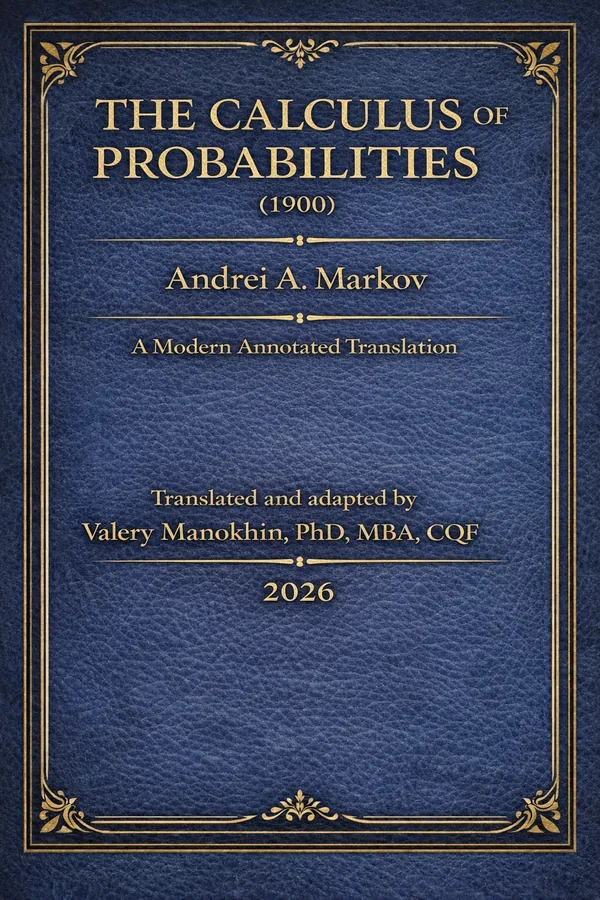
Markov: Probabilidades
por Andrei A. Markov
Séries 12 and university (EUA) · Year 13 and university (RU)
A obra fundacional de 1900 sobre a teoria da probabilidade pelo matemático que nos deu as cadeias de Markov.