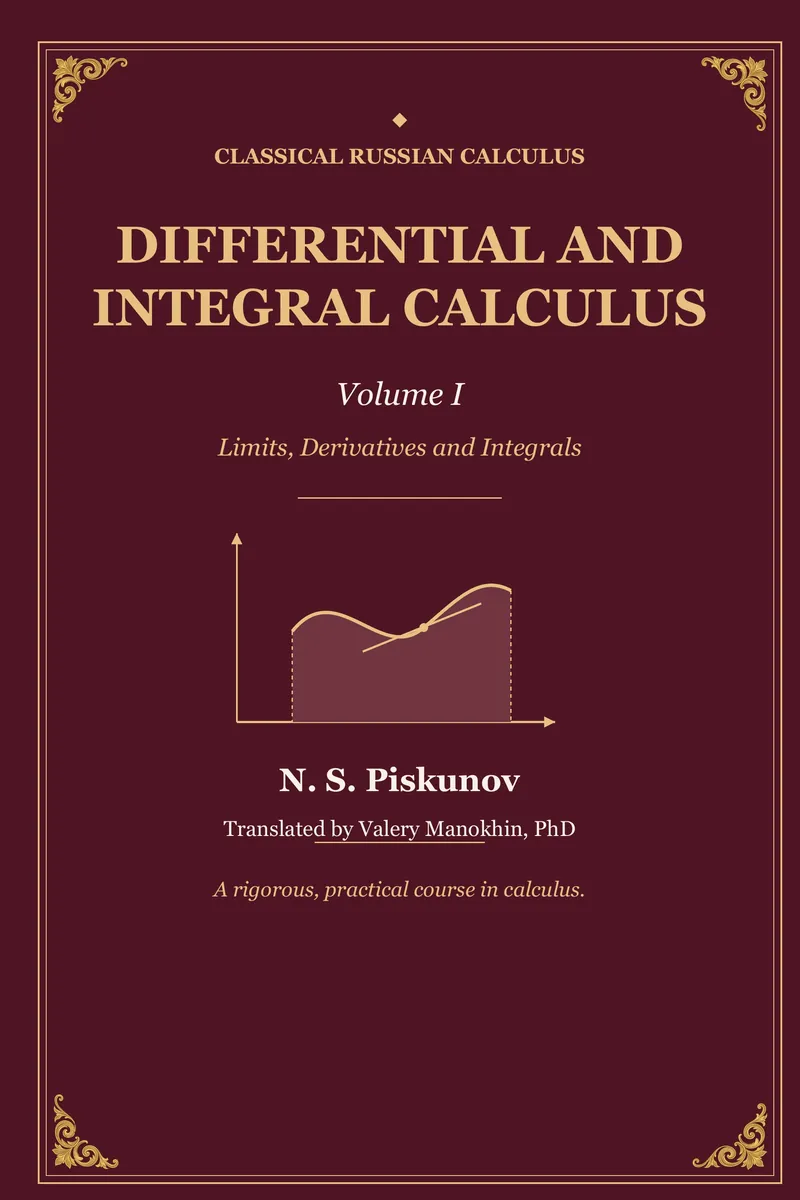
Cálculo Diferencial e Integral de Piskunov, Volumen I: Límites, Derivadas e Integrales
por N. S. Piskunov
Traducido por Valery Manokhin, PhD
Edición en inglés
¿Aún no te decides a comprar? Prueba un problema al día, gratis (en inglés) →
El curso clásico ruso de cálculo escrito para ingenieros, en una nueva edición inglesa fiel. Durante décadas Piskunov fue el libro de texto habitual en las universidades técnicas, y se sigue recomendando a quien busca un curso completo, riguroso y práctico. El Volumen I abarca el cálculo diferencial de una y varias variables y la integral indefinida y definida, con sus aplicaciones. Cada concepto llega a través de un problema concreto antes de definirse en general —la derivada mediante la velocidad de un punto móvil, la integral definida mediante el área bajo una curva—, cada teorema se demuestra y cada método se aplica de inmediato en ejemplos resueltos paso a paso. Los métodos aproximados se enseñan junto a la teoría en que se apoyan: raíces de ecuaciones, fórmulas de interpolación de Lagrange y Newton, derivación numérica, el método de mínimos cuadrados y las fórmulas del rectángulo, del trapecio, de Simpson y de Chebyshev. Doce capítulos y 147 secciones: número, variable y función; límites y continuidad; la derivada y la diferencial; teoremas sobre funciones derivables; el comportamiento de las funciones; la curvatura; números complejos y polinomios; funciones de varias variables; aplicaciones a la geometría del espacio; la integral indefinida; la integral definida; y aplicaciones geométricas y mecánicas, incluidos el trabajo, los centros de masa y los momentos de inercia. Completo y sin abreviar, con las 249 figuras, los ejercicios y sus respuestas y un índice temático completo en inglés. 512 páginas.
12 capítulos· 147 artículos numerados· 512 páginas
Dónde encaja en el curso escolar — EE. UU., Reino Unido y Canadá ↓Adultos y autodidactas bienvenidos — las grandes matemáticas no tienen límite de edad.
Dónde encaja en el curso escolar
¿No sabe si este es el primer libro adecuado? Empiece aquí →Plan de estudios completo: todos los libros por curso →| Estados Unidos | University 1–2 | Calculus I–III for engineering and science |
|---|---|---|
| Inglaterra | Undergraduate 1–2 | first- and second-year engineering mathematics and calculus |
| Canadá (Ontario) | University 1–2 | QC CEGEP 201-NYA / NYB · first- and second-year university calculus |
Dónde encaja este libro
Ver la secuencia completa →Estudiar antes
- Cálculo de Kiselev$54.95
Cubre gran parte del mismo temario
Granville–Luzin es más extenso —537 páginas, 21 capítulos, 203 secciones numeradas— y lo dedica todo al cálculo diferencial: los límites y los infinitésimos se construyen con mucha más lentitud, y añade capítulos de series y desarrollos de Taylor y Maclaurin, de asíntotas y puntos singulares de curvas, y un capítulo de fórmulas y tablas de referencia. No trae integración alguna; el cálculo integral es su Parte II. No tiene índice temático.
Fikhtengolts cubre el mismo recorrido —de los números reales a la integral definida— en 390 páginas frente a 512, como curso teórico: demuestra paso a paso y cierra con una reseña histórica hasta Newton y Leibniz. Este volumen está escrito para ingenieros: abre cada idea con un problema concreto y dedica secciones enteras a los métodos aproximados: raíces de ecuaciones, interpolación de Lagrange y Newton, derivación numérica y mínimos cuadrados. Ambos traen índice.
Se solapan en gran medida. Cada nota indica qué trae ese libro que este no — esas diferencias son las que deciden.
Problemas para trabajar en paralelo
- Gunter y Kuzmin$99.95
- Gunter y Kuzmin, Parte I$64.95
Qué viene después
Lectura complementaria
Un texto histórico para leer junto al curso, no para sustituirlo.
Índice
147 secciones — el índice completo del libro impreso.
Translator's Preface
I. Number. Variable. Function10 secciónes
- § 1 Real numbers. Representation of real numbers by points on the number axis
- § 2 The absolute value of a real number
- § 3 Variable and constant quantities
- § 4 The range of a variable
- § 5 Ordered variable. Increasing and decreasing variables. Bounded variable
- § 6 Function
- § 7 Ways of specifying a function
- § 8 Basic elementary functions. Elementary functions
- § 9 Algebraic functions
- § 10 Polar coordinate system
II. Limit. Continuity of Functions11 secciónes
- § 1 Limit of a variable. An infinitely large variable
- § 2 Limit of a function
- § 3 A function tending to infinity. Bounded functions
- § 4 Infinitesimals and their basic properties
- § 5 Basic theorems on limits
- § 6 The limit of the function sin x / x as x → 0
- § 7 The number e
- § 8 Natural logarithms
- § 9 Continuity of functions
- § 10 Some properties of continuous functions
- § 11 Comparison of infinitesimals
III. The Derivative and the Differential27 secciónes
- § 1 Velocity of motion
- § 2 Definition of the derivative
- § 3 Geometric meaning of the derivative
- § 4 Differentiability of functions
- § 5 The derivative of the function y = xn for n a positive integer
- § 6 Derivatives of the functions y = sin x, y = cos x
- § 7 Derivatives of a constant, of the product of a constant and a function, of a sum, of a product, and of a quotient
- § 8 The derivative of the logarithmic function
- § 9 The derivative of a composite function
- § 10 Derivatives of the functions y = tg x, y = ctg x, y = ln |x|
- § 11 Implicit functions and their differentiation
- § 12 Derivatives of the power function for any real exponent, of the exponential function, and of the composite exponential function
- § 13 The inverse function and its differentiation
- § 14 Inverse trigonometric functions and their differentiation
- § 15 Table of basic differentiation formulas
- § 16 Parametric specification of a function
- § 17 Equations of certain curves in parametric form
- § 18 Derivative of a function defined parametrically
- § 19 Hyperbolic functions
- § 20 The differential
- § 21 Geometric meaning of the differential
- § 22 Derivatives of various orders
- § 23 Differentials of various orders
- § 24 Derivatives of various orders of implicit functions and functions given parametrically
- § 25 The mechanical meaning of the second derivative
- § 26 Equations of the tangent and the normal. Lengths of the subtangent and subnormal
- § 27 Geometric meaning of the derivative of the radius vector with respect to the polar angle
IV. Some Theorems on Differentiable Functions7 secciónes
- § 1 The theorem on the roots of the derivative (Rolle's theorem)
- § 2 The finite-increment theorem (Lagrange's theorem)
- § 3 Theorem on the ratio of the increments of two functions (Cauchy's theorem)
- § 4 The limit of the ratio of two infinitesimals (“the resolution of indeterminacies of the form 00 ”)
- § 5 The limit of the ratio of two infinitely large quantities (“the resolution of indeterminacies of the form ∞ ∞ ”)
- § 6 Taylor's formula
- § 7 Expansion by Taylor's formula of the functions e^x, sin x, cos x
V. Investigation of the Behavior of Functions12 secciónes
- § 1 Statement of the problem
- § 2 Increasing and decreasing functions
- § 3 Maxima and minima of functions
- § 4 Scheme for investigating a differentiable function for maximum and minimum by means of the first derivative
- § 5 Investigation of a function for maximum and minimum using the second derivative
- § 6 The greatest and least values of a function on an interval
- § 7 Application of the theory of maximum and minimum of functions to the solution of problems
- § 8 Investigation of a function for maximum and minimum by means of Taylor's formula
- § 9 Convexity and concavity of a curve. Points of inflection
- § 10 Asymptotes
- § 11 General plan for investigating functions and constructing graphs
- § 12 Investigation of curves given parametrically
VI. Curvature of a Curve8 secciónes
- § 1 Arc length and its derivative
- § 2 Curvature
- § 3 Computation of curvature
- § 4 Calculation of the curvature of a curve given parametrically
- § 5 Calculation of the curvature of a curve given by an equation in polar coordinates
- § 6 Radius and circle of curvature. Center of curvature. Evolute and involute
- § 7 Properties of the evolute
- § 8 Approximate computation of real roots of an equation
VII. Complex Numbers. Polynomials12 secciónes
- § 1 Complex numbers. Initial definitions
- § 2 Basic operations on complex numbers
- § 3 Raising a complex number to a power and extracting a root of a complex number
- § 4 The exponential function with a complex exponent and its properties
- § 5 Euler's formula. The exponential form of a complex number
- § 6 Factoring a polynomial
- § 7 On multiple roots of a polynomial
- § 8 Factorization of a polynomial in the case of complex roots
- § 9 Interpolation. Lagrange's interpolation formula
- § 10 Newton's interpolation formula
- § 11 Numerical differentiation
- § 12 On the best approximation of functions by polynomials. Chebyshev's theory
VIII. Functions of Several Variables20 secciónes
- § 1 Definition of a function of several variables
- § 2 Geometric representation of a function of two variables
- § 3 Partial and total increment of a function
- § 4 Continuity of a function of several variables
- § 5 Partial derivatives of a function of several variables
- § 6 Geometric interpretation of partial derivatives of a function of two variables
- § 7 Total increment and total differential
- § 8 Application of the total differential in approximate calculations
- § 9 Application of the differential to the estimation of error in computations
- § 10 The derivative of a composite function. The total derivative. The total differential of a composite function
- § 11 The derivative of an implicitly defined function
- § 12 Partial derivatives of various orders
- § 13 Level surfaces
- § 14 Directional derivative
- § 15 Gradient
- § 16 Taylor's formula for a function of two variables
- § 17 Maximum and minimum of a function of several variables
- § 18 Maximum and minimum of a function of several variables connected by given equations (conditional maxima and minima)
- § 19 Obtaining a function from experimental data by the method of least squares
- § 20 Singular points of a curve
IX. Applications of the Differential Calculus to Geometry6 secciónes
- § 1 Equations of a curve in space
- § 2 Limit and derivative of a vector function of a scalar argument. Equation of the tangent to a curve. Equation of the normal plane
- § 3 Rules for differentiating vectors (vector functions)
- § 4 The first and second derivatives of a vector with respect to arc length. Curvature of a curve. Principal normal. Velocity and acceleration of a point in curvilinear motion
- § 5 Osculating plane. Binormal. Torsion
- § 6 Tangent plane and normal to a surface
X. The Indefinite Integral14 secciónes
- § 1 The antiderivative and the indefinite integral
- § 2 Table of integrals
- § 3 Some properties of the indefinite integral
- § 4 Integration by change of variable or by substitution
- § 5 Integrals of certain functions containing a quadratic trinomial
- § 6 Integration by parts
- § 7 Rational fractions. Partial fractions and their integration
- § 8 Decomposition of a rational fraction into partial fractions
- § 9 Integration of rational fractions
- § 10 Integrals of irrational functions
- § 11 Integrals of the form ∫ R(x, √(ax² + bx + c)) dx
- § 12 Integration of certain classes of trigonometric functions
- § 13 Integration of certain irrational functions by means of trigonometric substitutions
- § 14 On functions whose integrals are not expressible in terms of elementary functions
XI. The Definite Integral11 secciónes
- § 1 Statement of the problem. Lower and upper integral sums
- § 2 The definite integral. Theorem on the existence of the definite integral
- § 3 Basic properties of the definite integral
- § 4 Calculation of the definite integral. The Newton–Leibniz formula
- § 5 Change of variable in a definite integral
- § 6 Integration by parts
- § 7 Improper integrals
- § 8 Approximate computation of definite integrals
- § 9 Chebyshev's formula
- § 10 Integrals depending on a parameter. The gamma function
- § 11 Integration of a complex function of a real variable
XII. Geometric and Mechanical Applications of the Definite Integral9 secciónes
- § 1 Computation of areas in rectangular coordinates
- § 2 Area of a curvilinear sector in polar coordinates
- § 3 Arc length of a curve
- § 4 Calculation of the volume of a body from the areas of parallel cross sections
- § 5 Volume of a solid of revolution
- § 6 Surface area of a solid of revolution
- § 7 Computation of work by means of the definite integral
- § 8 Coordinates of the center of mass
- § 9 Computing the moment of inertia of a line, a circle, and a cylinder by means of the definite integral
Subject Index
Formatos y ediciones
Edición en inglés
- Comprar →
Tapa blanda · $69.95
Amazon
ISBN 978-1-80910-086-3
- Comprar →
Tapa dura · $99.95
Amazon
ISBN 978-1-80910-087-0
| Formato | Precio de lista (USD) | ISBN-13 | Dónde | Comprar |
|---|---|---|---|---|
| Tapa blanda | $69.95 | 978-1-80910-086-3 | Amazon | Comprar → |
| Tapa dura | $99.95 | 978-1-80910-087-0 | Amazon | Comprar → |
Precio de lista: el precio de lista del editor en EE. UU., en USD, solo como referencia. Amazon fija su propio precio en cada tienda — consulte el precio actual en Amazon. El precio de Gumroad es el que se cobra.
Detalles del producto
- Editorial
- Northern Star Academic Press
- Idioma
- English
- Traductor
- Valery Manokhin, PhD
- Extensión
- 512 páginas
- Primera publicación
- 2026-11-10
¿Preguntas? Consulta las preguntas frecuentes →
Publicado por Northern Star Academic Press · Primera traducción fiel del original ruso
Más de Esta Serie

1001 Problemas de Rachinsky
por S. A. Rachinsky
Grados 4–8 (EE. UU.) · Years 5–9 (RU)
1.001 problemas cuidadosamente seleccionados del maestro rural cuyos estudiantes fueron retratados en la famosa pintura de 1895 "Aritmética Mental."

Aritmética Recreativa
por Ya. I. Perelman
Grados 4+ (EE. UU.) · Year 5+ (RU)
El clásico de las matemáticas populares rusas. Rompecabezas, acertijos y curiosidades que hacen la aritmética verdaderamente entretenida.

Markov: Probabilidades
por Andrei A. Markov
Grados 12 and university (EE. UU.) · Year 13 and university (RU)
La obra fundacional de 1900 sobre la teoría de la probabilidad por el matemático que nos dio las cadenas de Markov.