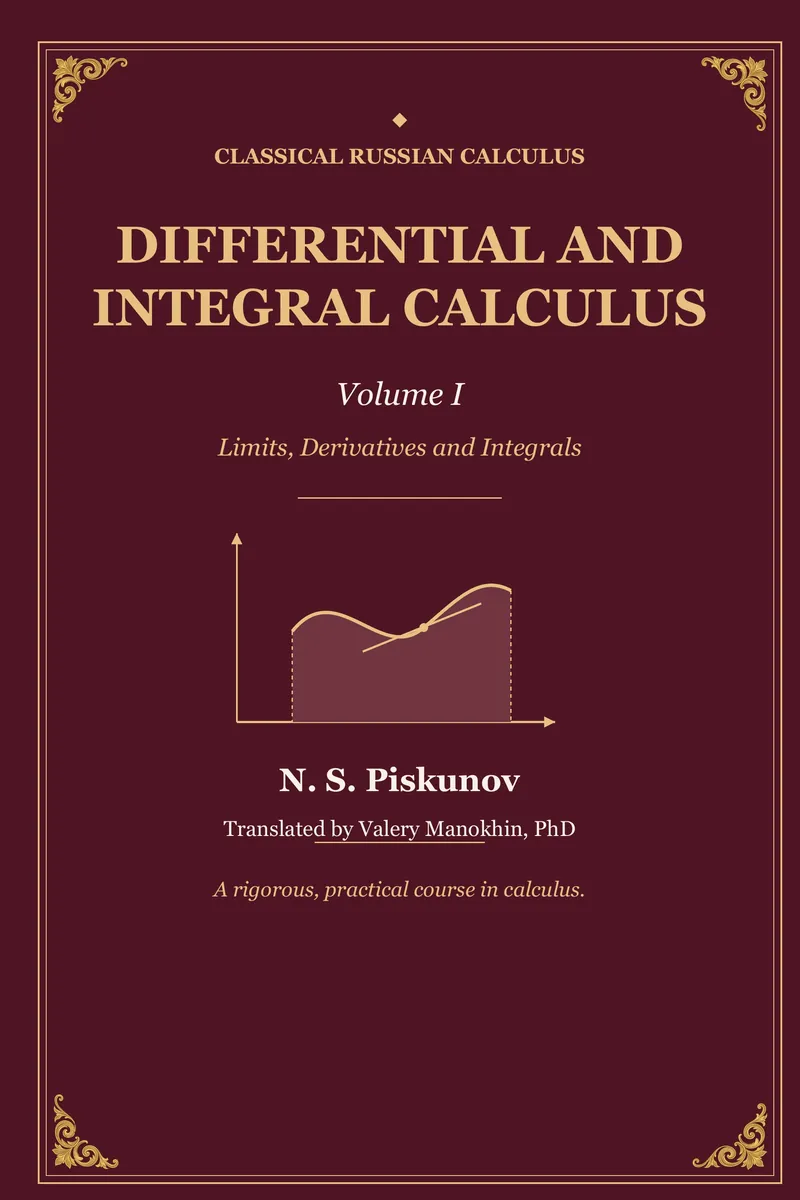
Cálculo Diferencial e Integral de Piskunov, Volume I: Limites, Derivadas e Integrais
por N. S. Piskunov
Traduzido por Valery Manokhin, PhD
Edição em inglês
Ainda não vai comprar? Experimente um problema por dia, grátis (em inglês) →
O curso clássico russo de cálculo escrito para engenheiros, em uma nova edição inglesa fiel. Durante décadas Piskunov foi o livro-texto padrão nas universidades técnicas e continua recomendado a quem procura um curso completo, rigoroso e prático. O Volume I cobre o cálculo diferencial de uma e de várias variáveis e a integral indefinida e definida, com suas aplicações. Cada conceito chega por um problema concreto antes de ser definido em geral — a derivada pela velocidade de um ponto em movimento, a integral definida pela área sob uma curva —, cada teorema é demonstrado e cada método é aplicado de imediato em exemplos resolvidos passo a passo. Os métodos aproximados são ensinados ao lado da teoria que os sustenta: raízes de equações, fórmulas de interpolação de Lagrange e Newton, derivação numérica, o método dos mínimos quadrados e as fórmulas do retângulo, do trapézio, de Simpson e de Chebyshev. Doze capítulos e 147 seções: número, variável e função; limites e continuidade; a derivada e a diferencial; teoremas sobre funções deriváveis; o comportamento das funções; a curvatura; números complexos e polinômios; funções de várias variáveis; aplicações à geometria no espaço; a integral indefinida; a integral definida; e aplicações geométricas e mecânicas, incluindo trabalho, centros de massa e momentos de inércia. Completo e integral, com as 249 figuras, os exercícios e suas respostas e um índice remissivo completo em inglês. 512 páginas.
12 capítulos· 147 artigos numerados· 512 páginas
Onde se encaixa na escola — EUA, Reino Unido e Canadá ↓Adultos e autodidatas são bem-vindos — a grande matemática não tem limite de idade.
Onde se encaixa na escola
Não sabe se este é o primeiro livro certo? Comece aqui →Currículo completo: todos os livros por ano escolar →| Estados Unidos | University 1–2 | Calculus I–III for engineering and science |
|---|---|---|
| Inglaterra | Undergraduate 1–2 | first- and second-year engineering mathematics and calculus |
| Canadá (Ontário) | University 1–2 | QC CEGEP 201-NYA / NYB · first- and second-year university calculus |
Onde este livro se encaixa
Ver a sequência completa →Estudar antes
- Cálculo de Kiselev$54.95
Cobre grande parte do mesmo conteúdo
Granville–Luzin é mais extenso — 537 páginas, 21 capítulos, 203 seções numeradas — e dedica tudo ao cálculo diferencial: os limites e os infinitésimos são construídos com muito mais vagar, e acrescenta capítulos de séries e desenvolvimentos de Taylor e Maclaurin, de assíntotas e pontos singulares de curvas, e um capítulo de fórmulas e tabelas de referência. Não traz integração alguma; o cálculo integral é sua Parte II. Não tem índice remissivo.
Fikhtengolts cobre o mesmo percurso — dos números reais à integral definida — em 390 páginas contra 512, como curso teórico: demonstra passo a passo e encerra com um panorama histórico até Newton e Leibniz. Este volume é escrito para engenheiros: abre cada ideia com um problema concreto e dedica seções inteiras aos métodos aproximados: raízes de equações, interpolação de Lagrange e Newton, derivação numérica e mínimos quadrados. Ambos trazem índice.
Há forte sobreposição. Cada nota diz o que aquele livro traz e este não — são essas diferenças que decidem.
Problemas para trabalhar em paralelo
- Gunter e Kuzmin$99.95
- Gunter e Kuzmin, Parte I$64.95
O que vem depois
Leitura complementar
Um texto histórico para ler ao lado do curso, não para substituí-lo.
Sumário
147 seções — o sumário completo do livro impresso.
Translator's Preface
I. Number. Variable. Function10 seções
- § 1 Real numbers. Representation of real numbers by points on the number axis
- § 2 The absolute value of a real number
- § 3 Variable and constant quantities
- § 4 The range of a variable
- § 5 Ordered variable. Increasing and decreasing variables. Bounded variable
- § 6 Function
- § 7 Ways of specifying a function
- § 8 Basic elementary functions. Elementary functions
- § 9 Algebraic functions
- § 10 Polar coordinate system
II. Limit. Continuity of Functions11 seções
- § 1 Limit of a variable. An infinitely large variable
- § 2 Limit of a function
- § 3 A function tending to infinity. Bounded functions
- § 4 Infinitesimals and their basic properties
- § 5 Basic theorems on limits
- § 6 The limit of the function sin x / x as x → 0
- § 7 The number e
- § 8 Natural logarithms
- § 9 Continuity of functions
- § 10 Some properties of continuous functions
- § 11 Comparison of infinitesimals
III. The Derivative and the Differential27 seções
- § 1 Velocity of motion
- § 2 Definition of the derivative
- § 3 Geometric meaning of the derivative
- § 4 Differentiability of functions
- § 5 The derivative of the function y = xn for n a positive integer
- § 6 Derivatives of the functions y = sin x, y = cos x
- § 7 Derivatives of a constant, of the product of a constant and a function, of a sum, of a product, and of a quotient
- § 8 The derivative of the logarithmic function
- § 9 The derivative of a composite function
- § 10 Derivatives of the functions y = tg x, y = ctg x, y = ln |x|
- § 11 Implicit functions and their differentiation
- § 12 Derivatives of the power function for any real exponent, of the exponential function, and of the composite exponential function
- § 13 The inverse function and its differentiation
- § 14 Inverse trigonometric functions and their differentiation
- § 15 Table of basic differentiation formulas
- § 16 Parametric specification of a function
- § 17 Equations of certain curves in parametric form
- § 18 Derivative of a function defined parametrically
- § 19 Hyperbolic functions
- § 20 The differential
- § 21 Geometric meaning of the differential
- § 22 Derivatives of various orders
- § 23 Differentials of various orders
- § 24 Derivatives of various orders of implicit functions and functions given parametrically
- § 25 The mechanical meaning of the second derivative
- § 26 Equations of the tangent and the normal. Lengths of the subtangent and subnormal
- § 27 Geometric meaning of the derivative of the radius vector with respect to the polar angle
IV. Some Theorems on Differentiable Functions7 seções
- § 1 The theorem on the roots of the derivative (Rolle's theorem)
- § 2 The finite-increment theorem (Lagrange's theorem)
- § 3 Theorem on the ratio of the increments of two functions (Cauchy's theorem)
- § 4 The limit of the ratio of two infinitesimals (“the resolution of indeterminacies of the form 00 ”)
- § 5 The limit of the ratio of two infinitely large quantities (“the resolution of indeterminacies of the form ∞ ∞ ”)
- § 6 Taylor's formula
- § 7 Expansion by Taylor's formula of the functions e^x, sin x, cos x
V. Investigation of the Behavior of Functions12 seções
- § 1 Statement of the problem
- § 2 Increasing and decreasing functions
- § 3 Maxima and minima of functions
- § 4 Scheme for investigating a differentiable function for maximum and minimum by means of the first derivative
- § 5 Investigation of a function for maximum and minimum using the second derivative
- § 6 The greatest and least values of a function on an interval
- § 7 Application of the theory of maximum and minimum of functions to the solution of problems
- § 8 Investigation of a function for maximum and minimum by means of Taylor's formula
- § 9 Convexity and concavity of a curve. Points of inflection
- § 10 Asymptotes
- § 11 General plan for investigating functions and constructing graphs
- § 12 Investigation of curves given parametrically
VI. Curvature of a Curve8 seções
- § 1 Arc length and its derivative
- § 2 Curvature
- § 3 Computation of curvature
- § 4 Calculation of the curvature of a curve given parametrically
- § 5 Calculation of the curvature of a curve given by an equation in polar coordinates
- § 6 Radius and circle of curvature. Center of curvature. Evolute and involute
- § 7 Properties of the evolute
- § 8 Approximate computation of real roots of an equation
VII. Complex Numbers. Polynomials12 seções
- § 1 Complex numbers. Initial definitions
- § 2 Basic operations on complex numbers
- § 3 Raising a complex number to a power and extracting a root of a complex number
- § 4 The exponential function with a complex exponent and its properties
- § 5 Euler's formula. The exponential form of a complex number
- § 6 Factoring a polynomial
- § 7 On multiple roots of a polynomial
- § 8 Factorization of a polynomial in the case of complex roots
- § 9 Interpolation. Lagrange's interpolation formula
- § 10 Newton's interpolation formula
- § 11 Numerical differentiation
- § 12 On the best approximation of functions by polynomials. Chebyshev's theory
VIII. Functions of Several Variables20 seções
- § 1 Definition of a function of several variables
- § 2 Geometric representation of a function of two variables
- § 3 Partial and total increment of a function
- § 4 Continuity of a function of several variables
- § 5 Partial derivatives of a function of several variables
- § 6 Geometric interpretation of partial derivatives of a function of two variables
- § 7 Total increment and total differential
- § 8 Application of the total differential in approximate calculations
- § 9 Application of the differential to the estimation of error in computations
- § 10 The derivative of a composite function. The total derivative. The total differential of a composite function
- § 11 The derivative of an implicitly defined function
- § 12 Partial derivatives of various orders
- § 13 Level surfaces
- § 14 Directional derivative
- § 15 Gradient
- § 16 Taylor's formula for a function of two variables
- § 17 Maximum and minimum of a function of several variables
- § 18 Maximum and minimum of a function of several variables connected by given equations (conditional maxima and minima)
- § 19 Obtaining a function from experimental data by the method of least squares
- § 20 Singular points of a curve
IX. Applications of the Differential Calculus to Geometry6 seções
- § 1 Equations of a curve in space
- § 2 Limit and derivative of a vector function of a scalar argument. Equation of the tangent to a curve. Equation of the normal plane
- § 3 Rules for differentiating vectors (vector functions)
- § 4 The first and second derivatives of a vector with respect to arc length. Curvature of a curve. Principal normal. Velocity and acceleration of a point in curvilinear motion
- § 5 Osculating plane. Binormal. Torsion
- § 6 Tangent plane and normal to a surface
X. The Indefinite Integral14 seções
- § 1 The antiderivative and the indefinite integral
- § 2 Table of integrals
- § 3 Some properties of the indefinite integral
- § 4 Integration by change of variable or by substitution
- § 5 Integrals of certain functions containing a quadratic trinomial
- § 6 Integration by parts
- § 7 Rational fractions. Partial fractions and their integration
- § 8 Decomposition of a rational fraction into partial fractions
- § 9 Integration of rational fractions
- § 10 Integrals of irrational functions
- § 11 Integrals of the form ∫ R(x, √(ax² + bx + c)) dx
- § 12 Integration of certain classes of trigonometric functions
- § 13 Integration of certain irrational functions by means of trigonometric substitutions
- § 14 On functions whose integrals are not expressible in terms of elementary functions
XI. The Definite Integral11 seções
- § 1 Statement of the problem. Lower and upper integral sums
- § 2 The definite integral. Theorem on the existence of the definite integral
- § 3 Basic properties of the definite integral
- § 4 Calculation of the definite integral. The Newton–Leibniz formula
- § 5 Change of variable in a definite integral
- § 6 Integration by parts
- § 7 Improper integrals
- § 8 Approximate computation of definite integrals
- § 9 Chebyshev's formula
- § 10 Integrals depending on a parameter. The gamma function
- § 11 Integration of a complex function of a real variable
XII. Geometric and Mechanical Applications of the Definite Integral9 seções
- § 1 Computation of areas in rectangular coordinates
- § 2 Area of a curvilinear sector in polar coordinates
- § 3 Arc length of a curve
- § 4 Calculation of the volume of a body from the areas of parallel cross sections
- § 5 Volume of a solid of revolution
- § 6 Surface area of a solid of revolution
- § 7 Computation of work by means of the definite integral
- § 8 Coordinates of the center of mass
- § 9 Computing the moment of inertia of a line, a circle, and a cylinder by means of the definite integral
Subject Index
Formatos e edições
Edição em inglês
- Comprar →
Brochura · $69.95
Amazon
ISBN 978-1-80910-086-3
- Comprar →
Capa dura · $99.95
Amazon
ISBN 978-1-80910-087-0
| Formato | Preço de tabela (USD) | ISBN-13 | Onde | Comprar |
|---|---|---|---|---|
| Brochura | $69.95 | 978-1-80910-086-3 | Amazon | Comprar → |
| Capa dura | $99.95 | 978-1-80910-087-0 | Amazon | Comprar → |
Preço de tabela: o preço de tabela da editora nos EUA, em USD, apenas como referência. A Amazon define o próprio preço em cada loja — veja o preço atual na Amazon. O preço do Gumroad é o preço cobrado.
Detalhes do produto
- Editora
- Northern Star Academic Press
- Idioma
- English
- Tradutor
- Valery Manokhin, PhD
- Extensão
- 512 páginas
- Primeira publicação
- 2026-11-10
Dúvidas? Veja as perguntas frequentes →
Publicado por Northern Star Academic Press · Primeira tradução fiel da edição original russa
Mais Desta Série

1001 Problemas de Rachinsky
por S. A. Rachinsky
Séries 4–8 (EUA) · Years 5–9 (RU)
1.001 problemas cuidadosamente selecionados do professor rural cujos alunos foram retratados na famosa pintura de 1895 "Aritmética Mental."

Aritmética Recreativa
por Ya. I. Perelman
Séries 4+ (EUA) · Year 5+ (RU)
O clássico da matemática popular russa. Quebra-cabeças, enigmas e curiosidades que tornam a aritmética verdadeiramente divertida.

Markov: Probabilidades
por Andrei A. Markov
Séries 12 and university (EUA) · Year 13 and university (RU)
A obra fundacional de 1900 sobre a teoria da probabilidade pelo matemático que nos deu as cadeias de Markov.