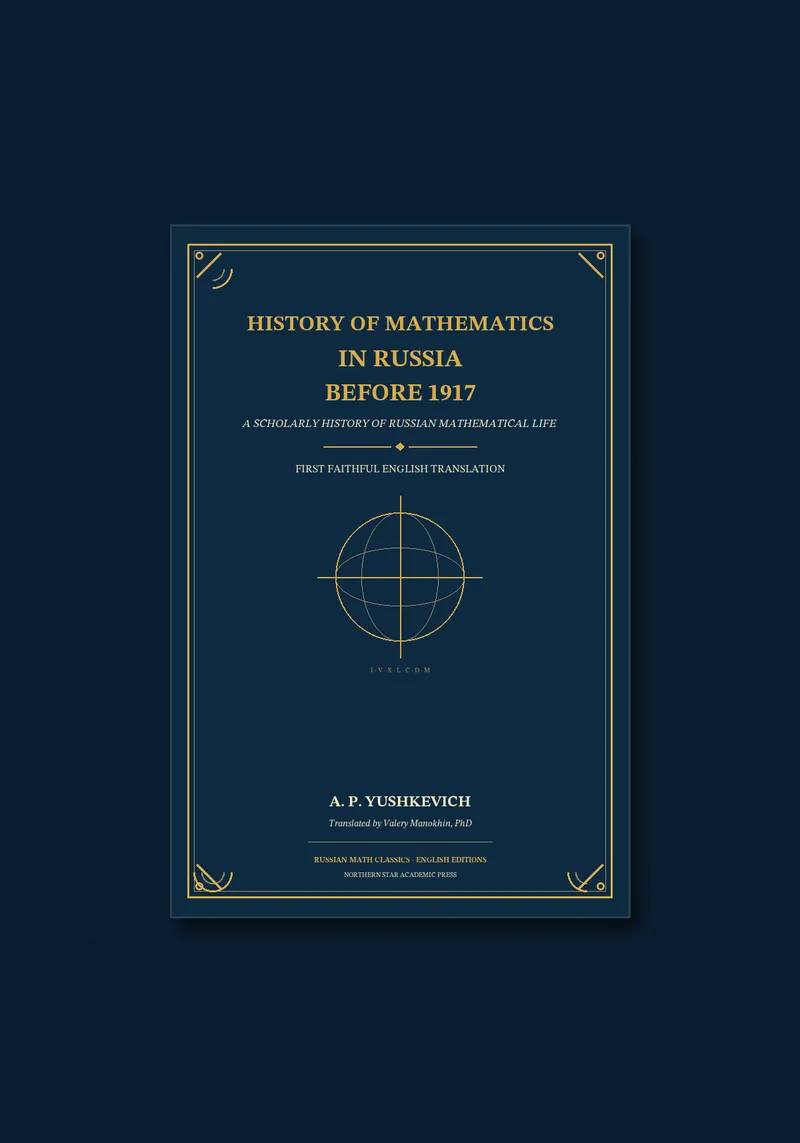
Historia de las Matemáticas en Rusia antes de 1917
por A. P. Yushkevich
Traducido por Valery Manokhin, PhD
La historia de las matemáticas en Rusia desde sus comienzos hasta 1917 de A. P. Yushkevich, en primera traducción fiel al inglés desde la edición rusa original. Cuatro partes y 26 capítulos: la numeración, la metrología y los manuscritos aritméticos y geométricos de la antigua Rus; la Aritmética de Magnitski y las escuelas de Pedro el Grande; la Academia de Ciencias de San Petersburgo, con cinco capítulos sobre Euler —series infinitas, su trilogía de análisis, ecuaciones diferenciales y cálculo de variaciones— y uno sobre sus discípulos y sucesores, entre ellos Fuss; Lobachevski y el descubrimiento de la geometría no euclidiana; Ostrogradski y Buniakovski; Chebyshov y la escuela de San Petersburgo, con capítulos sobre teoría de números, probabilidad, aproximación de funciones, ecuaciones diferenciales, series, funciones analíticas, geometría y álgebra; y el nacimiento de la escuela moscovita de teoría de funciones con Egorov y Luzin. Los manuales escolares de Kiselev, Davidov y Malinin y Burenin aparecen en su lugar. Cincuenta figuras numeradas con retratos y facsímiles, e índice onomástico. 673 páginas.
26 capítulos · 673 páginas
Dónde encaja en el curso escolar — EE. UU., Reino Unido y Canadá ↓ Adultos y autodidactas bienvenidos — las grandes matemáticas no tienen límite de edad.
Dónde encaja en el curso escolar
Plan de estudios completo: todos los libros por curso →| Estados Unidos | University and adult | History of mathematics — a reading text, not a course |
|---|---|---|
| Reino Unido | Undergraduate and adult | History of mathematics; no qualification maps to it |
| Canadá | University and adult | history-of-mathematics reading |
Este libro no corresponde a ningún curso actual. Merece la pena por las matemáticas; no dará puntos en un examen oficial.
No incluido en este libro
ejercicios: este volumen es solo exposición
Estos bloques habrá que cubrirlos con otro material. Faltan en el libro, no en esta descripción.
Dónde encaja este libro
Ver la secuencia completa →Lectura complementaria
- Gunter y Kuzmin$99.95
- Álgebra Elemental$69.95
- Geometría Elemental$69.95
- Álgebra de Davidov$59.95
- Geometría de Davidov$59.95
- Markov: Probabilidades$59.95
- Álgebra de Fuss$54.95
- Geometría de Fuss$44.95
- Malinin y Burenin$44.95
Un texto histórico para leer junto al curso, no para sustituirlo.
Índice
250 secciones — el índice completo del libro impreso.
Translator's Preface
Author's Preface
Part One. Mathematical Culture in Russia before the Beginning of the Eighteenth Century
Chapter 1. Mathematical Knowledge in Ancient Rus'7 secciónes
- Old Russian numeration
- Metrology
- The first systems of fractions
- Mathematical monuments of Kievan Rus'
- Kirik of Novgorod
- Questions of the “philosophy of mathematics”
- The Tatar yoke
Chapter 2. Manuscripts of the Fifteenth–Seventeenth Centuries14 secciónes
- The rise of the Muscovite state
- Arithmetic in seventeenth-century manuscripts
- Instrumental reckoning
- The rule of three
- The rule of false position
- Problems for amusement
- Geometric progressions
- The problem “of knowing the money in a heap”
- Terminology
- An assessment of the arithmetic manuscripts
- The measurement of figures
- The geometric manuscript “Synodal No. 42”
- Problems of the continuous and of indivisibles
- Summary
Chapter 3. The State and Mathematics in the Era of Peter the First8 secciónes
- Training of military and technical personnel
- New schools
- Ya. V. Bruce
- L. F. Magnitsky
- A. D. Farquharson
- Magnitsky's Arithmetic
- Algebra and trigonometry in Magnitsky
- The first textbooks of geometry and trigonometry
Part Two. Mathematics in the Petersburg Academy of Sciences in the Eighteenth Century
Chapter 4. The Petersburg Academy of Sciences4 secciónes
- The founding of the Academy of Sciences
- Mathematics in the Academy of Sciences
- The Academy of Sciences and mathematical education
- Educational literature
Chapter 5. The First Academician-Mathematicians16 secciónes
- Mathematics at the turn of the seventeenth and eighteenth centuries
- The first academicians
- J. Hermann
- Differential equations
- Questions of geometry
- F. C. Maier and the development of trigonometry
- N. Bernoulli
- G. W. Krafft
- C. Goldbach and the theory of series
- Goldbach's problems in number theory
- Integration of the differential binomial
- Daniel Bernoulli
- Problems of the theory of oscillations
- Numerical solution of equations
- Probability theory and statistics
- The error distribution curve
Chapter 6. Leonhard Euler5 secciónes
- Beginning of his career
- Move to Petersburg
- Euler in Berlin
- Euler's return to Petersburg
- General characterization of his work
Chapter 7. Infinite Series4 secciónes
- Interpolation of sequences and series; special functions
- Euler's summation formula
- The zeta function
- Summation of divergent series
Chapter 8. L. Euler's Mathematical Trilogy17 secciónes
- Introduction to the Analysis of the Infinite
- The concept of function
- Investigation of elementary functions
- Elements of the theory of functions of a complex variable
- The fundamental theorem of algebra
- The logarithmic function
- New applications of complex numbers
- Conformal mappings
- Computation of definite integrals and the d'Alembert–Euler equations
- The problem of interpreting complex numbers
- The foundations of the differential calculus
- Euler's “calculus of zeros”
- The development of the differential calculus
- Integral calculus
- Elliptic integrals
- Definite integrals
- Multiple integrals
Chapter 9. Differential Equations and the Calculus of Variations13 secciónes
- Ordinary differential equations
- The Riccati equation
- Linear equations with constant coefficients
- Linear equations with variable coefficients
- The integrating factor
- Singular solutions
- Numerical solution of differential equations
- Partial differential equations
- The problem of the vibrating string. The d'Alembert–Euler method
- D. Bernoulli's principle of superposition of oscillations
- Analytic representability of functions
- Trigonometric series
- The calculus of variations
Chapter 10. Other Mathematical Works of L. Euler5 secciónes
- Elementary geometry and trigonometry
- Analytic geometry
- Differential geometry of surfaces
- Topological problems
- Number theory
Chapter 11. Euler's Students and First Successors9 secciónes
- Euler's school
- S. K. Kotelnikov and S. Ya. Rumovsky
- A. J. Lexell
- N. I. Fuss
- F. I. Schubert
- S. E. Guryev's memoir
- Questions of the foundations of analysis at the turn of the eighteenth–nineteenth centuries
- S. E. Guryev and his followers
- Mathematics in the Academy of Sciences at the beginning of the nineteenth century
Part Three. Mathematics in Russia in the First Half of the Nineteenth Century
Chapter 12. General Conditions of the Development of Mathematics4 secciónes
- Reform of the educational system
- Physics and mathematics faculties
- The Academy of Sciences
- Peculiarities of the development of mathematics in Russia and abroad
Chapter 13. N. I. Lobachevsky and the Discovery of Non-Euclidean Geometry20 secciónes
- Euclid's parallel postulate
- N. I. Lobachevsky
- The worldview of N. I. Lobachevsky
- Space and reality
- Initial concepts of geometry
- The discovery of non-Euclidean geometry
- Lobachevsky on the geometry of the real world
- The first applications of Lobachevsky's geometry
- The consistency of hyperbolic geometry
- N. I. Lobachevsky and his contemporaries
- C. F. Gauss's theory of surfaces
- F. G. Minding's investigations in the theory of surfaces
- Further development of non-Euclidean geometry
- Geometry and physics of the twentieth century
- The axiomatic method
- Lobachevsky's Algebra
- The works on algebra of M. V. Ostrogradsky and O. I. Somov
- P. L. Chebyshev's student work
- Lobachevsky's investigations in the theory of Fourier series
- Lobachevsky's convergence test
Chapter 14. A New Upsurge of Research in the Academy of Sciences; M. V. Ostrogradsky and V. Ya. Bunyakovsky11 secciónes
- The life of M. V. Ostrogradsky
- Ostrogradsky's works on the theory of heat
- Calculus of variations
- Differential equations
- Multiple integrals
- Integration of algebraic functions
- The life and work of V. Ya. Bunyakovsky
- Bunyakovsky's inequality
- Bunyakovsky and the theory of parallels
- Probability theory
- Computing devices
Part Four. Mathematics in Russia in the Second Half of the Nineteenth and the Beginning of the Twentieth Century
Chapter 15. General Conditions and Features of the Development of Mathematics5 secciónes
- Mathematical education; the secondary school
- Mathematics in the universities
- Mathematical societies and scientific congresses
- Mathematical journals and other publications
- Principal directions of mathematical research in Russia and abroad
Chapter 16. P. L. Chebyshev and the Petersburg Mathematical School3 secciónes
- The life of P. L. Chebyshev
- On Chebyshev's work
- Chebyshev and his students
Chapter 17. Number Theory9 secciónes
- P. L. Chebyshev's investigations on the distribution of prime numbers
- Diophantine approximations
- The works of N. V. Bugaev
- A. N. Korkin and E. I. Zolotarev
- Works of A. N. Korkin and E. I. Zolotarev on the theory of quadratic forms
- A. A. Markov and his master's dissertation
- G. F. Voronoi and the geometry of numbers
- Theory of algebraic numbers
- New investigations in analytic number theory
Chapter 18. Integration of Algebraic Functions3 secciónes
- The investigations of P. L. Chebyshev
- O. I. Somov
- Chebyshev's successors
Chapter 19. Probability Theory7 secciónes
- The law of large numbers and the central limit theorem
- P. L. Chebyshev and the theory of probability
- Problems of the theory of moments
- Limit theorems of A. A. Markov and A. M. Lyapunov
- Markov chains
- E. E. Slutsky
- The axioms of probability theory of S. N. Bernstein
Chapter 20. Theory of Approximation of Functions5 secciónes
- The investigations of P. L. Chebyshev
- Works of E. I. Zolotarev, A. A. Markov, and V. A. Markov
- Interpolation and orthogonal polynomials
- Mechanical quadratures
- S. N. Bernstein and the constructive theory of functions
Chapter 21. Differential Equations26 secciónes
- Classical methods; A. Yu. Davidov
- V. G. Imshenetsky
- A. V. Letnikov and applications of “intermediate derivatives”
- M. E. Vashchenko-Zakharchenko and symbolic calculus
- New directions in the theory of differential equations
- S. V. Kovalevskaya
- Kovalevskaya's theorem
- The problem of the rotation of a rigid body
- V. A. Anisimov
- S. N. Bernstein and Hilbert's problems
- Qualitative theory of differential equations and stability theory
- The work of N. E. Zhukovsky
- The life of A. M. Lyapunov
- Figures of equilibrium of a rotating liquid mass and their stability
- Pear-shaped figures
- Stability of systems with a finite number of degrees of freedom
- P. G. Bohl and the method of fixed points
- Quasiperiodic functions
- The life of V. A. Steklov
- Problems of mathematical physics
- Theory of closedness
- N. M. Günter
- Integral equations
- The younger generation of the Petersburg school
- The methods of W. Ritz and B. G. Galerkin
- A. N. Krylov
Chapter 22. Convergence and Summation of Series5 secciónes
- N. V. Bugaev and the theory of conjugate series
- V. P. Ermakov and his convergence test
- Newton's parallelogram
- G. F. Voronoi's summation method
- Improvement of the convergence of Fourier series according to A. N. Krylov
Chapter 23. Theory of Analytic Functions; Special Functions12 secciónes
- The dissemination of the theory of analytic functions
- M. E. Vashchenko-Zakharchenko
- Yu. V. Sokhotsky
- Sokhotsky's theorem
- Boundary properties of analytic functions
- Elliptic and hyperelliptic functions
- B. Ya. Bukreev
- Other works
- Historian of the theory of analytic functions I. Yu. Timchenko
- Investigations on cylindrical functions; N. Ya. Sonin
- The gamma function
- Bernoulli functions and numbers
Chapter 24. Geometric Investigations; Questions of Mathematical Logic19 secciónes
- O. I. Somov and vector calculus
- Chebyshev nets
- K. M. Peterson and the Moscow geometric school
- Lectures of V. Ya. Tsinger
- Works on projective geometry of K. A. Andreev and A. K. Vlasov
- Differential-geometric investigations of B. K. Mlodzeevsky
- D. F. Egorov and his students
- Geometry in Kazan; F. M. Suvorov
- A. V. Vasilyev
- A. P. Kotelnikov and the theory of vectors in non-Euclidean spaces
- D. N. Zeiliger and the geometry of ruled spaces
- The work of D. M. Sintsov on the theory of connexes
- Foundations of geometry
- Geometry in Odessa; the axiomatics of V. F. Kagan
- S. O. Shatunovsky and the theory of measurement of polyhedra
- Axioms of the theory of magnitude
- P. S. Poretsky and the algebra of logic
- I. V. Sleshinsky
- The problem of the law of excluded middle
Chapter 25. Investigations in Algebra11 secciónes
- Computation of roots
- Solution of algebraic equations in transcendental functions
- Group theory
- Dissemination of group theory in Russia
- Emergence of the Kiev algebraic school
- D. A. Grave
- Students of D. A. Grave; O. Yu. Schmidt
- S. O. Shatunovsky and Galois theory
- Hypercomplex numbers
- The dissertation of P. E. Romer
- F. E. Molin
Chapter 26. Emergence of the Moscow School of Function Theory8 secciónes
- Set theory and function theory
- First works on function theory in Russia
- Theory of functions at Moscow University
- The theorem of D. F. Egorov
- N. N. Luzin
- The theorem on the C-property
- “The Integral and the Trigonometric Series”
- Students and followers of Luzin
Conclusion
Name Index
Formatos y ediciones
| Formato | Precio | ISBN-13 | Dónde | Comprar |
|---|---|---|---|---|
| $69.95 | — | Gumroad · Descarga inmediata | Comprar → |
Los precios son los de lista del editor. Amazon fija el precio final en cada tienda.
Detalles del producto
- Editorial
- Northern Star Academic Press
- Idioma
- English
- Traductor
- Valery Manokhin, PhD
- Extensión
- 673 páginas
Publicado por Northern Star Academic Press · Primera traducción fiel del original ruso
Más de Esta Serie
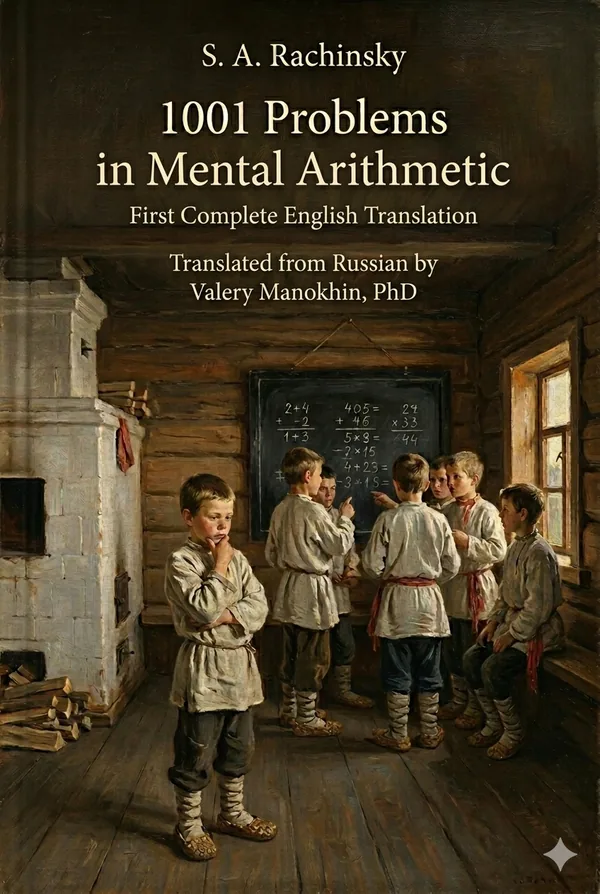
1001 Problemas de Rachinsky
por S. A. Rachinsky
Grados 4–8 (EE. UU.) · Years 5–9 (RU)
1.001 problemas cuidadosamente seleccionados del maestro rural cuyos estudiantes fueron retratados en la famosa pintura de 1895 "Aritmética Mental."
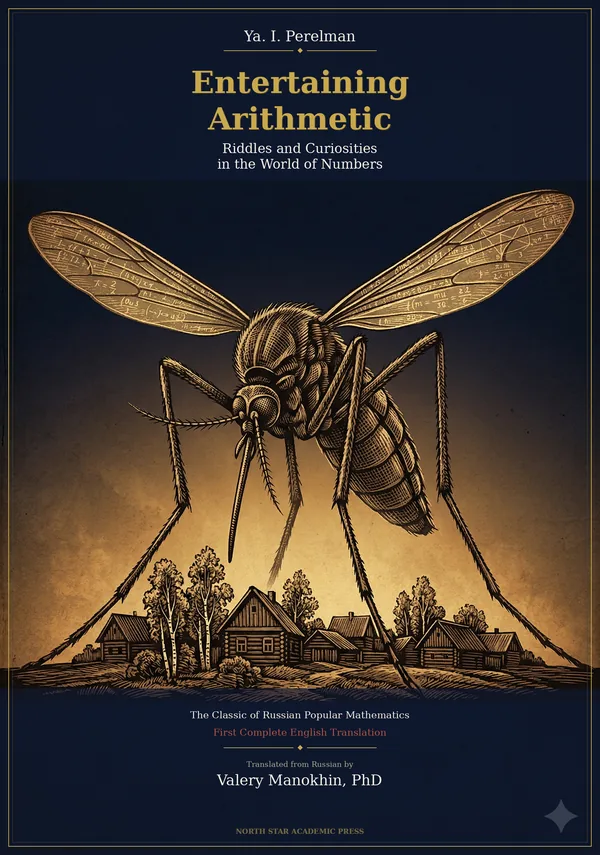
Aritmética Recreativa
por Ya. I. Perelman
Grados 4+ (EE. UU.) · Year 5+ (RU)
El clásico de las matemáticas populares rusas. Rompecabezas, acertijos y curiosidades que hacen la aritmética verdaderamente entretenida.
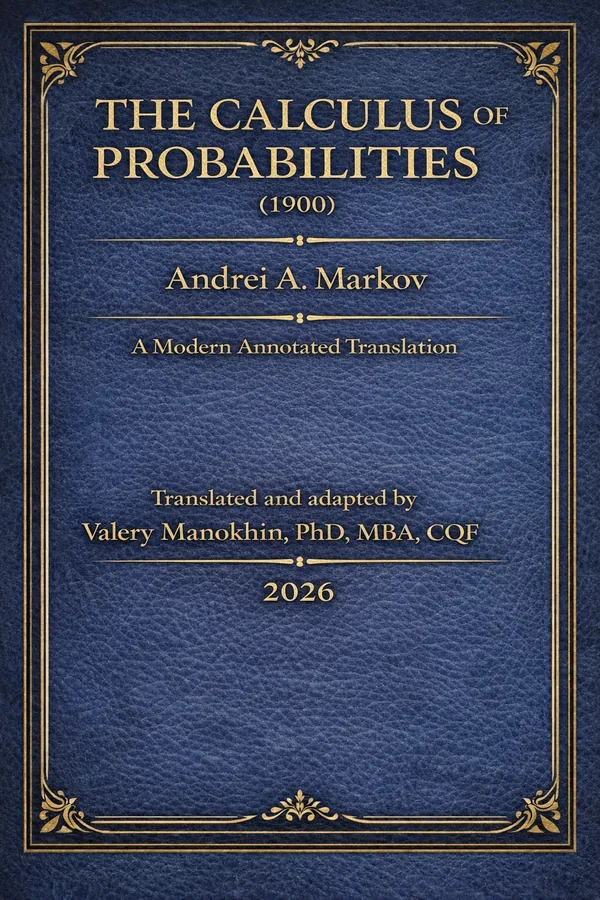
Markov: Probabilidades
por Andrei A. Markov
Grados 12 and university (EE. UU.) · Year 13 and university (RU)
La obra fundacional de 1900 sobre la teoría de la probabilidad por el matemático que nos dio las cadenas de Markov.