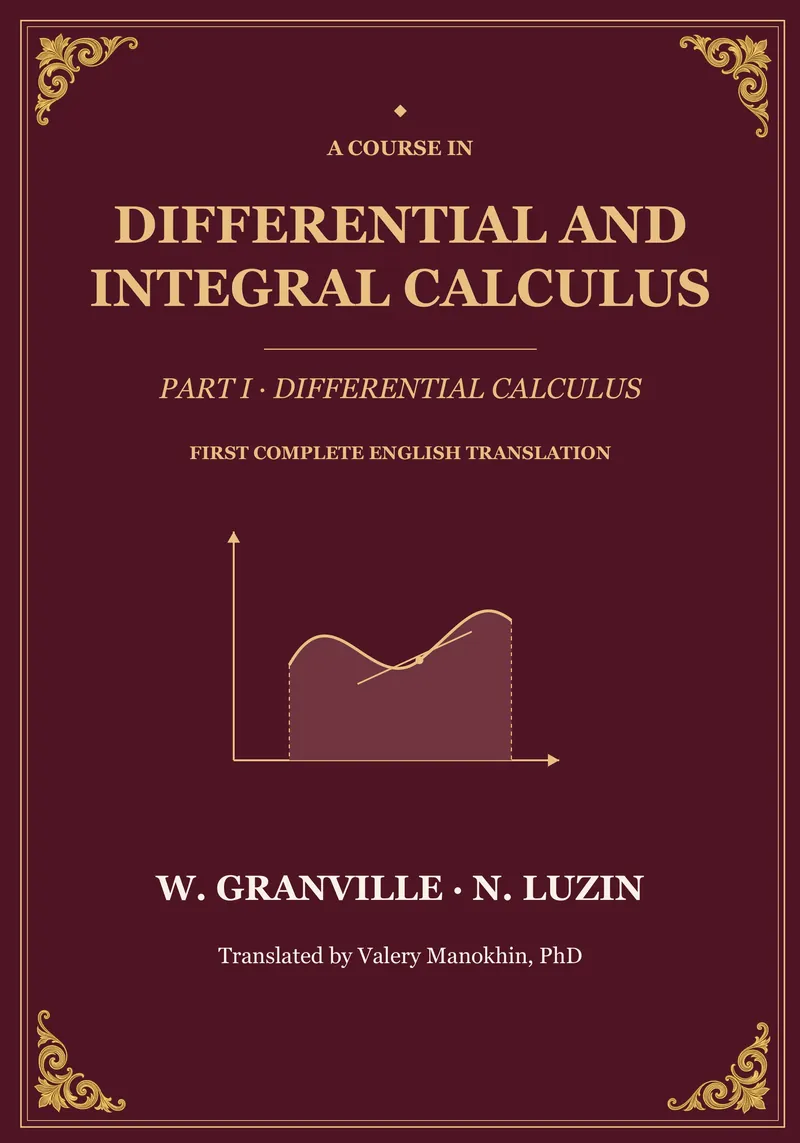
Curso de Cálculo Diferencial e Integral, Parte I: Cálculo Diferencial
por W. Granville and N. Luzin
Traducido por Valery Manokhin, PhD
Edición en inglés
¿Aún no te decides a comprar? Prueba un problema al día, gratis (en inglés) →
Para una generación de ingenieros soviéticos, «Granville–Luzin» fue el primer paso hacia el análisis matemático y el libro de matemáticas superiores más leído del país. Empezó como el curso de cálculo del estadounidense W. A. Granville; Nikolai Luzin, fundador de la escuela de Moscú de teoría de funciones, lo reescribió y amplió hasta convertirlo en un libro nuevo. Esta es la primera traducción completa al inglés de la Parte I, Cálculo Diferencial. Veintiún capítulos y 203 secciones numeradas recorren los números reales, variables y funciones, la teoría de límites y la continuidad, la derivada y las reglas de derivación de las funciones elementales, la derivación sucesiva, máximos y mínimos y el trazado de curvas, los diferenciales, la razón de cambio, el cambio de variable, la curvatura y el círculo de curvatura, el teorema de los incrementos finitos y las formas indeterminadas, las derivadas parciales y los diferenciales totales, las envolventes, las series y los desarrollos de Taylor y Maclaurin, las asíntotas y los puntos singulares, y la geometría de curvas y superficies en el espacio. El último capítulo es la colección de fórmulas y tablas de referencia de los propios autores. Cada capítulo enseña con ejemplos resueltos y termina con ejercicios, la mayoría con respuestas. 537 páginas.
21 capítulos· 203 artículos numerados· 537 páginas
Dónde encaja en el curso escolar — EE. UU., Reino Unido y Canadá ↓Adultos y autodidactas bienvenidos — las grandes matemáticas no tienen límite de edad.
Dónde encaja en el curso escolar
¿No sabe si este es el primer libro adecuado? Empiece aquí →Plan de estudios completo: todos los libros por curso →| Estados Unidos | University 1–2 | Calculus I–III, the differential calculus half |
|---|---|---|
| Inglaterra | Undergraduate 1–2 | first- and second-year differential calculus and introductory analysis |
| Canadá (Ontario) | University 1–2 | QC CEGEP 201-NYA · first- and second-year university calculus |
Dónde encaja este libro
Ver la secuencia completa →Estudiar antes
- Cálculo de Kiselev$54.95
Cubre gran parte del mismo temario
Fikhtengolts abarca más terreno en muchas menos páginas —390 frente a 537, 14 capítulos frente a 21— y llega hasta la integral indefinida y definida, donde este volumen se detiene al final del cálculo diferencial. Aquél es el curso teórico, con índice alfabético y una reseña histórica final hasta Newton y Leibniz; éste es el curso de enseñanza, con 203 secciones numeradas breves, ejemplos resueltos a lo largo de todo el libro y un capítulo de fórmulas y tablas de referencia.
El Volumen I de Piskunov es más breve —512 páginas, 12 capítulos, 147 secciones— y llega a la integral indefinida y definida, que este volumen no toca: aquí la integración es la Parte II. Piskunov trae además números complejos y polinomios, interpolación, derivación numérica y mínimos cuadrados, 249 figuras y un índice temático. No tiene capítulo de series, asíntotas ni puntos singulares, que este volumen sí enseña.
Se solapan en gran medida. Cada nota indica qué trae ese libro que este no — esas diferencias son las que deciden.
Problemas para trabajar en paralelo
- Gunter y Kuzmin$99.95
- Gunter y Kuzmin, Parte I$64.95
Qué viene después
Lectura complementaria
Un texto histórico para leer junto al curso, no para sustituirlo.
Índice
202 secciones — el índice completo del libro impreso.
Translator's Preface
Preface
I. Numbers9 secciónes
- § 1. Rational numbers
- § 2. The practical significance of rational numbers
- § 3. Comparison of rational numbers with points of a straight line
- § 4. Incommensurable segments
- § 5. Irrational numbers
- § 6. Representation of rational numbers in the form of decimal fractions
- § 7. Real numbers
- § 8. Absolute value
- § 9. Division by zero is impossible
II. Variable and Function23 secciónes
- § 10. On quantities in general
- § 11. Variable quantities
- § 12. Constant quantities
- § 13. Geometric representation of quantities
- § 14. The range of values of a variable
- § 15. Segment and interval
- § 16. Monotonic and oscillating variation of a quantity
- § 17. Bounded quantity
- § 18. Increment of a variable
- § 19. A constant quantity as a variable
- § 20. Function
- § 21. Dependent and independent variables
- § 22. Characteristic of a function
- § 23. Computation of functions
- § 24. Domain of the argument
- § 25. Increment of a function
- § 26. Geometric representation of functions
- § 27. Geometric representation of the increment of a function
- § 28. Classification of functions
- § 29. On the different origins of functions
- § 30. Function of a function
- § 31. Increasing and decreasing functions
- § 32. Inverse functions
III. Theory of Limits21 secciónes
- § 33. The limit of a variable
- § 34. On the ways in which a variable quantity may approach its limit
- § 35. Infinitesimals
- § 36. Connection between the concept of limit and the infinitesimal
- § 37. Basic properties of infinitesimals
- § 38. Fundamental theorems on limits
- § 39. The concept of the infinitely large (infinity: +∞, −∞, and ∞)
- § 40. Connection between the infinitely large and the infinitely small
- § 41. Continuity of functions
- § 42. Properties of Continuous Functions
- § 43. The fundamental theorem on continuous functions
- § 44. Types of Discontinuities of Functions
- § 45. Removable and non-removable discontinuities
- § 46. Apparent discontinuity and the so-called “true value” of a function Resolution of indeterminacies
- § 47. Two remarkable limits
- § 48. Comparison of infinitesimals with one another
- § 49. Orders of infinitesimals
- § 50. Equivalent infinitesimals
- § 51. Regarding equivalent infinitesimals, the following proposition, which reveals their essence, is very important:
- § 52. The first principle of the analysis of infinitesimals
- § 53. Application of the first principle
IV. Differentiation7 secciónes
- § 54. Introduction
- § 55. Comparison of increments
- § 56. The derivative of a function of one variable
- § 57. Various notations for the derivative
- § 58. Differentiable functions
- § 59. General rule for differentiation
- § 60. The first application of the derivative to geometry
V. Rules for differentiating elementary functions28 secciónes
- § 61. Importance of the general rule
- § 62. Differentiation of a constant
- § 63. Differentiation of a variable with respect to that same variable
- § 64. Differentiation of a sum (algebraic)
- § 65. Differentiation of the product of a constant and a variable
- § 66. Differentiation of the product of two variables
- § 67. Differentiation of the product of any finite number of variables
- § 68. Differentiation of a power function with a constant exponent
- § 69. Differentiation of a quotient
- § 70. Differentiation of a function of a function
- § 72. Practice of the rule for differentiating functions of functions
- § 73. Differentiation of the inverse function
- § 74. Differentiation of a logarithm
- § 75. Differentiation of the simple exponential function
- § 76. Differentiation of the general exponential function
- § 77. Practice in differentiating logarithmic functions
- § 78. Differentiation of sin v
- § 79. Differentiation of cos v
- § 80. Differentiation of tan v
- § 81. Differentiation of cot v
- § 82. Differentiation of sec v
- § 83. Differentiation of csc v
- § 85. Differentiation of arcsin v
- § 86. Differentiation of arccos v
- § 87. Differentiation of arctan v
- § 88. Differentiation of arccot v
- § 89. Implicit functions
- § 90. Differentiation of implicit functions
VI. The Simplest Applications of the Derivative11 secciónes
- § 91. Direction (slope) of a curve
- § 92. Equations of the tangent and the normal; lengths of the subtangent and subnormal in rectangular coordinates
- § 93. Parametric equations of a curve
- § 94. The angle between the radius vector drawn to a point on a curve and the tangent to the curve at that point
- § 95. Lengths of the polar subtangent and polar subnormal
- § 96. Separation of multiple roots of polynomials
- § 97. Applications of the derivative in mechanics. Velocity
- § 98. Components of velocity
- § 99. The derivative as a ratio of rates
- § 100. Tangential acceleration
- § 101. Components of tangential acceleration
VII. Successive Differentiation5 secciónes
- § 102. Definition of successive derivatives
- § 103. Notation
- § 104. The nth Derivative
- § 105. Leibniz's formula for the nth derivative of a product
- § 106. Successive differentiation of implicit functions
VIII. Maxima and Minima. Points of Inflection. Tracing of Curves9 secciónes
- § 107. Introduction
- § 108. Increasing and decreasing functions
- § 109. Criteria determining whether a function increases or decreases
- § 110. Maximum and minimum values of a function
- § 111. First method of investigating a function for maximum and minimum Practical rule
- § 112. Second method of investigating a function for maximum and minimum
- § 113. General directions for solving maximum and minimum problems
- § 114. Points of Inflection
- § 115. Plotting curves
IX. Differentials9 secciónes
- § 116. Introduction
- § 117. Definitions
- § 118. Geometric representation of the differential
- § 119. Increment of a function and differential of a function
- § 120. The importance of the differential of a function
- § 121. Derivative of an arc in rectangular coordinates
- § 122. Derivative of Arc Length in Polar Coordinates
- § 123. Formulas for finding differentials of functions
- § 124. Differentials of higher orders
X. Rate of Change1 sección
- § 125. The derivative regarded as the ratio of two rates
XI. Change of Variables4 secciónes
- § 126. Interchange of the dependent and independent variables
- § 127. Change of the dependent variable
- § 128. Change of the independent variable
- § 129. Simultaneous change of the independent and dependent variables
XII. Curvature. Radius of Curvature6 secciónes
- § 130. Curvature
- § 131. Formulas for curvature
- § 132. Formula for curvature in the case when the curve is given by equations in parametric form
- § 133. Formula for curvature in polar coordinates
- § 134. Radius of curvature
- § 135. Circle of curvature
XIII. The Theorem of Finite Increments. Indeterminate Forms12 secciónes
- § 136. Rolle's theorem
- § 137. Lagrange's theorem on finite increments
- § 138. Further development of the theorem on finite increments; Taylor's formula
- § 139. Maxima and minima, considered analytically
- § 140. Cauchy's Theorem
- § 141. Indeterminate forms
- § 142. Computation of the value of a function taking an indeterminate form
- § 143. Resolving the indeterminate form
- § 144. Evaluation of the indeterminate form ∞/∞
- § 145. Resolving the indeterminate form 0 · ∞
- § 146. Resolving the indeterminate form ∞ − ∞
- § 147. Evaluation of the indeterminate forms 00 , 1∞ , ∞
XIV. Circle of Curvature. Center of Curvature5 secciónes
- § 148. Circle of curvature. Center of curvature
- § 149.
- § 150. Evolutes
- § 151. Properties of the Evolute
- § 152. Involutes and their mechanical construction
XV. Partial Derivatives. Partial and Total Differentials9 secciónes
- § 153. Continuous functions of two or more independent variables
- § 154. Partial derivatives
- § 155. Geometric interpretation of partial derivatives
- § 156. The total increment
- § 157. The total differential
- § 158. Derivatives and differentials of a composite function of one independent variable
- § 159. Differentiation of an implicit function
- § 160. Successive partial derivatives
- § 161. The order of differentiation is immaterial
XVI. Envelopes4 secciónes
- § 162. Family of curves. Variable parameter
- § 163. Envelope of a family of curves depending on one parameter
- § 164. The evolute of a given curve, considered as the envelope of its normals
- § 165. Two parameters connected by one conditional equation
XVII. Series18 secciónes
- § 166. Infinite sequences
- § 167. For a given sequence u1 , u2 , . . . , un , . . . it is extremely important to be able to determine whether it has a limit, even if we cannot compute exactly the value of that limit
- § 168. Here are examples of sequences that do not have limits:
- § 169. Series
- § 170. A necessary condition for convergence
- § 171. Sufficient conditions for convergence. Comparison of series
- § 172. d'Alembert's convergence test
- § 173. Series with alternating signs
- § 174. Absolute convergence
- § 175. Series of functions
- § 176. Power series
- § 177. Expansion of functions in series
- § 178. Taylor Series
- § 179. Maclaurin's formula and Maclaurin's series
- § 180. Computations by means of series
- § 181. Approximate formulas derived from series
- § 182. Taylor Series for Two or More Variables
- § 183. Maxima and minima of functions of two independent variables
XIX. Asymptotes. Singular Points10 secciónes
- § 184. Rectilinear asymptotes
- § 185. Finding asymptotes by the method of taking limits of intercepts on the coordinate axes
- § 186. A method for determining the asymptotes of algebraic curves
- § 187. Asymptotes in polar coordinates
- § 188. Singular Points
- § 189. Determination of the tangent to an algebraic curve at a given singular point on it
- § 190. Nodes
- § 191. Cusp
- § 192. Isolated points
- § 193. Singular points of transcendental curves
XX. Applications to Geometry in Space5 secciónes
- § 194. The tangent line and the normal plane to a curve of double curvature whose equations are given in parametric form
- § 195. Tangent plane to a surface
- § 196. Normal to a surface
- § 197. Another form of the equations of the tangent line to a curve of double curvature
- § 198. Another form of the equation of the normal plane to a curve of double curvature
XXI. Formulas and Tables for Reference6 secciónes
- § 199. For the reader's convenience we give the following list of elementary formulas
- § 200. The Greek alphabet
- § 201. Conversion from degrees to radians (arc) and conversely
- § 202. Tables of trigonometric functions
- § 203. Natural logarithms
- Curves for Reference
Formatos y ediciones
Edición en inglés
- Comprar →
Tapa blanda · $79.95
Amazon
ISBN 978-1-80910-088-7
- Comprar →
Tapa dura · $119.95
Amazon
ISBN 978-1-80910-089-4
| Formato | Precio de lista (USD) | ISBN-13 | Dónde | Comprar |
|---|---|---|---|---|
| Tapa blanda | $79.95 | 978-1-80910-088-7 | Amazon | Comprar → |
| Tapa dura | $119.95 | 978-1-80910-089-4 | Amazon | Comprar → |
Precio de lista: el precio de lista del editor en EE. UU., en USD, solo como referencia. Amazon fija su propio precio en cada tienda — consulte el precio actual en Amazon. El precio de Gumroad es el que se cobra.
Detalles del producto
- Editorial
- Northern Star Academic Press
- Idioma
- English
- Traductor
- Valery Manokhin, PhD
- Extensión
- 537 páginas
- Primera publicación
- 2026-11-10
¿Preguntas? Consulta las preguntas frecuentes →
Publicado por Northern Star Academic Press · Primera traducción fiel del original ruso
Más de Esta Serie

1001 Problemas de Rachinsky
por S. A. Rachinsky
Grados 4–8 (EE. UU.) · Years 5–9 (RU)
1.001 problemas cuidadosamente seleccionados del maestro rural cuyos estudiantes fueron retratados en la famosa pintura de 1895 "Aritmética Mental."

Aritmética Recreativa
por Ya. I. Perelman
Grados 4+ (EE. UU.) · Year 5+ (RU)
El clásico de las matemáticas populares rusas. Rompecabezas, acertijos y curiosidades que hacen la aritmética verdaderamente entretenida.

Markov: Probabilidades
por Andrei A. Markov
Grados 12 and university (EE. UU.) · Year 13 and university (RU)
La obra fundacional de 1900 sobre la teoría de la probabilidad por el matemático que nos dio las cadenas de Markov.