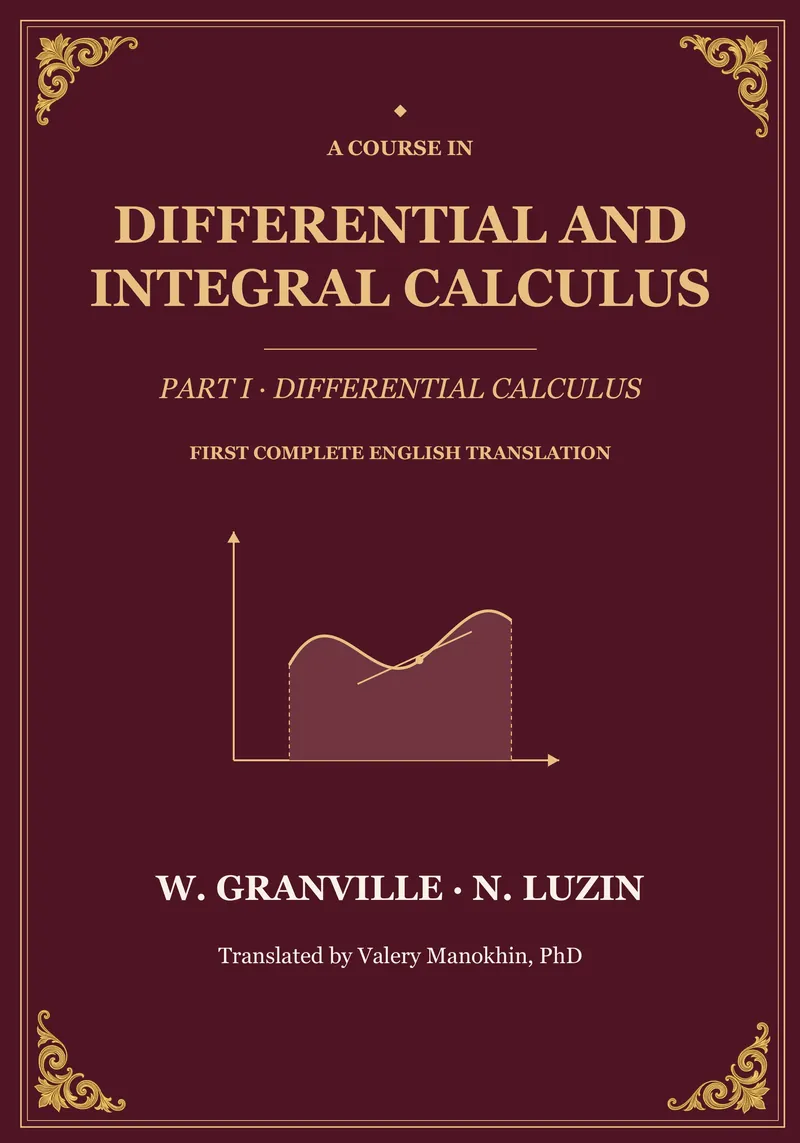
Curso de Cálculo Diferencial e Integral, Parte I: Cálculo Diferencial
por W. Granville and N. Luzin
Traduzido por Valery Manokhin, PhD
Edição em inglês
Ainda não vai comprar? Experimente um problema por dia, grátis (em inglês) →
Para uma geração de engenheiros soviéticos, "Granville–Luzin" foi o primeiro passo rumo à análise matemática e o livro de matemática superior mais lido do país. Começou como o curso de cálculo do americano W. A. Granville; Nikolai Luzin, fundador da escola de Moscou de teoria das funções, reescreveu-o e ampliou-o a ponto de torná-lo um livro novo. Esta é a primeira tradução completa para o inglês da Parte I, Cálculo Diferencial. Vinte e um capítulos e 203 seções numeradas percorrem os números reais, variáveis e funções, a teoria dos limites e a continuidade, a derivada e as regras de derivação das funções elementares, a derivação sucessiva, máximos e mínimos e o traçado de curvas, os diferenciais, a taxa de variação, a mudança de variável, a curvatura e o círculo de curvatura, o teorema dos incrementos finitos e as formas indeterminadas, as derivadas parciais e os diferenciais totais, as envolventes, as séries e os desenvolvimentos de Taylor e Maclaurin, as assíntotas e os pontos singulares, e a geometria de curvas e superfícies no espaço. O último capítulo é a coleção de fórmulas e tabelas de referência dos próprios autores. Cada capítulo ensina com exemplos resolvidos e termina com exercícios, a maioria com respostas. 537 páginas.
21 capítulos· 203 artigos numerados· 537 páginas
Onde se encaixa na escola — EUA, Reino Unido e Canadá ↓Adultos e autodidatas são bem-vindos — a grande matemática não tem limite de idade.
Onde se encaixa na escola
Não sabe se este é o primeiro livro certo? Comece aqui →Currículo completo: todos os livros por ano escolar →| Estados Unidos | University 1–2 | Calculus I–III, the differential calculus half |
|---|---|---|
| Inglaterra | Undergraduate 1–2 | first- and second-year differential calculus and introductory analysis |
| Canadá (Ontário) | University 1–2 | QC CEGEP 201-NYA · first- and second-year university calculus |
Onde este livro se encaixa
Ver a sequência completa →Estudar antes
- Cálculo de Kiselev$54.95
Cobre grande parte do mesmo conteúdo
Fikhtengolts abrange mais terreno em muito menos páginas — 390 contra 537, 14 capítulos contra 21 — e vai até a integral indefinida e definida, onde este volume para no fim do cálculo diferencial. Aquele é o curso teórico, com índice alfabético e um panorama histórico final até Newton e Leibniz; este é o curso de ensino, com 203 seções numeradas curtas, exemplos resolvidos ao longo de todo o livro e um capítulo de fórmulas e tabelas de referência.
O Volume I de Piskunov é mais curto — 512 páginas, 12 capítulos, 147 seções — e chega à integral indefinida e definida, que este volume não aborda: aqui a integração é a Parte II. Piskunov traz ainda números complexos e polinômios, interpolação, derivação numérica e mínimos quadrados, 249 figuras e um índice remissivo. Não tem capítulo de séries, assíntotas nem pontos singulares, que este volume ensina.
Há forte sobreposição. Cada nota diz o que aquele livro traz e este não — são essas diferenças que decidem.
Problemas para trabalhar em paralelo
- Gunter e Kuzmin$99.95
- Gunter e Kuzmin, Parte I$64.95
O que vem depois
Leitura complementar
Um texto histórico para ler ao lado do curso, não para substituí-lo.
Sumário
202 seções — o sumário completo do livro impresso.
Translator's Preface
Preface
I. Numbers9 seções
- § 1. Rational numbers
- § 2. The practical significance of rational numbers
- § 3. Comparison of rational numbers with points of a straight line
- § 4. Incommensurable segments
- § 5. Irrational numbers
- § 6. Representation of rational numbers in the form of decimal fractions
- § 7. Real numbers
- § 8. Absolute value
- § 9. Division by zero is impossible
II. Variable and Function23 seções
- § 10. On quantities in general
- § 11. Variable quantities
- § 12. Constant quantities
- § 13. Geometric representation of quantities
- § 14. The range of values of a variable
- § 15. Segment and interval
- § 16. Monotonic and oscillating variation of a quantity
- § 17. Bounded quantity
- § 18. Increment of a variable
- § 19. A constant quantity as a variable
- § 20. Function
- § 21. Dependent and independent variables
- § 22. Characteristic of a function
- § 23. Computation of functions
- § 24. Domain of the argument
- § 25. Increment of a function
- § 26. Geometric representation of functions
- § 27. Geometric representation of the increment of a function
- § 28. Classification of functions
- § 29. On the different origins of functions
- § 30. Function of a function
- § 31. Increasing and decreasing functions
- § 32. Inverse functions
III. Theory of Limits21 seções
- § 33. The limit of a variable
- § 34. On the ways in which a variable quantity may approach its limit
- § 35. Infinitesimals
- § 36. Connection between the concept of limit and the infinitesimal
- § 37. Basic properties of infinitesimals
- § 38. Fundamental theorems on limits
- § 39. The concept of the infinitely large (infinity: +∞, −∞, and ∞)
- § 40. Connection between the infinitely large and the infinitely small
- § 41. Continuity of functions
- § 42. Properties of Continuous Functions
- § 43. The fundamental theorem on continuous functions
- § 44. Types of Discontinuities of Functions
- § 45. Removable and non-removable discontinuities
- § 46. Apparent discontinuity and the so-called “true value” of a function Resolution of indeterminacies
- § 47. Two remarkable limits
- § 48. Comparison of infinitesimals with one another
- § 49. Orders of infinitesimals
- § 50. Equivalent infinitesimals
- § 51. Regarding equivalent infinitesimals, the following proposition, which reveals their essence, is very important:
- § 52. The first principle of the analysis of infinitesimals
- § 53. Application of the first principle
IV. Differentiation7 seções
- § 54. Introduction
- § 55. Comparison of increments
- § 56. The derivative of a function of one variable
- § 57. Various notations for the derivative
- § 58. Differentiable functions
- § 59. General rule for differentiation
- § 60. The first application of the derivative to geometry
V. Rules for differentiating elementary functions28 seções
- § 61. Importance of the general rule
- § 62. Differentiation of a constant
- § 63. Differentiation of a variable with respect to that same variable
- § 64. Differentiation of a sum (algebraic)
- § 65. Differentiation of the product of a constant and a variable
- § 66. Differentiation of the product of two variables
- § 67. Differentiation of the product of any finite number of variables
- § 68. Differentiation of a power function with a constant exponent
- § 69. Differentiation of a quotient
- § 70. Differentiation of a function of a function
- § 72. Practice of the rule for differentiating functions of functions
- § 73. Differentiation of the inverse function
- § 74. Differentiation of a logarithm
- § 75. Differentiation of the simple exponential function
- § 76. Differentiation of the general exponential function
- § 77. Practice in differentiating logarithmic functions
- § 78. Differentiation of sin v
- § 79. Differentiation of cos v
- § 80. Differentiation of tan v
- § 81. Differentiation of cot v
- § 82. Differentiation of sec v
- § 83. Differentiation of csc v
- § 85. Differentiation of arcsin v
- § 86. Differentiation of arccos v
- § 87. Differentiation of arctan v
- § 88. Differentiation of arccot v
- § 89. Implicit functions
- § 90. Differentiation of implicit functions
VI. The Simplest Applications of the Derivative11 seções
- § 91. Direction (slope) of a curve
- § 92. Equations of the tangent and the normal; lengths of the subtangent and subnormal in rectangular coordinates
- § 93. Parametric equations of a curve
- § 94. The angle between the radius vector drawn to a point on a curve and the tangent to the curve at that point
- § 95. Lengths of the polar subtangent and polar subnormal
- § 96. Separation of multiple roots of polynomials
- § 97. Applications of the derivative in mechanics. Velocity
- § 98. Components of velocity
- § 99. The derivative as a ratio of rates
- § 100. Tangential acceleration
- § 101. Components of tangential acceleration
VII. Successive Differentiation5 seções
- § 102. Definition of successive derivatives
- § 103. Notation
- § 104. The nth Derivative
- § 105. Leibniz's formula for the nth derivative of a product
- § 106. Successive differentiation of implicit functions
VIII. Maxima and Minima. Points of Inflection. Tracing of Curves9 seções
- § 107. Introduction
- § 108. Increasing and decreasing functions
- § 109. Criteria determining whether a function increases or decreases
- § 110. Maximum and minimum values of a function
- § 111. First method of investigating a function for maximum and minimum Practical rule
- § 112. Second method of investigating a function for maximum and minimum
- § 113. General directions for solving maximum and minimum problems
- § 114. Points of Inflection
- § 115. Plotting curves
IX. Differentials9 seções
- § 116. Introduction
- § 117. Definitions
- § 118. Geometric representation of the differential
- § 119. Increment of a function and differential of a function
- § 120. The importance of the differential of a function
- § 121. Derivative of an arc in rectangular coordinates
- § 122. Derivative of Arc Length in Polar Coordinates
- § 123. Formulas for finding differentials of functions
- § 124. Differentials of higher orders
X. Rate of Change1 seção
- § 125. The derivative regarded as the ratio of two rates
XI. Change of Variables4 seções
- § 126. Interchange of the dependent and independent variables
- § 127. Change of the dependent variable
- § 128. Change of the independent variable
- § 129. Simultaneous change of the independent and dependent variables
XII. Curvature. Radius of Curvature6 seções
- § 130. Curvature
- § 131. Formulas for curvature
- § 132. Formula for curvature in the case when the curve is given by equations in parametric form
- § 133. Formula for curvature in polar coordinates
- § 134. Radius of curvature
- § 135. Circle of curvature
XIII. The Theorem of Finite Increments. Indeterminate Forms12 seções
- § 136. Rolle's theorem
- § 137. Lagrange's theorem on finite increments
- § 138. Further development of the theorem on finite increments; Taylor's formula
- § 139. Maxima and minima, considered analytically
- § 140. Cauchy's Theorem
- § 141. Indeterminate forms
- § 142. Computation of the value of a function taking an indeterminate form
- § 143. Resolving the indeterminate form
- § 144. Evaluation of the indeterminate form ∞/∞
- § 145. Resolving the indeterminate form 0 · ∞
- § 146. Resolving the indeterminate form ∞ − ∞
- § 147. Evaluation of the indeterminate forms 00 , 1∞ , ∞
XIV. Circle of Curvature. Center of Curvature5 seções
- § 148. Circle of curvature. Center of curvature
- § 149.
- § 150. Evolutes
- § 151. Properties of the Evolute
- § 152. Involutes and their mechanical construction
XV. Partial Derivatives. Partial and Total Differentials9 seções
- § 153. Continuous functions of two or more independent variables
- § 154. Partial derivatives
- § 155. Geometric interpretation of partial derivatives
- § 156. The total increment
- § 157. The total differential
- § 158. Derivatives and differentials of a composite function of one independent variable
- § 159. Differentiation of an implicit function
- § 160. Successive partial derivatives
- § 161. The order of differentiation is immaterial
XVI. Envelopes4 seções
- § 162. Family of curves. Variable parameter
- § 163. Envelope of a family of curves depending on one parameter
- § 164. The evolute of a given curve, considered as the envelope of its normals
- § 165. Two parameters connected by one conditional equation
XVII. Series18 seções
- § 166. Infinite sequences
- § 167. For a given sequence u1 , u2 , . . . , un , . . . it is extremely important to be able to determine whether it has a limit, even if we cannot compute exactly the value of that limit
- § 168. Here are examples of sequences that do not have limits:
- § 169. Series
- § 170. A necessary condition for convergence
- § 171. Sufficient conditions for convergence. Comparison of series
- § 172. d'Alembert's convergence test
- § 173. Series with alternating signs
- § 174. Absolute convergence
- § 175. Series of functions
- § 176. Power series
- § 177. Expansion of functions in series
- § 178. Taylor Series
- § 179. Maclaurin's formula and Maclaurin's series
- § 180. Computations by means of series
- § 181. Approximate formulas derived from series
- § 182. Taylor Series for Two or More Variables
- § 183. Maxima and minima of functions of two independent variables
XIX. Asymptotes. Singular Points10 seções
- § 184. Rectilinear asymptotes
- § 185. Finding asymptotes by the method of taking limits of intercepts on the coordinate axes
- § 186. A method for determining the asymptotes of algebraic curves
- § 187. Asymptotes in polar coordinates
- § 188. Singular Points
- § 189. Determination of the tangent to an algebraic curve at a given singular point on it
- § 190. Nodes
- § 191. Cusp
- § 192. Isolated points
- § 193. Singular points of transcendental curves
XX. Applications to Geometry in Space5 seções
- § 194. The tangent line and the normal plane to a curve of double curvature whose equations are given in parametric form
- § 195. Tangent plane to a surface
- § 196. Normal to a surface
- § 197. Another form of the equations of the tangent line to a curve of double curvature
- § 198. Another form of the equation of the normal plane to a curve of double curvature
XXI. Formulas and Tables for Reference6 seções
- § 199. For the reader's convenience we give the following list of elementary formulas
- § 200. The Greek alphabet
- § 201. Conversion from degrees to radians (arc) and conversely
- § 202. Tables of trigonometric functions
- § 203. Natural logarithms
- Curves for Reference
Formatos e edições
Edição em inglês
- Comprar →
Brochura · $79.95
Amazon
ISBN 978-1-80910-088-7
- Comprar →
Capa dura · $119.95
Amazon
ISBN 978-1-80910-089-4
| Formato | Preço de tabela (USD) | ISBN-13 | Onde | Comprar |
|---|---|---|---|---|
| Brochura | $79.95 | 978-1-80910-088-7 | Amazon | Comprar → |
| Capa dura | $119.95 | 978-1-80910-089-4 | Amazon | Comprar → |
Preço de tabela: o preço de tabela da editora nos EUA, em USD, apenas como referência. A Amazon define o próprio preço em cada loja — veja o preço atual na Amazon. O preço do Gumroad é o preço cobrado.
Detalhes do produto
- Editora
- Northern Star Academic Press
- Idioma
- English
- Tradutor
- Valery Manokhin, PhD
- Extensão
- 537 páginas
- Primeira publicação
- 2026-11-10
Dúvidas? Veja as perguntas frequentes →
Publicado por Northern Star Academic Press · Primeira tradução fiel da edição original russa
Mais Desta Série

1001 Problemas de Rachinsky
por S. A. Rachinsky
Séries 4–8 (EUA) · Years 5–9 (RU)
1.001 problemas cuidadosamente selecionados do professor rural cujos alunos foram retratados na famosa pintura de 1895 "Aritmética Mental."

Aritmética Recreativa
por Ya. I. Perelman
Séries 4+ (EUA) · Year 5+ (RU)
O clássico da matemática popular russa. Quebra-cabeças, enigmas e curiosidades que tornam a aritmética verdadeiramente divertida.

Markov: Probabilidades
por Andrei A. Markov
Séries 12 and university (EUA) · Year 13 and university (RU)
A obra fundacional de 1900 sobre a teoria da probabilidade pelo matemático que nos deu as cadeias de Markov.