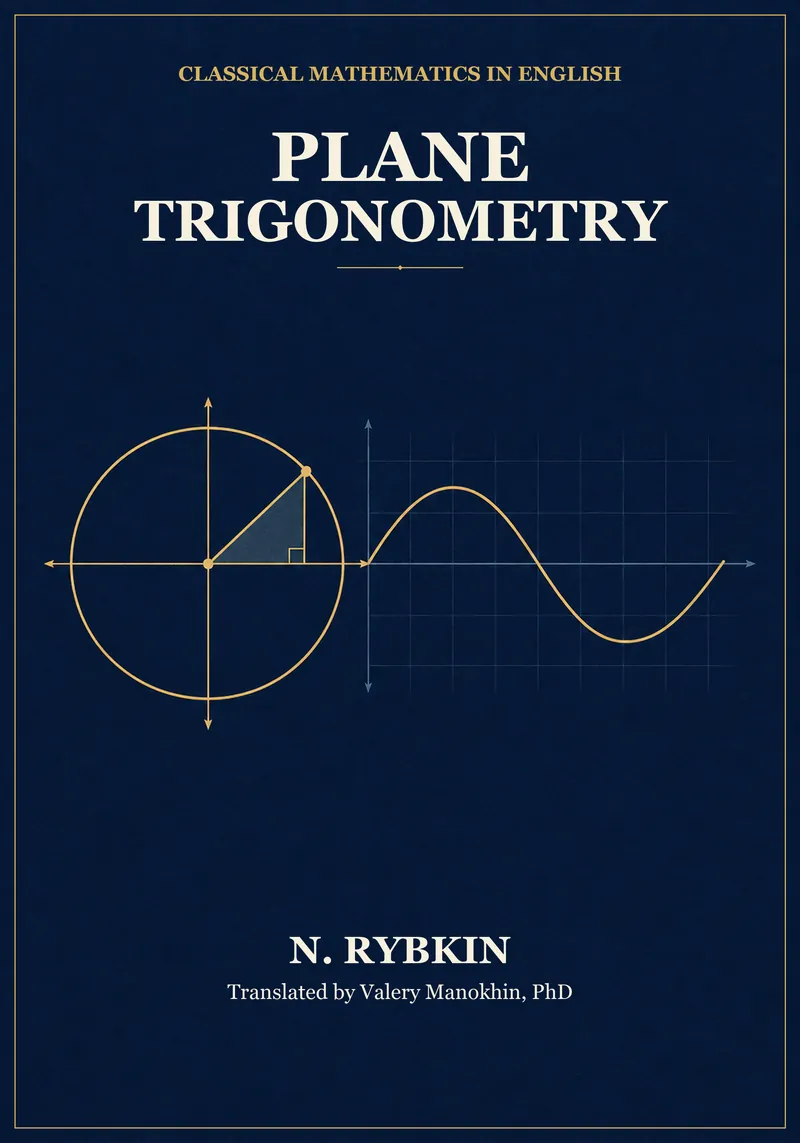
Trigonometría Plana
por N. A. Rybkin
Traducido por Valery Manokhin, PhD
Un curso completo de trigonometría plana, en primera traducción fiel al inglés desde la edición rusa original. Once capítulos y 126 secciones numeradas en tres divisiones. La goniometría construye las seis funciones trigonométricas a partir de líneas en la circunferencia, primero para el ángulo agudo y luego para la vuelta completa: fórmulas de reducción, ángulos negativos y periodicidad, gráficas de las funciones, funciones circulares inversas, fórmulas de suma y diferencia, del ángulo doble y del ángulo mitad, reducción a forma logarítmica y ángulo auxiliar, y un capítulo de ecuaciones trigonométricas. La segunda división explica cómo se construyen las tablas trigonométricas y cómo se usan las de cuatro y cinco cifras. La tercera resuelve triángulos rectángulos y oblicuángulos y cierra con la medición sobre el terreno: distancias inaccesibles, alturas y triangulación. Cincuenta y cuatro figuras y un resumen de las fórmulas básicas.
11 capítulos · 126 artículos numerados · 117 páginas
Dónde encaja en el curso escolar — EE. UU., Reino Unido y Canadá ↓ Adultos y autodidactas bienvenidos — las grandes matemáticas no tienen límite de edad.
Dónde encaja en el curso escolar
Plan de estudios completo: todos los libros por curso →| Estados Unidos | 10–12 | Trigonometry / Precalculus; closes with measurement in the field and triangulation |
|---|---|---|
| Reino Unido | Years 10–13 | GCSE Higher (sine and cosine rules) → A-level Pure |
| Canadá | Ontario 10–12 | MPM2D → MCR3U → MHF4U · QC Secondary IV–V SN |
No incluido en este libro
ejercicios: este volumen es solo exposición · estadística y tratamiento de datos · probabilidad · vectores
Estos bloques habrá que cubrirlos con otro material. Faltan en el libro, no en esta descripción.
Dónde encaja este libro
Ver la secuencia completa →Estudiar antes
- Álgebra Elemental$69.95
- Álgebra II de Kiselev$54.95
Cubre gran parte del mismo temario
Derzhavin llega a 192 páginas y 86 secciones numeradas, y añade la derivada, las series de seno y coseno, el cálculo de π y las Tablas I–V encuadernadas, nada de lo cual trae este libro. Ambos cierran la resolución de triángulos con la medición sobre el terreno y la triangulación.
Anoshchenko es más extenso —188 páginas en tres partes y 25 capítulos— y añade artículos suplementarios sobre máximos y mínimos y sobre expresiones indeterminadas, que este libro no trata. Ambos terminan la resolución de triángulos con la triangulación sobre el terreno.
- Trigonometría de Davidov$49.95
El de Davidov tiene 176 páginas y añade una parte entera de trigonometría esférica, un Suplemento en siete partes que llega a la fórmula de De Moivre y a las series, y 265 problemas, 212 con respuesta. Este libro es solo trigonometría plana y no trae series de ejercicios.
Rashevsky es el curso más breve —81 páginas frente a 117— y se detiene en la resolución de triángulos: sin capítulo de ecuaciones trigonométricas ni medición sobre el terreno. Sí trae ejercicios con respuestas, que este libro no tiene.
Se solapan en gran medida. Cada nota indica qué trae ese libro que este no — esas diferencias son las que deciden.
Problemas para trabajar en paralelo
Qué viene después
- Cálculo de Kiselev$54.95
Índice
81 secciones — el índice completo del libro impreso.
Translator's Preface
Introduction4 secciónes
- § 1. The subject of trigonometry
- § 2. The concept of a function
- § 3. Measurement of arcs and angles
- § 3a. Arc length
I. Trigonometric Functions of an Acute Angle10 secciónes
- § 4. Names and symbols
- § 5. Definition of the trigonometric functions of an acute angle
- § 9. Change of the trigonometric functions as the angle changes from 0° to 90°
- § 10. Construction of an acute angle from a given trigonometric function
- § 12. Dependence between the trigonometric functions of one and the same angle
- § 13. Between the trigonometric functions of one and the same angle there exist only five independent relations
- § 17. The dependence between the trigonometric functions of complementary angles
- § 19. Examples of calculating the values of the trigonometric functions of a given angle
- § 20. Dependence between the sides and angles in a right triangle
- § 22. Examples illustrating the solution of triangles. The concept of tables
II. Trigonometric Functions of Angles from 90° to 360°10 secciónes
- § 23. Preliminary remarks
- § 24. Construction of trigonometric lines
- § 25. Table of trigonometric functions
- § 26. Constructing an angle from a given value of a trigonometric function
- § 27. Extension of the formulas of § 12
- § 28. Application of formulas (I)–(VIII)
- § 29. Variation of the trigonometric functions as the angle increases from 0° to 360°
- § 30. Reduction formulas
- § 31. Another derivation of the reduction formulas
- § 32. Determination of an angle from the given value of a trigonometric function (within the limits from 0° to 360°)
III. Negative Angles and Angles Greater Than 360°8 secciónes
- § 33. On negative angles
- § 35. On angles exceeding 360°. Periodicity of trigonometric functions
- § 37. Reduction of the trigonometric function of any angle to functions of the least positive argument
- § 38. The generality of the reduction formulas
- § 45. General form of arcs having their endpoint at a given point of the circle
- § 46. Graphs of trigonometric functions
- § 47. General form of the angles corresponding to a given value of a trigonometric function
- § 48. Inverse circular functions
IV. Expression of the Sine, Cosine, and Tangent of the Sum and Difference of Angles, of the Double Angle, and of the Half-Angle8 secciónes
- § 50. Sine and cosine of the sum and difference of two angles
- § 51. Sine of a sum
- § 52. Sine of a difference
- § 54. Proof of the generality of the formulas of § 53
- § 55. Tangent of the sum and difference of two angles
- § 57. The sine, cosine, and tangent of the double angle
- § 60. The sine, cosine, and tangent of half an angle
- § 61. On the double signs in formulas (X) and (XI)
V. Reduction of Expressions to a Form Convenient for Taking Logarithms4 secciónes
- § 63. General remark
- § 64. Transformation of the sum and difference of two sines or cosines
- § 66. Transformation of the sum and difference of two tangents or cotangents
- § 67. Introduction of an auxiliary angle
VI. On Trigonometric Equations2 secciónes
- § 70. General remarks
- § 71. Examples
VII. The Concept of Constructing Trigonometric Tables
VIII. Trigonometric Tables3 secciónes
- § 80. Use of five-place logarithm tables
- § 81. The case of a very large tabular difference
- § 82. Degree of accuracy in determining an angle from five-place tables
IX. Right Triangles4 secciónes
- § 83. Relations between the elements of a right triangle
- § 84. Between the elements of any triangle there exist only three independent relations
- § 85. Solution of right triangles
- Solution of right triangles by means of four-place logarithmic tables
X. Oblique Triangles11 secciónes
- § 97. Relations between the elements of an oblique triangle
- § 101. Mollweide’s formulas
- § 103. Formulas for determining the angles of a triangle from its three sides
- § 104. The tangent of half an angle of a triangle can also be determined with the help of the radius of the inscribed circle
- § 105. On the independent relations between the sides and angles of an oblique triangle
- § 106. Expressions for the area of a triangle
- § 109. Expressions for the radius of the circumscribed circle
- § 110. Expressions for the radius of the inscribed circle
- Solution of oblique triangles by natural tables
- Solution of oblique triangles by means of four-place logarithmic tables
- Solution of oblique triangles by means of five-place tables
XI. Measurements in the Field7 secciónes
- § 117. General remarks
- § 118. Measurement of lines
- § 119. Angle-measuring instruments
- § 123. Application of trigonometry
- § 124. Determination of inaccessible distances
- § 125. Determination of height
- § 126. Triangulation
Basic Trigonometric Formulas10 secciónes
- Relations between trigonometric functions
- Formulas for the sum and difference of angles
- Functions of the double angle
- Functions of the half-angle
- Formulas for reduction to logarithmic form
- Relations in a right triangle
- Relations in an oblique triangle
- Area of a triangle
- Trigonometric functions of the principal angles
- Reduction formulas
Formatos y ediciones
| Formato | Precio | ISBN-13 | Dónde | Comprar |
|---|---|---|---|---|
| Tapa blanda | $49.95 | 978-1-919012-88-9 | Amazon | Comprar → |
| Tapa dura | $69.95 | 978-1-919012-89-6 | Amazon | Comprar → |
Los precios son los de lista del editor. Amazon fija el precio final en cada tienda.
Detalles del producto
- Editorial
- Northern Star Academic Press
- Idioma
- English
- Traductor
- Valery Manokhin, PhD
- Extensión
- 117 páginas
- Primera publicación
- 2026-09-28
Publicado por Northern Star Academic Press · Primera traducción fiel del original ruso
Más de Esta Serie
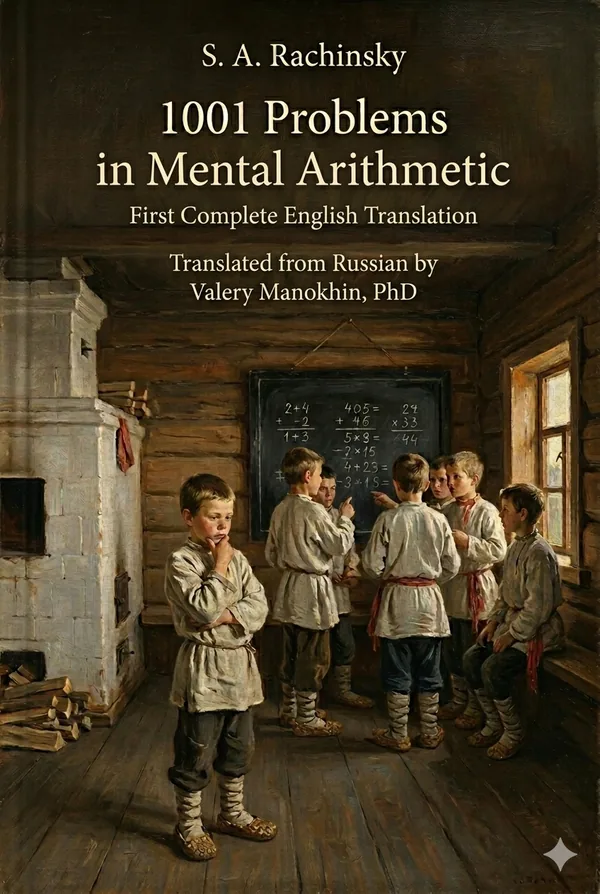
1001 Problemas de Rachinsky
por S. A. Rachinsky
Grados 4–8 (EE. UU.) · Years 5–9 (RU)
1.001 problemas cuidadosamente seleccionados del maestro rural cuyos estudiantes fueron retratados en la famosa pintura de 1895 "Aritmética Mental."
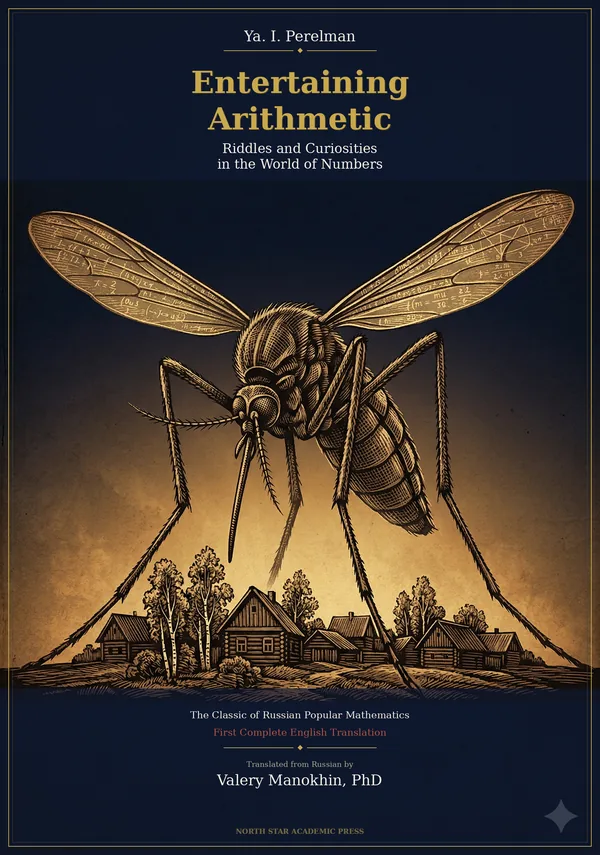
Aritmética Recreativa
por Ya. I. Perelman
Grados 4+ (EE. UU.) · Year 5+ (RU)
El clásico de las matemáticas populares rusas. Rompecabezas, acertijos y curiosidades que hacen la aritmética verdaderamente entretenida.
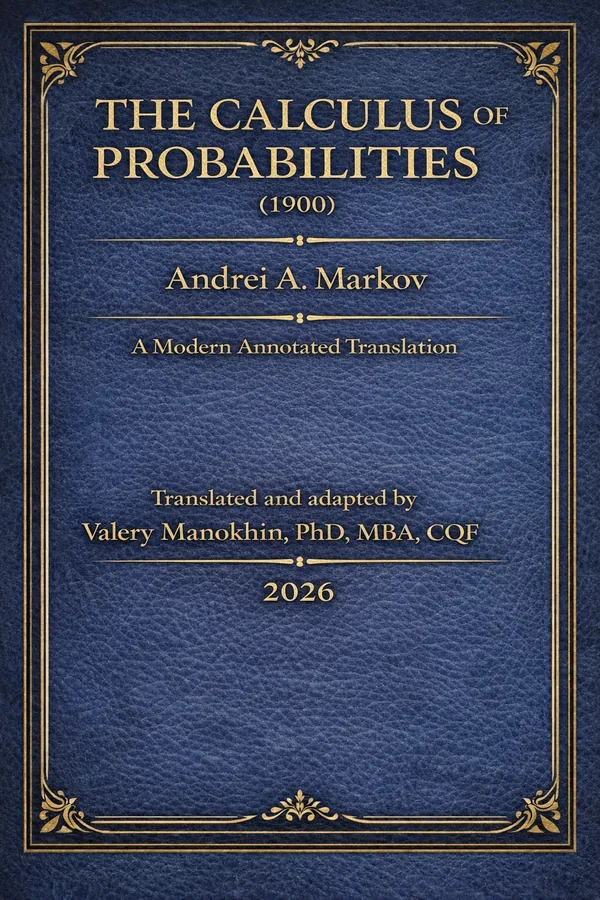
Markov: Probabilidades
por Andrei A. Markov
Grados 12 and university (EE. UU.) · Year 13 and university (RU)
La obra fundacional de 1900 sobre la teoría de la probabilidad por el matemático que nos dio las cadenas de Markov.