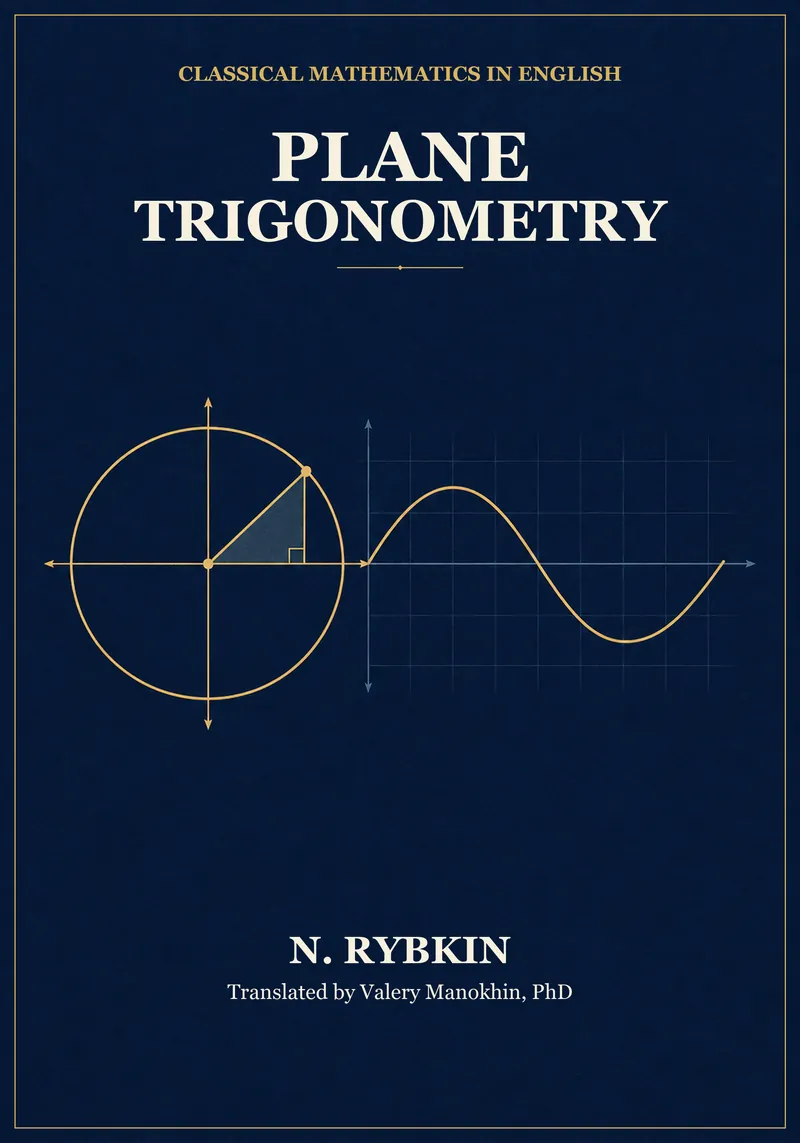
Plane Trigonometry
by N. A. Rybkin
Translated by Valery Manokhin, PhD
A complete course in plane trigonometry, in first faithful English translation from the original Russian edition. Eleven chapters and 126 numbered sections in three divisions. Goniometry builds the six trigonometric functions from lines in the circle, first for the acute angle and then through the full revolution: reduction formulas, negative angles and periodicity, graphs of the functions, inverse circular functions, the sum and difference, double-angle and half-angle formulas, reduction to logarithmic form and the auxiliary angle, and a chapter of trigonometric equations that shows how roots are lost. The second division explains how trigonometric tables are constructed and how four- and five-place tables are used. The third solves right and oblique triangles, each case worked with natural values and again with logarithms, and closes with measurement in the field: inaccessible distances, heights and triangulation. Fifty-four figures and a summary of the basic formulas.
11 chapters · 126 numbered articles · 117 pages
Where this fits in school — US, UK and Canada ↓ Adults and self-learners welcome — great mathematics has no age limit.
Where this fits in school
Full curriculum table — every book by school year →| United States | 10–12 | Trigonometry / Precalculus; closes with measurement in the field and triangulation |
|---|---|---|
| United Kingdom | Years 10–13 | GCSE Higher (sine and cosine rules) → A-level Pure |
| Canada | Ontario 10–12 | MPM2D → MCR3U → MHF4U · QC Secondary IV–V SN |
Not covered in this book
exercises — this volume is exposition only · statistics and data handling · probability · vectors
Source these strands elsewhere. They are missing from the book, not from this description.
How this book fits
See the whole sequence →Work through first
- Elementary Algebra$69.95
- Kiselev's Algebra II$54.95
Covers much of the same ground
- Derzhavin's Trigonometry$54.95
Derzhavin runs to 192 pages and 86 numbered sections, and adds the derivative, the series for sine and cosine, the computation of π and Tables I–V bound in — none of which this book has. Both close the triangle work with measurement in the field and triangulation.
Anoshchenko is longer — 188 pages in three parts and 25 chapters — and adds supplementary articles on maxima and minima and on indeterminate expressions, which this book does not treat. Both end the triangle work with triangulation in the field.
- Davidov's Trigonometry$49.95
Davidov's is 176 pages and adds a whole part on spherical trigonometry, a seven-part Supplement reaching De Moivre's formula and infinite series, and 265 problems, 212 of them answered. This book is plane trigonometry only, with no exercise sets.
- Rashevsky's Trigonometry$39.95
Rashevsky is the shorter course — 81 pages to 117 — and stops at the solution of triangles: no chapter on trigonometric equations and no measurement in the field. It does carry exercises with answers, which this book does not.
These overlap heavily. Each note says what that book has which this one does not — the differences are what decide between them.
Problems to work alongside it
What comes next
- Kiselev's Calculus$54.95
Table of contents
81 section headings — the printed contents page in full.
Translator's Preface
Introduction4 sections
- § 1. The subject of trigonometry
- § 2. The concept of a function
- § 3. Measurement of arcs and angles
- § 3a. Arc length
I. Trigonometric Functions of an Acute Angle10 sections
- § 4. Names and symbols
- § 5. Definition of the trigonometric functions of an acute angle
- § 9. Change of the trigonometric functions as the angle changes from 0° to 90°
- § 10. Construction of an acute angle from a given trigonometric function
- § 12. Dependence between the trigonometric functions of one and the same angle
- § 13. Between the trigonometric functions of one and the same angle there exist only five independent relations
- § 17. The dependence between the trigonometric functions of complementary angles
- § 19. Examples of calculating the values of the trigonometric functions of a given angle
- § 20. Dependence between the sides and angles in a right triangle
- § 22. Examples illustrating the solution of triangles. The concept of tables
II. Trigonometric Functions of Angles from 90° to 360°10 sections
- § 23. Preliminary remarks
- § 24. Construction of trigonometric lines
- § 25. Table of trigonometric functions
- § 26. Constructing an angle from a given value of a trigonometric function
- § 27. Extension of the formulas of § 12
- § 28. Application of formulas (I)–(VIII)
- § 29. Variation of the trigonometric functions as the angle increases from 0° to 360°
- § 30. Reduction formulas
- § 31. Another derivation of the reduction formulas
- § 32. Determination of an angle from the given value of a trigonometric function (within the limits from 0° to 360°)
III. Negative Angles and Angles Greater Than 360°8 sections
- § 33. On negative angles
- § 35. On angles exceeding 360°. Periodicity of trigonometric functions
- § 37. Reduction of the trigonometric function of any angle to functions of the least positive argument
- § 38. The generality of the reduction formulas
- § 45. General form of arcs having their endpoint at a given point of the circle
- § 46. Graphs of trigonometric functions
- § 47. General form of the angles corresponding to a given value of a trigonometric function
- § 48. Inverse circular functions
IV. Expression of the Sine, Cosine, and Tangent of the Sum and Difference of Angles, of the Double Angle, and of the Half-Angle8 sections
- § 50. Sine and cosine of the sum and difference of two angles
- § 51. Sine of a sum
- § 52. Sine of a difference
- § 54. Proof of the generality of the formulas of § 53
- § 55. Tangent of the sum and difference of two angles
- § 57. The sine, cosine, and tangent of the double angle
- § 60. The sine, cosine, and tangent of half an angle
- § 61. On the double signs in formulas (X) and (XI)
V. Reduction of Expressions to a Form Convenient for Taking Logarithms4 sections
- § 63. General remark
- § 64. Transformation of the sum and difference of two sines or cosines
- § 66. Transformation of the sum and difference of two tangents or cotangents
- § 67. Introduction of an auxiliary angle
VI. On Trigonometric Equations2 sections
- § 70. General remarks
- § 71. Examples
VII. The Concept of Constructing Trigonometric Tables
VIII. Trigonometric Tables3 sections
- § 80. Use of five-place logarithm tables
- § 81. The case of a very large tabular difference
- § 82. Degree of accuracy in determining an angle from five-place tables
IX. Right Triangles4 sections
- § 83. Relations between the elements of a right triangle
- § 84. Between the elements of any triangle there exist only three independent relations
- § 85. Solution of right triangles
- Solution of right triangles by means of four-place logarithmic tables
X. Oblique Triangles11 sections
- § 97. Relations between the elements of an oblique triangle
- § 101. Mollweide’s formulas
- § 103. Formulas for determining the angles of a triangle from its three sides
- § 104. The tangent of half an angle of a triangle can also be determined with the help of the radius of the inscribed circle
- § 105. On the independent relations between the sides and angles of an oblique triangle
- § 106. Expressions for the area of a triangle
- § 109. Expressions for the radius of the circumscribed circle
- § 110. Expressions for the radius of the inscribed circle
- Solution of oblique triangles by natural tables
- Solution of oblique triangles by means of four-place logarithmic tables
- Solution of oblique triangles by means of five-place tables
XI. Measurements in the Field7 sections
- § 117. General remarks
- § 118. Measurement of lines
- § 119. Angle-measuring instruments
- § 123. Application of trigonometry
- § 124. Determination of inaccessible distances
- § 125. Determination of height
- § 126. Triangulation
Basic Trigonometric Formulas10 sections
- Relations between trigonometric functions
- Formulas for the sum and difference of angles
- Functions of the double angle
- Functions of the half-angle
- Formulas for reduction to logarithmic form
- Relations in a right triangle
- Relations in an oblique triangle
- Area of a triangle
- Trigonometric functions of the principal angles
- Reduction formulas
Formats and editions
| Format | Price | ISBN-13 | Where | Buy |
|---|---|---|---|---|
| Paperback | $49.95 | 978-1-919012-88-9 | Amazon | Buy → |
| Hardcover | $69.95 | 978-1-919012-89-6 | Amazon | Buy → |
Prices are the publisher list prices. Amazon sets the final price in each store.
Product details
- Publisher
- Northern Star Academic Press
- Language
- English
- Translator
- Valery Manokhin, PhD
- Print length
- 117 pages
- First published
- 2026-09-28
Published by Northern Star Academic Press · First faithful English translation from the original Russian edition
More in This Series
Rachinsky's 1001 Problems
by S. A. Rachinsky
US grades 4–8 · UK Years 5–9
1,001 carefully selected problems from the village schoolteacher whose students were depicted in Bogdanov-Belsky's famous 1895 painting "Mental Arithmetic."
Perelman's Entertaining Arithmetic
by Ya. I. Perelman
US grades 4+ · UK Year 5+
The classic of Russian popular mathematics. Puzzles, riddles, and curiosities that make arithmetic genuinely entertaining.
Markov: Probabilities
by Andrei A. Markov
US grades 12 and university · UK Year 13 and university
The foundational 1900 work on probability theory by the mathematician who gave us Markov chains. A modern annotated English translation.