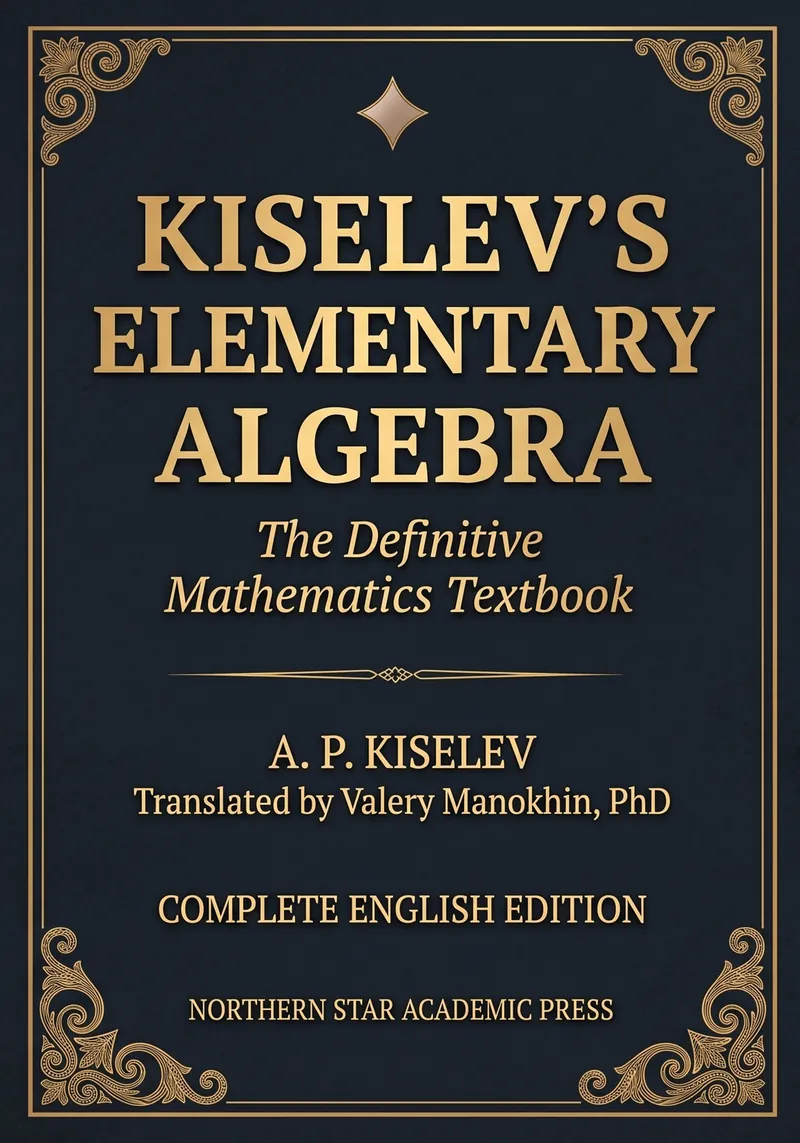
Kiselev's Elementary Algebra
by A. P. Kiselev
Translated by Valery Manokhin, PhD
The single-volume algebra course, covering in one book essentially what Algebra Part I and Part II cover between them. Concepts arrive in a deliberate order, rules are tied to the operations that justify them, and proof is treated as part of elementary education rather than an ornament. Keeps hand extraction of cube roots, indeterminate multipliers and compound interest; omits the functions-and-graphs material of the two-part course.
· 292 pages
Where this fits in school — US, UK and Canada ↓Adults and self-learners welcome — great mathematics has no age limit.
Where this fits in school
Full curriculum table — every book by school year →| United States | 7–11 | Algebra 1 and Algebra 2 as a skills spine — not a standalone course |
|---|---|---|
| England | Years 8–12 | KS3 → GCSE Higher algebra strand → AS Pure |
| Canada (Ontario) | Ontario 8–11 | supports MTH1W · MPM2D · the algebra of MCR3U |
Not covered in this book
graphs and the function concept · coordinate geometry · exercises — this volume is exposition only · statistics and data handling · probability
Source these strands elsewhere. They are missing from the book, not from this description.
How this book fits
See the whole sequence →Work through first
- Kiselev's Arithmetic$44.95
Covers much of the same ground
Malinin and Burenin's is the course and its problem book in one 458-page volume — 429 numbered articles, more than 3,300 problems, 2,698 answers — where this volume has no exercises. It adds chapters on limits and series. Neither carries functions or graphs.
- Bugaev's Algebra$64.95
Bugaev's covers the same course in 287 pages and 160 numbered sections, and closes with more than 400 numbered review questions where this volume has no exercises. Neither carries functions or graphs.
Rashevsky's covers the same course in 272 pages and 308 numbered articles and teaches it through graphs — first- and second-degree functions and complex numbers on the plane, in 49 figures. It has six short exercise sets, without answers, and no continued fractions or indeterminate equations.
- Davidov's Algebra$59.95
Davidov's is the whole course in one 509-page volume, 478 numbered articles, and it prints full solutions to its problems — this volume has no exercises. Neither carries functions or graphs.
- Kiselev's Algebra II$54.95
Part II carries coordinates, the function concept and graphs. This volume has none of them anywhere in its 292 pages, so the two are not interchangeable for a modern course.
- Kiselev's Algebra I$44.95
Part I covers the same first-course algebra and brings 239 graded exercises with answers. This volume is exposition only — it has no exercises.
These overlap heavily. Each note says what that book has which this one does not — the differences are what decide between them.
Problems to work alongside it
- Barsukov's Algebra$54.95
What comes next
- Derzhavin's Trigonometry$54.95
- Rashevsky's Trigonometry$39.95
Further reading
- Fuss's Algebra$54.95
A historical text to read beside the course, not a substitute for it.
Table of contents
17 section headings — the printed contents page in full.
Translator's Note
Section I. Preliminary Concepts
1. Algebraic Sign Notation
2. Principal Properties of the First Four Operations
3. Monomial and Polynomial
4. Reduction of Like Terms
Section II. The First Four Algebraic Operations
1. Algebraic Addition and Subtraction
2. Negative Number and Zero
3. Algebraic Multiplication
4. Multiplication of Negative Numbers
5. Multiplication of Arranged Polynomials
6. Special Cases of Multiplying Binomials
7. Algebraic Division
8. Some Cases of Division of Polynomials
9. Factoring Polynomials
10. Algebraic Fractions
11. Negative Exponents
12. Ratio and Proportion
Section III. First-degree Equations
1. General Principles for Solving Equations
2. Equations Containing Unknowns in Denominators
3. Equation with One Unknown
4. Two Equations with Two Unknowns
5. Three Equations with Three Unknowns
6. Equations with Many Unknowns
7. Special Cases of Systems of Equations
8. Method of Indeterminate Multipliers
9. Indeterminate, Inconsistent, and Conditional Equations
10. Investigation of First-degree Equations2 sections
- One Equation with One Unknown
- System of Two Equations with Two Unknowns
Section IV. Powers and Roots
1. Raising Monomials to a Power
2. Squaring Polynomials
3. Extracting a Root from a Monomial
4. Extracting the Square Root of the Greatest Whole Square Contained in a Given Number3 sections
- Extracting Approximate Square Roots
- Extracting Square Roots of Fractions
- Extracting the Square Root of a Polynomial
5. Extracting the Cube Root of the Greatest Whole Cube Contained in a Given Number2 sections
- Extracting Approximate Cube Roots
- Extracting Cube Roots of Fractions
6. The Notion of an Incommensurable Number
7. Operations with Radicals
Section V. Equations of Degree Higher than the First
1. Quadratic Equation
2. Some Special Cases of Quadratic Equations
3. Investigation of the Quadratic Equation
4. Complex Numbers
5. Freeing an Equation from Radicals
6. Higher-degree Equations Reducible to Quadratic Equations or to First-degree Equations
7. Some Remarks on Algebraic Equations
8. System of Second-degree Equations
Section VI. Inequalities and Indeterminate Equations
1. Inequalities
2. Indeterminate First-degree Equation with Two Unknowns
3. Two First-degree Equations with Three Unknowns
Section VII. Generalization of the Notion of Exponents1 section
- Fractional Exponents
Section VIII. Progressions and Logarithms
1. Progressions3 sections
- Arithmetic Progression
- Geometric Progression
- Infinite Geometric Progression
2. Logarithms6 sections
- Preliminary Concepts
- Logarithm of a Product, Quotient, Power, and Root
- Common Logarithms
- Construction and Use of Tables
- Exponential and Logarithmic Equations
- Compound Interest, Term Payments, and Periodic Instalments
Section IX. Additions
1. Combinations
2. Newton's Binomial
3. One Application of Newton's Binomial
4. Continued Fractions
5. Some Applications of Continued Fractions
6. Greatest and Least Value of a Quadratic Trinomial
Formats and editions
| Format | Price | ISBN-13 | Where | Buy |
|---|---|---|---|---|
| Paperback | $69.95 | 978-1-919012-68-1 | Amazon | Buy → |
| Hardcover | $109.95 | 978-1-919012-69-8 | Amazon | Buy → |
Prices are the publisher list prices. Amazon sets the final price in each store.
Product details
- Publisher
- Northern Star Academic Press
- Language
- English
- Translator
- Valery Manokhin, PhD
- Print length
- 292 pages
- First published
- 2026-09-08
Published by Northern Star Academic Press · First faithful English translation from the original Russian edition
More in This Series
Kiselev's Arithmetic
by A. P. Kiselev
US grades 4–7 · UK Years 5–8
The foundational arithmetic textbook used in Russian schools for over a century. 6 parts, 214 sections. Whole numbers through proportional quantities, with mathematical proofs for every operation.
Kiselev's Algebra I
by A. P. Kiselev
US grades 7–9 · UK Years 8–10
6 chapters, 126 sections, 239 exercises. From relative numbers and polynomials through first-degree equations, powers, roots, and quadratics.
Kiselev's Algebra II
by A. P. Kiselev
US grades 9–12 · UK Years 10–13
12 chapters plus Supplements, 187 sections. Functions, quadratic systems, inequalities, logarithms, progressions, complex numbers, the binomial theorem, and continued fractions.