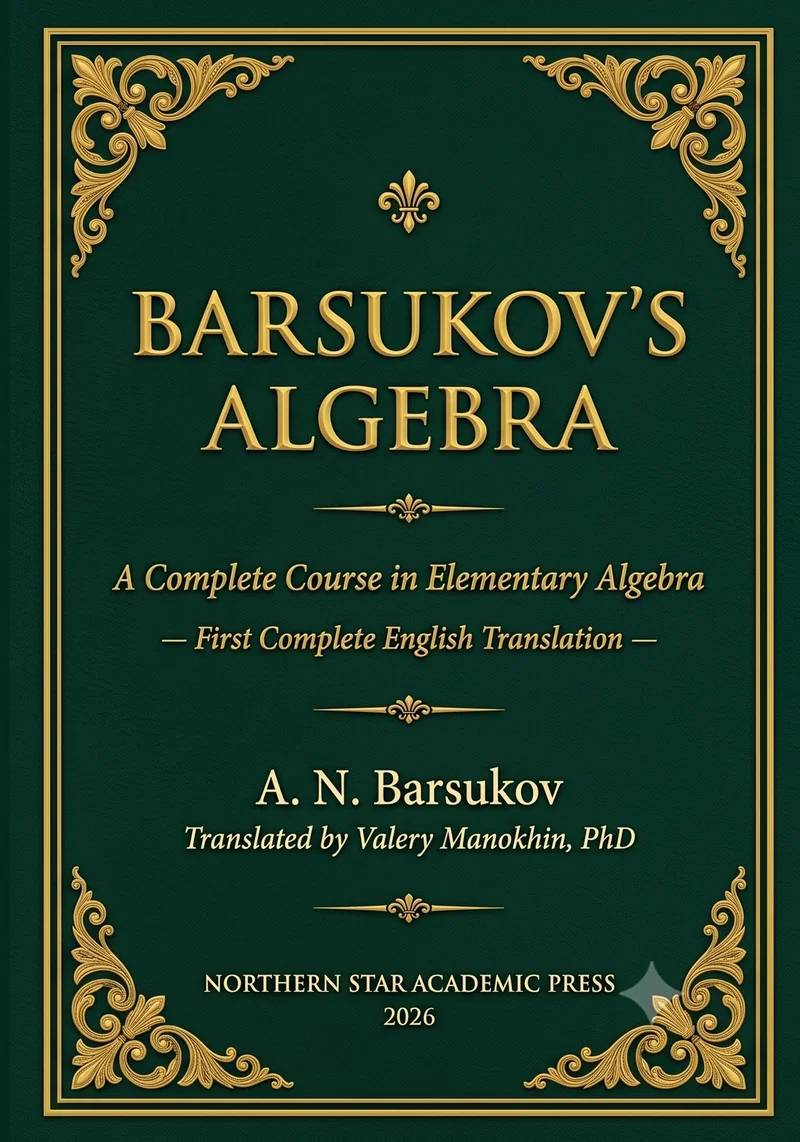
Barsukov's Algebra
by A. N. Barsukov
Translated by Valery Manokhin, PhD
The Soviet school's standard algebra textbook — ten editions, roughly ten million copies. The first complete, faithful English translation of Barsukov's course, prepared from the original Russian and typeset to modern standards with source-exact section numbering. Twelve chapters, 130 numbered sections: from algebraic expressions and rational numbers through factoring, algebraic fractions, coordinates and graphs, systems of equations, the square root worked digit-by-digit, quadratic equations, and functions and graphs. Includes a full chapter on the slide rule — a subject once central to technical education, almost never found in a modern Western algebra text.
12 chapters · 130 numbered articles
Where this fits in school — US, UK and Canada ↓ Adults and self-learners welcome — great mathematics has no age limit.
Where this fits in school
Full curriculum table — every book by school year →| United States | 8–10 | Algebra 1 in full, plus the quadratic-function half of Algebra 2 |
|---|---|---|
| United Kingdom | Years 9–11 | GCSE Foundation and Higher — covers the algebra strand almost completely |
| Canada | Ontario 9–11 | MTH1W + MPM2D, quadratics reaching MCR3U · BC Math 9, FMP 10, Pre-Calc 11 |
Not covered in this book
statistics and data handling · probability · graphs of the trigonometric functions and radian measure
Source these strands elsewhere. They are missing from the book, not from this description.
How this book fits
See the whole sequence →Problems to work alongside it
- Elementary Algebra$69.95
- Kiselev's Algebra I$44.95
Table of contents
130 section headings — the printed contents page in full.
Algebraic Expressions6 sections
- Use of Letters
- Algebraic Expressions
- Permissible values of letters
- Order of Operations
- The Fundamental Laws of Addition and Multiplication
- Brief Historical Information
Rational Numbers21 sections
- Positive and Negative Numbers
- Number Line
- Opposite Numbers
- Absolute Value of a Number
- Comparison of rational numbers
- Addition of Rational Numbers
- Addition of several numbers
- Laws of Addition
- Subtraction of Rational Numbers
- Algebraic sum
- Multiplication
- Multiplication of Several Numbers
- Laws of Multiplication
- Division
- Properties of Division
- Raising to a Power
- Order of Performing Operations
- Equations
- Solving Problems by Means of Equations
- Graphs
- Brief Historical Information
Operations on Integral Algebraic Expressions18 sections
- Monomial and polynomial
- Identities and Identical Transformations
- Coefficient
- Arranged polynomials
- Combining Like Terms
- Addition of monomials and polynomials
- Opposite Polynomials
- Subtraction of monomials and polynomials
- Multiplication of monomials
- Multiplication of a polynomial by a monomial
- Multiplication of polynomials
- Multiplication of arranged polynomials
- Raising monomials to a power
- Formulas for abbreviated multiplication
- General remarks on the division of integral algebraic expressions
- Division of monomials
- Division of a polynomial by a monomial
- Examples of solving equations
First-Degree Equations8 sections
- General information
- Equivalent Equations
- Two fundamental properties of equations
- Equations containing the unknown in both sides
- Linear Equation with One Unknown
- General instructions for solving equations
- Solving problems by means of equations
- Brief Historical Information
Factoring Polynomials6 sections
- The Concept of Factoring
- Factoring Out a Common Factor
- The grouping method
- Application of the formulas of abbreviated multiplication
- Application of Several Methods
- Division of polynomials by means of factorization
Algebraic Fractions12 sections
- The Concept of an Algebraic Fraction
- The Fundamental Property of a Fraction and Reduction of Fractions
- Changing the Sign of the Terms of a Fraction
- Negative integer and zero powers of a number
- Reducing fractions to a common denominator
- Addition of Fractions
- Subtraction of fractions
- Multiplication of fractions
- Division of Fractions
- Raising a Fraction to a Natural Power
- Fractional equations
- Examples of solving equations with literal coefficients
Coordinates and Simplest Graphs5 sections
- Coordinates of a Point on the Plane
- Directly proportional dependence
- Graph of a Directly Proportional Dependence
- Linear dependence
- Inversely proportional dependence
Systems of First-Degree Equations8 sections
- Equation of the first degree with two unknowns
- A system of two first-degree equations with two unknowns
- Equivalent systems
- Solving systems of equations
- Graphical solution of a system of two equations
- Solving problems
- An Equation with Three Unknowns
- A system of three equations with three unknowns
The Slide Rule (Logarithmic Ruler)4 sections
- Uniform and non-uniform scales
- Construction of the calculating (logarithmic) slide rule
- The Main Scale
- Multiplication and division by means of the slide rule
The Square Root12 sections
- Construction of the graph of the dependence y=x^2
- Calculation of squares of numbers from tables and by means of the slide rule
- The Concept of Extracting a Root
- Arithmetic root
- Approximate square root of a positive number
- Graph of the relation y= x
- Extraction of the square root from whole numbers
- Extraction of the root to an accuracy of 0.1; 0.01; etc
- The square root of a product, fraction, and power
- Simplest transformations
- Extraction of the square root by tables and by means of the slide rule
- Brief Historical Information
Quadratic Equations13 sections
- Quadratic equations
- Equation of the form ax^2+bx=0
- An Equation of the Form ax^2+c=0
- Reduced quadratic equation
- Quadratic Equation of the General Form
- Discriminant
- Graphical solution of a quadratic equation
- Solution of problems leading to quadratic equations
- Vieta's Theorem
- Investigation of the roots of a quadratic equation
- Factorization of a quadratic trinomial into factors
- Systems of two equations, of which one is of the second degree and one of the first degree
- Brief Historical Information
Functions and Graphs17 sections
- Variable quantities
- Concept of Functional Dependence
- Argument and function
- Ways of Specifying a Function
- The Function y=kx
- Linear Function
- Quadratic trinomial
- Graph of the function y = x^2 + n
- Graph of the function y=(x+m)^2
- Graph of the trinomial y=x^2+px+q
- Graph of the trinomial y=ax^2+bx+c
- Increase and decrease of a quadratic trinomial
- The function y=x^3 and its graph
- The Concept of the Cube Root
- Approximate extraction of the cube root
- Graph of the function y= [3]x
- Examples of the graphical solution of equations and systems of equations
Formats and editions
| Format | Price | ISBN-13 | Where | Buy |
|---|---|---|---|---|
| $54.95 | — | Gumroad · Instant download | Buy → | |
| Kindle | $59.95 | — | Amazon | Buy → |
| Paperback | $59.95 | 978-1-919012-11-7 | Amazon | Buy → |
| Hardcover | $94.95 | 978-1-919012-12-4 | Amazon | Buy → |
Prices are the publisher list prices. Amazon sets the final price in each store.
Product details
- Publisher
- Northern Star Academic Press
- Language
- English
- Translator
- Valery Manokhin, PhD
- First published
- 2026-07-12
Published by Northern Star Academic Press · First faithful English translation from the original Russian edition
More in This Series
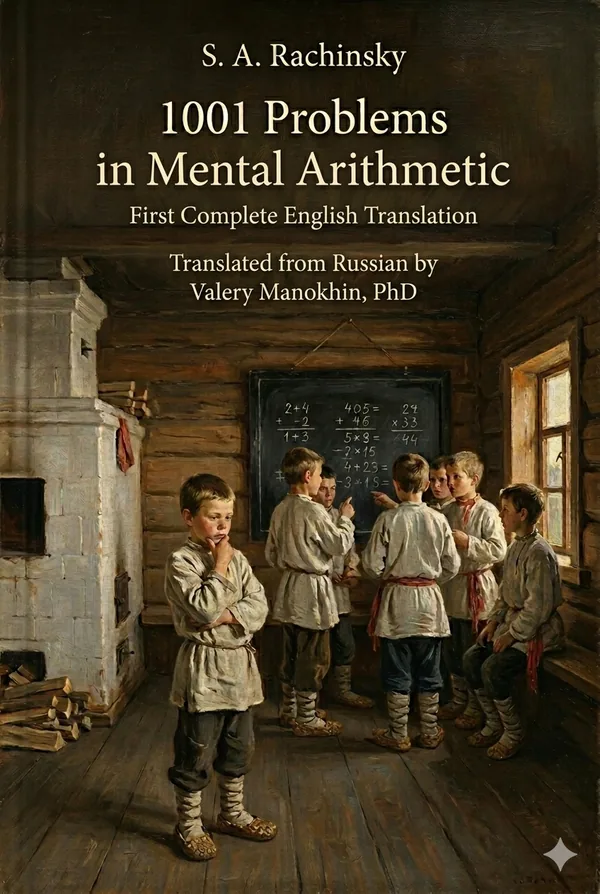
Rachinsky's 1001 Problems
by S. A. Rachinsky
US grades 4–8 · UK Years 5–9
1,001 carefully selected problems from the village schoolteacher whose students were depicted in Bogdanov-Belsky's famous 1895 painting "Mental Arithmetic."
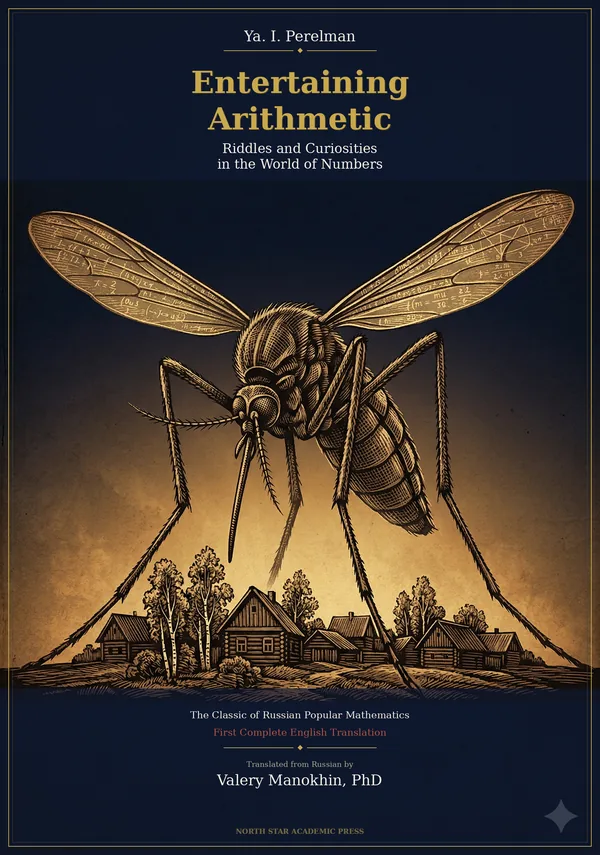
Perelman's Entertaining Arithmetic
by Ya. I. Perelman
US grades 4+ · UK Year 5+
The classic of Russian popular mathematics. Puzzles, riddles, and curiosities that make arithmetic genuinely entertaining.
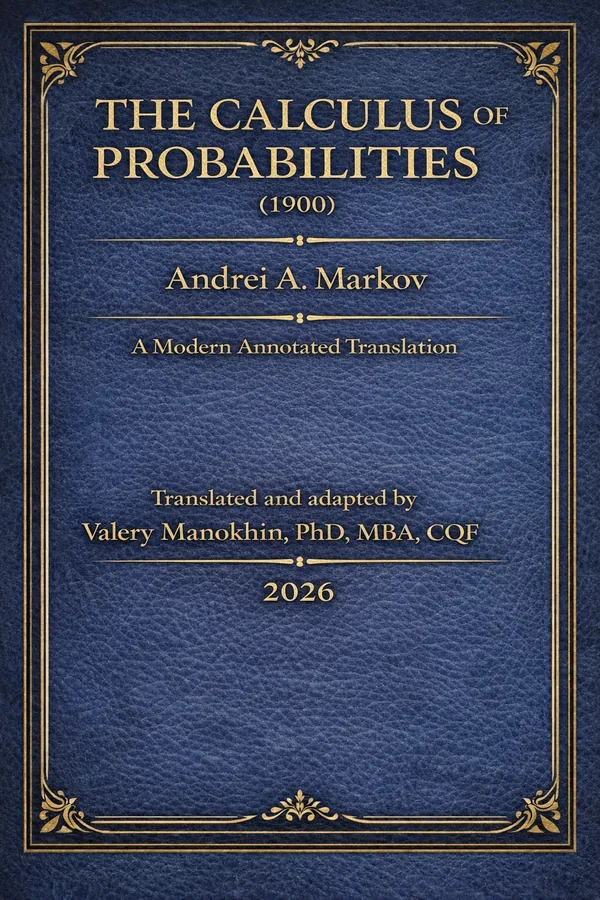
Markov: Probabilities
by Andrei A. Markov
US grades 12 and university · UK Year 13 and university
The foundational 1900 work on probability theory by the mathematician who gave us Markov chains. A modern annotated English translation.