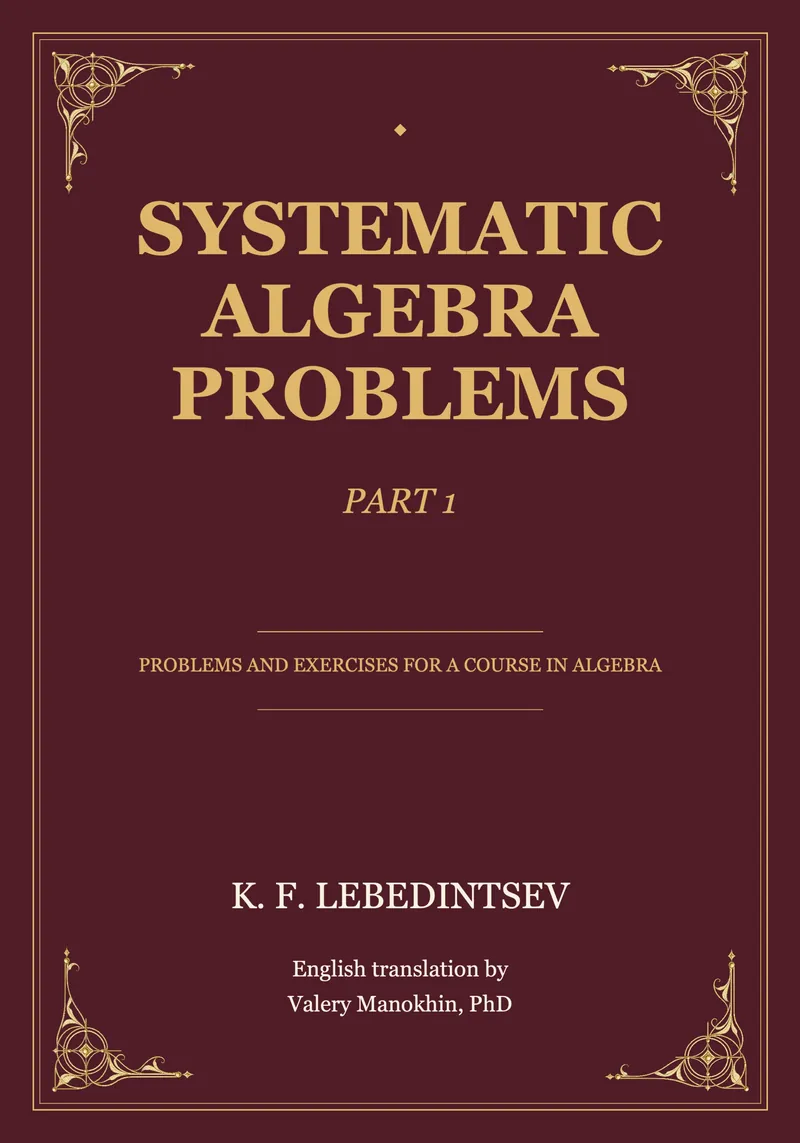
Lebedintsev's Systematic Algebra Problems, Part I
by K. F. Lebedintsev
Translated by Valery Manokhin, PhD
A graded collection of 1,637 problems for the first course in algebra, in first faithful English translation from the original Russian edition. Five divisions and sixty numbered sections lead from general formulas built out of arithmetic problems, coefficients, exponents and roots; through negative numbers, zero and coordinates on a line; the operations on integral and fractional expressions, factoring, the greatest common divisor and least common multiple, and zero and negative exponents; equations and inequalities of the first degree, proportions, and systems in two and three unknowns, with long runs of word problems from trade, travel, work and physics; to points and straight lines on the coordinate plane, functions of the first order and their graphs, and graphs of uniform change. No answers are printed: the author held that a pupil should check his own work.
5 chapters · 60 numbered articles · 1637 exercises · 140 pages
Where this fits in school — US, UK and Canada ↓ Adults and self-learners welcome — great mathematics has no age limit.
Where this fits in school
Full curriculum table — every book by school year →| United States | 7–9 | Problem companion to Pre-Algebra → Algebra 1 (linear graphs included; no quadratics) |
|---|---|---|
| United Kingdom | Years 8–10 | KS3 → GCSE Foundation and Higher |
| Canada | Ontario 7–9 | Grade 7–8 math → MTH1W · BC Math 8–9 · QC Secondary I–III |
Not covered in this book
statistics and data handling · probability · metric units — some problems use old Russian measures (versts, sazhens, arshins, poods)
Source these strands elsewhere. They are missing from the book, not from this description.
How this book fits
See the whole sequence →Problems to work alongside it
- Elementary Algebra$69.95
- Barsukov's Algebra$54.95
- Kiselev's Algebra I$44.95
Table of contents
60 section headings — the printed contents page in full.
Translator's Note
Division I. Introduction7 sections
- § 1. Formation of general formulas from particular ones
- § 2. Formation of general formulas from the conditions of problems, with computation of the numerical values of the results obtained
- § 3. Expression of general truths of arithmetic in the form of formulas
- § 4. Formation of problems for given general formulas
- § 5. Coefficient and exponent
- § 6. The concept of a root
- § 7. Representation and reading of algebraic expressions and formulas in connection with the computation of numerical values
Division II. The first four operations on explicit quantities8 sections
- § 1. The concept of a negative number and of zero
- § 2. Addition of algebraic numbers
- § 3. Subtraction of algebraic numbers
- § 4. Multiplication of algebraic numbers
- § 5. Division of algebraic numbers
- § 6. Raising algebraic numbers to a power
- § 7. Operations with zero
- § 8. The concept of coordinates determining the position of a point on a line. Its application to the calculation of relative distances and intervals of time
Division III. The first four operations on explicit quantities (not containing roots)25 sections
- § 1. Preliminary concepts
- § 2. Addition of monomials
- § 3. Addition of polynomials with monomials and polynomials
- § 4. Subtraction of monomials
- § 5. Subtraction of polynomials
- § 6. Transformation of a polynomial into the sum or difference of two quantities
- § 7. Multiplication of monomials
- § 8. Multiplication of a polynomial by a monomial, and conversely
- § 9. Change of sign of an implicit algebraic quantity
- § 10. Multiplication of a polynomial by a polynomial
- § 11. Division of monomials
- § 12. Division of a polynomial by a monomial
- § 13. Division of a polynomial by a polynomial
- § 14. Special cases of multiplication and division
- § 14a. Exercises on all operations with integral quantities
- § 15. Factoring polynomials
- § 16. The concept of entirely integral, prime, composite, and relatively prime expressions
- § 17. Finding the greatest common divisor and the least common multiple
- § 18. Reduction of the simplest implicit fractions to normal form. Cancellation of fractions
- § 19. Reduction of fractions to a common denominator
- § 20. Addition and subtraction of fractions with each other and with integral quantities
- § 21. Multiplication of fractions with each other and with integral quantities
- § 22. Division of fractions by one another and by integral quantities
- § 23. Reduction of any fraction to normal form. Operations on fractional polynomials
- § 24. Operations on quantities with zero and negative exponents
Division IV. The study of equalities and inequalities of the first degree14 sections
- § 1. The concept of explicit and implicit, conditional and unconditional equalities
- § 2. Formation of the simplest equations from the conditions of problems and their solution (by reasoning)
- § 3. The theory of proportions
- § 4. Classification of equations
- § 5. Solution of equations of the first degree in one unknown
- § 6. Application of equations of the first degree with one unknown to the solution of problems
- § 7. Investigation of the meaning of the results obtained in solving equations of the first degree with one unknown
- § 8. Equations of the first degree with two unknowns
- § 9. Solving problems by setting up a system of equations of the first degree with two unknowns
- § 10. Investigation of the meaning of the results obtained in solving a system of two equations of the first degree with two unknowns
- § 11. Equations with three or more unknowns
- § 12. Application of first-degree equations with three unknowns to the solution of problems
- § 13. Application of the fundamental properties of affirmative inequalities
- § 14. Interrogative inequalities of the first degree with one unknown
Division V. Functions of the first order and their graphical representation6 sections
- § 1. Construction of points on a plane from their given coordinates
- § 2. Construction of straight lines from their given equations, and formation of equations determining given straight lines
- § 3. Graphical representation of the solution of equations of the first degree with one and two unknowns
- § 4. The concept of constant and variable quantities, of independent variables and functions
- § 5. Investigation of the changes of functions of the first order in one independent variable
- § 6. Application of rectilinear graphs to questions concerning uniform change
Formats and editions
| Format | Price | ISBN-13 | Where | Buy |
|---|---|---|---|---|
| Paperback | $49.95 | 978-1-919012-96-4 | IngramSpark · direct | Buy → |
| Paperback | $49.95 | 978-1-919012-96-4 | Amazon (via Ingram) | Buy → |
| Hardcover | $69.95 | 978-1-80910-052-8 | IngramSpark · direct | Buy → |
| Hardcover | $69.95 | 978-1-80910-052-8 | Amazon (via Ingram) | Buy → |
Prices are the publisher list prices. Amazon sets the final price in each store.
IngramSpark prints and ships direct orders to the US, UK and Australia. Libraries, schools and bookshops can order the same ISBNs through Ingram: ordering for libraries →
Product details
- Publisher
- Northern Star Academic Press
- Language
- English
- Translator
- Valery Manokhin, PhD
- Print length
- 140 pages
- First published
- 2026-10-12
Published by Northern Star Academic Press · First faithful English translation from the original Russian edition
More in This Series
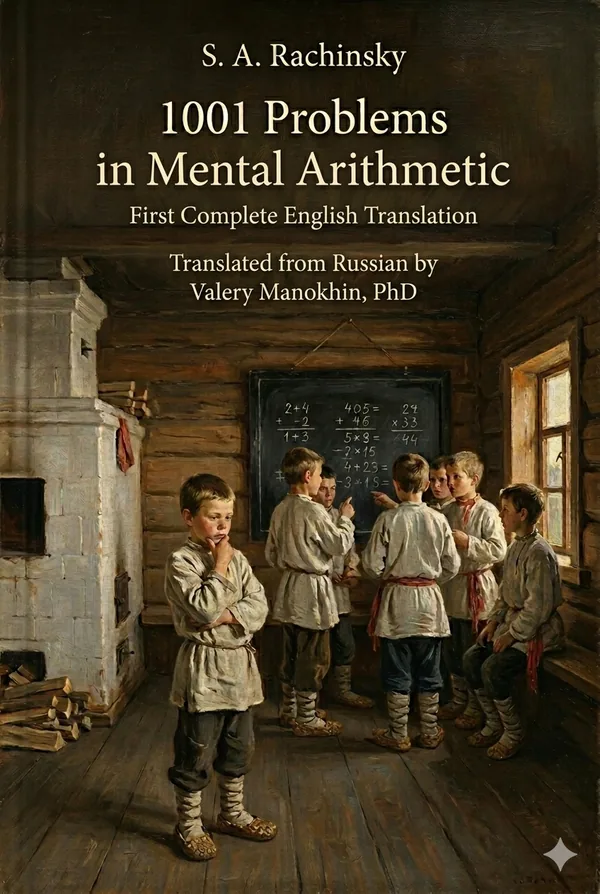
Rachinsky's 1001 Problems
by S. A. Rachinsky
US grades 4–8 · UK Years 5–9
1,001 carefully selected problems from the village schoolteacher whose students were depicted in Bogdanov-Belsky's famous 1895 painting "Mental Arithmetic."
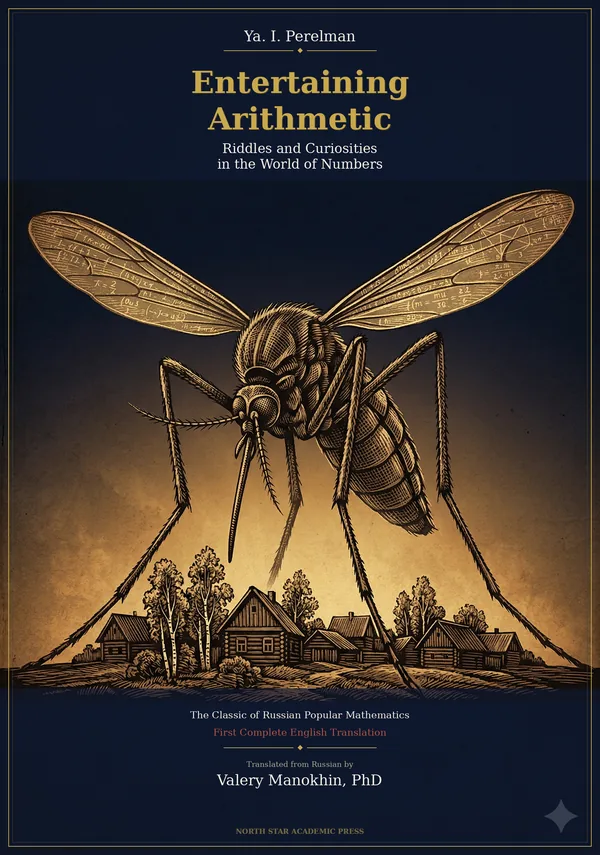
Perelman's Entertaining Arithmetic
by Ya. I. Perelman
US grades 4+ · UK Year 5+
The classic of Russian popular mathematics. Puzzles, riddles, and curiosities that make arithmetic genuinely entertaining.
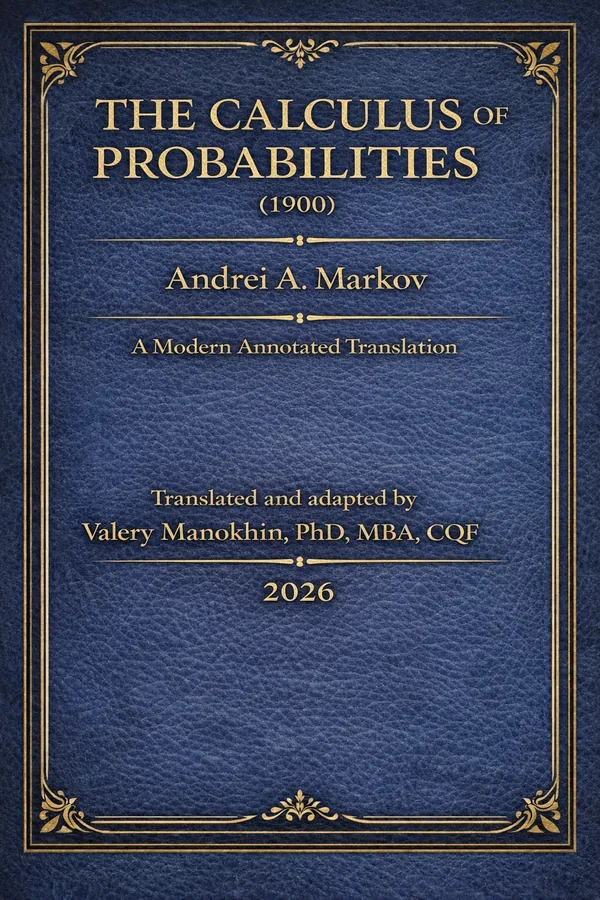
Markov: Probabilities
by Andrei A. Markov
US grades 12 and university · UK Year 13 and university
The foundational 1900 work on probability theory by the mathematician who gave us Markov chains. A modern annotated English translation.