BooksGeometry
Geometry books
Kiselev’s plane and solid geometry, the other classic Russian geometry courses, and the problem books written to go with them. The courses prove every theorem.
14 booksNot sure which one? Where to start →
Geometry books: 14 books
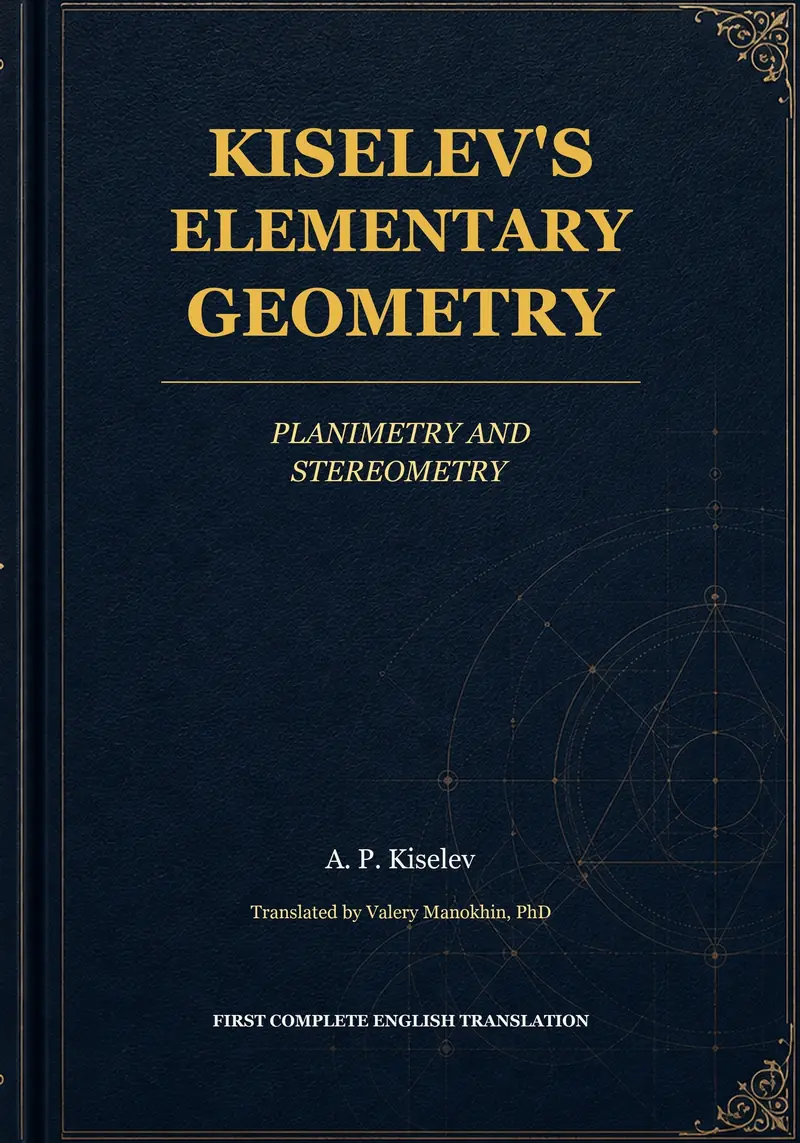
Kiselev's Elementary Geometry
by A. P. Kiselev
US grades 8–11 · UK Years 8–13
The complete geometry course — five books of plane geometry and three of solid geometry — in one English volume. Definitions are precise, theorems are proved, constructions are justified, and each idea is prepared by the one before it. 380 pages and 450 figures.
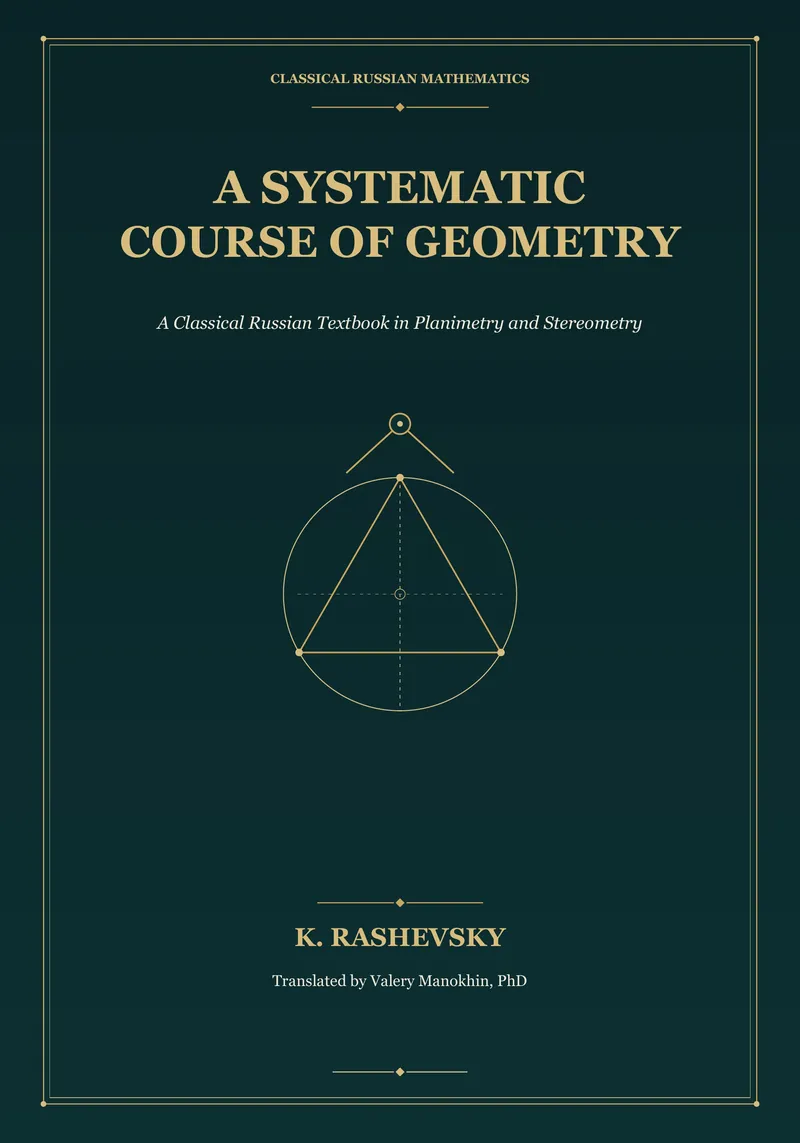
Rashevsky's Geometry
by K. N. Rashevsky
US grades 8–11 · UK Years 9–12
A complete school course in plane and solid geometry in one volume, in first faithful English translation from the original Russian edition. Two parts, thirty chapters and 406 numbered articles. The planimetry runs from the straight line, polygons and the circle through the three cases of equality of triangles, parallel lines, parallelograms and trapezoids and construction problems; the method of loci, parallel translation and rotation; ratio and common measure, angles in a circle, proportional segments, similarity and homothety; the basic trigonometric functions of the right triangle; regular polygons, areas, the concept of a limit, the circumference and area of the circle, and algebra applied to geometry. The stereometry covers the position of a plane, perpendicular and parallel lines and planes, dihedral and polyhedral angles, polyhedra and their volumes, the cylinder, cone and sphere, incommensurable quantities, and closes with practical work: making a plan and levelling. 338 figures and 367 exercises in ten graded sets.
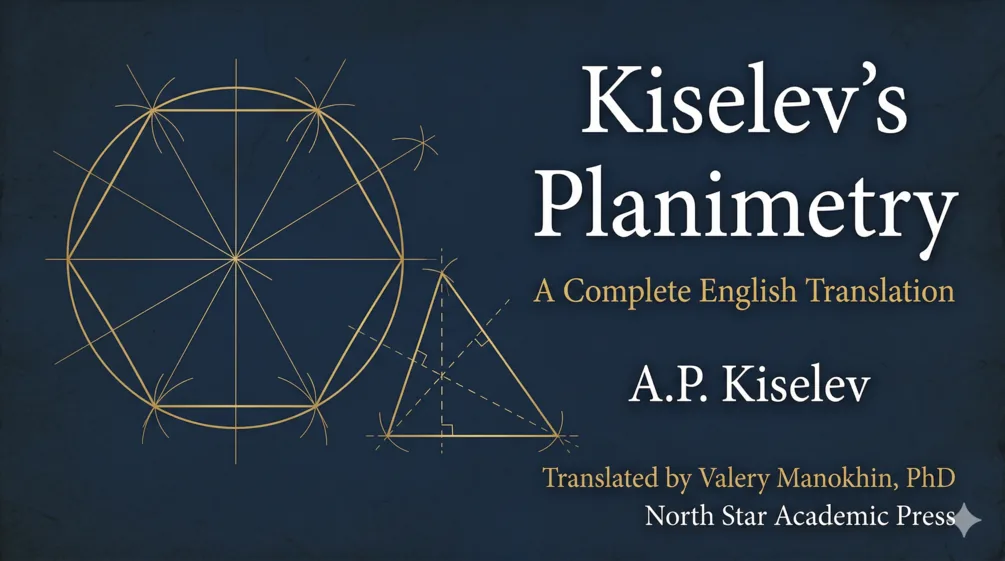
Kiselev's Planimetry
by A. P. Kiselev
US grades 8–10 · UK Years 8–11
The first complete English translation of Kiselev's proof-based Euclidean geometry. 269 sections across 6 chapters: basic concepts, triangles, circles, similarity, regular polygons, and areas. Digital edition, paperback and hardcover.
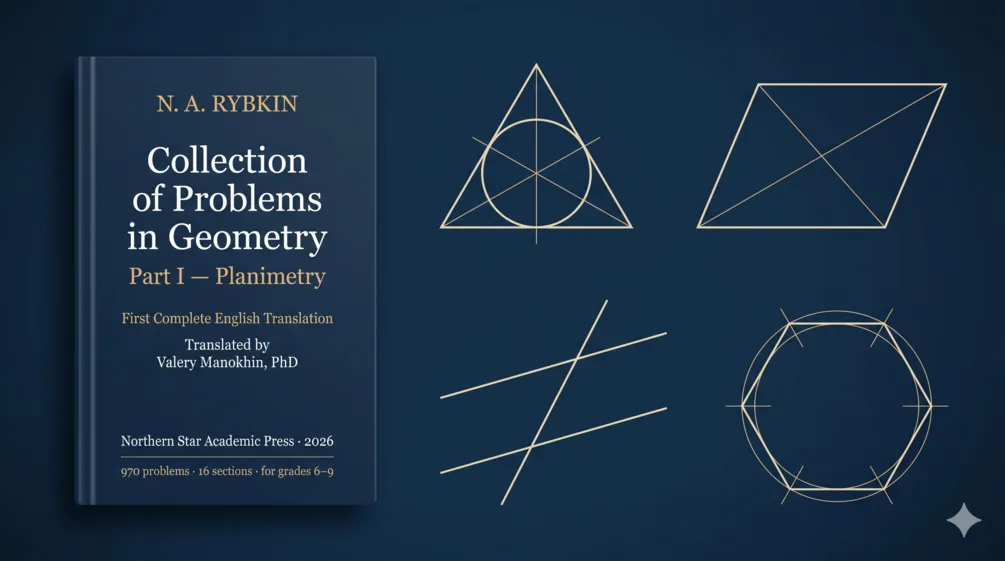
Rybkin's Planimetry Problems
by N. A. Rybkin
US grades 8–11 · UK Years 9–12
The companion problem collection to Kiselev's classical Russian geometry — now in English for the first time. Rybkin's Planimetry Problems is the set Russian students worked through alongside Kiselev's geometry textbook for over a century. Kiselev gives the definitions, theorems, and proofs; Rybkin gives the problems that turn those proofs into geometric intuition. 970 problems across 16 sections, organised chapter-by-chapter to mirror Kiselev's Planimetry — from preliminary concepts and lines through triangles, quadrilaterals, similar figures, the circle, regular polygons, and the measurement of areas. Worked solutions for the harder problems, hints for the rest.
Delone: Geometry Problems
by B. N. Delone, O. K. Zhitomirsky & A. I. Fetisov
US grades 10–12 + · UK Years 11–13
85 problems with full solutions, from three mathematicians who wrote for students who wanted to be stretched. Construction, loci, congruence, similarity, areas and geometry in space — with each solution showing how to analyse a construction, carry it out, prove it correct and establish when it exists. Includes the Simson line, homothety, regular polyhedra, and the common part of a cube and a rotated copy of itself. 75 figures.
Kiselev's Stereometry
by A. P. Kiselev
US grades 9–11 · UK Years 10–13
Kiselev's three-dimensional geometry text — the first complete English translation. Polyhedra, the five Platonic solids, cylinders, cones, the ball, and Cavalieri's principle.
Kvasnikova's Stereometry Problems
by Z. Ya. Kvasnikova, A. I. Pospelov, E. N. Yermolayeva & N. M. Kalitkin
US grades 10–12 · UK Years 11–13
A graded problem book for the whole of solid geometry, in first faithful English translation from the original Russian edition: 838 problems in 33 sections, numbered in one run from first to last, with an answer section. It begins with the axioms of stereometry and the relative position of lines and planes, then works through parallel and orthogonal projection, dihedral and polyhedral angles, prisms, pyramids and truncated pyramids, the regular polyhedra, cylinders, cones and truncated cones, the sphere, solids of revolution, inscribed and circumscribed spheres, and a closing mixed section. Five sets of practical exercises call for measurement and models. 54 figures.
Aleksandrov's Geometric Problems
by I. I. Aleksandrov
US grades 10–12 + · UK Years 11–13
A course in geometric construction organised by the idea that solves the problem, not by topic: direct constructions, geometric loci, similarity, symmetry, parallel translation, inversion, rotation and algebraic methods. Every problem is treated through analysis, construction, proof and discussion.
Fuss's Geometry
by N. I. Fuss
US grades 8–12 · UK Years 9–13
The geometry of Fuss's course of pure mathematics, the volume that follows his Algebra, in first complete English translation. Two parts, twelve chapters and 460 numbered sections. Planimetry: definitions and axioms; straight lines, angles and the sides of rectilinear figures; the circle and the figures inscribed in it and circumscribed about it; proportional lines and similar figures; the comparison and measurement of figures; the transformation and division of figures. Stereometry: the position of planes and of lines drawn outside them; the surface, comparison and volume of solids; and the five regular solids. 107 theorems with their proofs, 61 construction problems with their solutions and 158 corollaries. All 230 figures are reproduced on the nine engraved plates.
Perelman's Geometry
by Ya. I. Perelman
US grades 7–10 · UK Years 8–11
A practical course in plane and solid geometry for self-study, carried as far as the trigonometry of the right triangle, in first faithful English translation from the original Russian edition. Nine chapters: the straight line and the circle, with scales, circumferential speed, belts and gear wheels; angles and parallel lines, with the protractor; the triangle, its construction and the tests for equality; polygons and the parallelogram, with the vernier and slide calipers; chords, tangents, conjugation and the ellipse; similarity, Pythagoras’ rule and the square root; tangent, cotangent, sine and cosine, with their tables; areas, from the rectangle to the circle, the ellipse and irregular figures; and the surfaces, volumes and weights of solids. The main text rests on about forty theorems; 458 problems, about half the book, carry the rest, with solutions or answers to 423 of them. 230 figures.
Rybkin's Stereometry Problems
by N. Rybkin
US grades 10–12 · UK Years 11–13
The problem set Russian students worked through alongside Kiselev's geometry. 730 problems across 25 sections: perpendiculars and oblique lines to a plane, parallel lines and planes, dihedral and polyhedral angles, regular polyhedra, prisms, pyramids and frustums, cylinders, cones and the sphere, volumes and surface areas. Original numbering and all 46 figures retained.
Davidov's Geometry
by A. Yu. Davidov
US grades 8–11 · UK Years 9–12
The geometry course written by the founding president of the Moscow Mathematical Society, in first faithful English translation from the original Russian edition. Two parts, thirteen chapters and 305 numbered sections. The planimetry treats straight lines and angles; figures, the equality of triangles, perpendicular and oblique lines; parallel lines, parallelograms and trapezoids; similarity and the ratio of lines; the circle — chords and tangents, the measurement of angles, proportional lines, inscribed and circumscribed polygons, the relative position of two circles, the four remarkable points of a triangle, reciprocal points and polars; regular polygons; the measurement of areas, with the surveying of a plan; and the circumference and area of the circle by limits. The stereometry covers lines and planes in space; dihedral, polyhedral and trihedral angles; prisms, pyramids, symmetric and regular polyhedra; volumes; the cylinder, cone and sphere, the spherical triangle, and the conic sections. 344 figures and 256 problems, with solutions to all of them. A digital edition, read online in Gumroad Reader.
Raykovsky: Foundations of Geometry
by Stepan Raykovsky
US grades 9–12 · UK Years 10–13
A systematic course in plane and solid geometry, never before published in English. Definitions, axioms and postulates first; then 310 numbered articles building from the straight line to the sphere, each proposition proved and each construction carried out in full. Four divisions: straight lines in a plane, the line and the circle, measurement of plane figures, and the geometry of solids. All 157 figures reproduced from the five engraved plates.
Geometry Through Problems
by S. I. Shokhor-Trotsky
US grades 6–10 · UK Years 7–11
A complete school course in plane and solid geometry, written for the teacher and built from graded problems rather than ready-made theorems, in first faithful English translation from the original Russian edition. It opens with the author’s essay “To the Attention of the Teacher” on teaching by expedient problems, then runs in six chapters and eighteen numbered sections: the straight line, the angle and the arc; triangles, parallel lines and polygons, the length of the circumference and construction problems; areas of rectilinear figures and of the circle; the lateral surfaces of cylinders and cones and the surface of the sphere; lines and planes in space, dihedral and polyhedral angles, and projections of figures and solids onto a plane; and the volumes of prisms, cylinders, pyramids, cones and the sphere. 439 numbered problems with 251 lettered sub-problems, each with the teacher’s notes on how the class works it, answers given in the text, 398 drawings, the author’s alphabetical index and a selection of reviews. The numbers missing from the sequence belong to the companion pupils’ book, as the author explains.