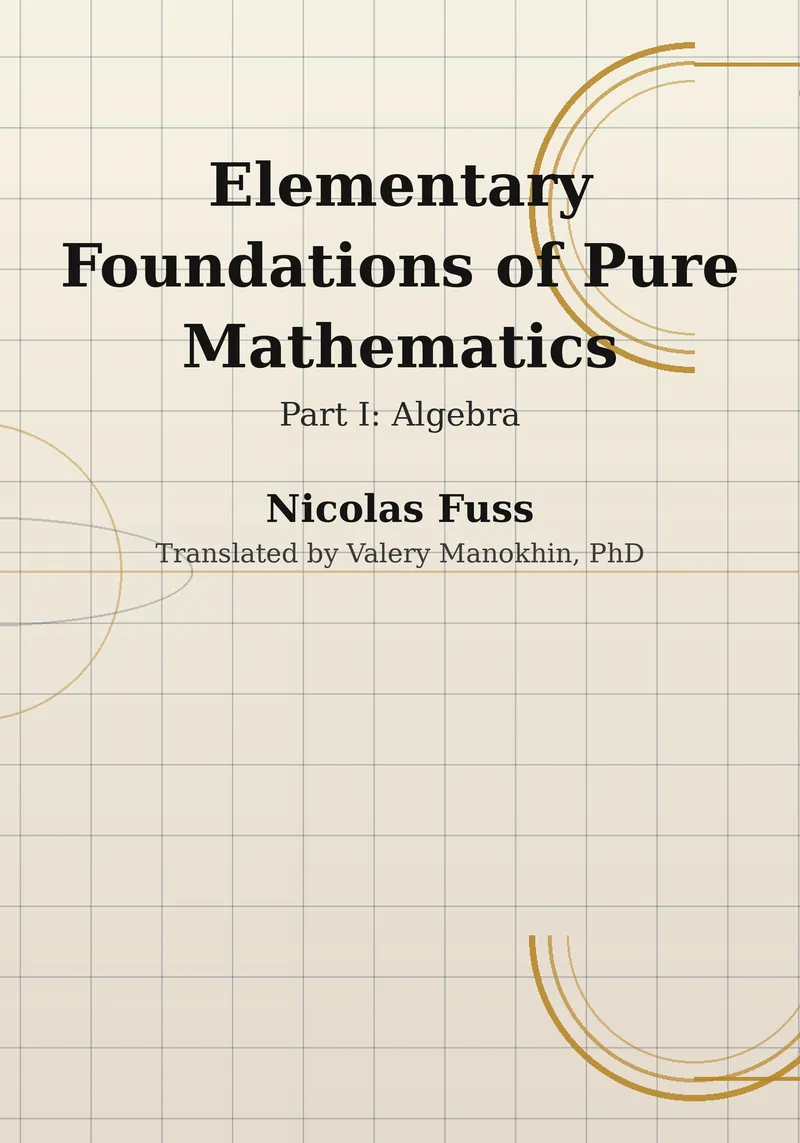
Fuss: Foundations of Pure Mathematics – Part I, Algebra
by N. I. Fuss
Translated by Valery Manokhin, PhD
The algebra course Euler's assistant wrote for the schools of the Russian Empire, in first complete English translation. Four divisions, 59 chapters and 570 numbered sections. Simple quantities: the four operations, common and decimal fractions, squares and square roots, irrational and imaginary numbers, cubes and cube roots, powers with fractional exponents, logarithms and the use of logarithmic tables. Compound quantities: the four operations, the resolution of fractions into infinite series, powers and roots of polynomials, the permutation of letters on which the binomial rule rests, and the expansion of irrational and negative powers into series. Equations of the first degree in one and several unknowns, indeterminate problems, equations of the second, third and fourth degree, and their approximate solution. Ratios, proportions, arithmetic and geometric progressions, and compound interest. Seventy questions are solved in full in the text; there are no exercise sets.
59 chapters · 570 numbered articles · 217 pages
Where this fits in school — US, UK and Canada ↓ Adults and self-learners welcome — great mathematics has no age limit.
Where this fits in school
Full curriculum table — every book by school year →| United States | 8–12 | A primary source, not a course — Algebra 1 and Algebra 2 content, with series and the quartic beyond both |
|---|---|---|
| United Kingdom | Years 9–13 | GCSE Higher → A-level Pure content; no qualification maps to it cleanly |
| Canada | Ontario 9–12 | historical reading beside MTH1W → MPM2D → MCR3U |
This book matches no modern course. It is worth reading for the mathematics; it will not put a mark on an exam paper.
Not covered in this book
graphs and the function concept · coordinate geometry · exercises — this volume is exposition only · statistics and data handling · probability
Source these strands elsewhere. They are missing from the book, not from this description.
How this book fits
See the whole sequence →What comes next
- Fuss's Geometry$44.95
Further reading
- Elementary Algebra$69.95
- Davidov's Algebra$59.95
- Kiselev's Algebra II$54.95
- Kiselev's Algebra I$44.95
A historical text to read beside the course, not a substitute for it.
Table of contents
59 section headings — the printed contents page in full.
Translator's Preface
Division I. On the different kinds of computation of simple or uncompounded quantities21 sections
- General concept of Algebra
- On the addition and subtraction of simple quantities
- On the multiplication of simple quantities
- On the division of simple quantities
- On fractions in general
- On the properties of fractions
- On the addition and subtraction of fractions
- On the multiplication and division of fractions
- On decimal fractions
- On square numbers
- On square roots and the irrational numbers arising from them
- On impossible or imaginary numbers
- On cubic numbers
- On cube roots and on the irrational numbers arising from them
- On powers in general
- On calculations with powers
- On roots of powers in general
- On the representation of irrational numbers by fractional exponents
- On Logarithms
- On logarithmic tables
- On the use of logarithms
Division II. On the methods of calculating compound or complex quantities12 sections
- On the addition of compound quantities
- On the subtraction of compound quantities
- On the multiplication of compound quantities
- On the division of compound quantities
- On the resolution of fractions into infinite series
- On the squares of compound quantities
- On the extraction of square roots from compound quantities
- On cubes and the extraction of cube roots
- On the higher powers of compound quantities
- On the permutation of letters, on which the proof of the preceding rule is based
- On the expansion of irrational powers into infinite series
- On the expansion of negative powers
Division III. On algebraic equations and their solution15 sections
- On the solution of problems in general
- On the solution of equations of the first degree
- On the solution of certain questions relating to the preceding chapter
- On the solution of equations of the first degree containing two or more unknown quantities
- On the solution of indeterminate problems of the first degree
- On the solution of pure equations of the second degree
- On the solution of complete equations of the second degree
- Discussions on the properties of equations of the second degree
- On the solution of pure equations of the third degree
- On the solution of complete equations of the third degree
- On the solution of equations of the third degree having irrational roots
- On the solution of incomplete equations of the fourth degree
- On the solution of complete equations of the fourth degree
- On the solution of equations of the fourth degree by means of equations of the third degree
- On the approximate solution of equations
Division IV. On ratios, proportions, and arithmetic and geometric progressions11 sections
- On the arithmetical ratio
- On arithmetical proportions
- On arithmetic progressions
- On finding the sum of an arithmetic progression
- On geometrical ratio
- On the reduction of geometrical ratios to their smallest terms
- On compound ratios
- On geometric proportions
- On geometric progressions
- On finding the sum of geometric progressions
- Application of geometric proportions and progressions to the computation of compound interest and to other questions of this kind
Formats and editions
| Format | Price | ISBN-13 | Where | Buy |
|---|---|---|---|---|
| Paperback | $54.95 | 978-1-80910-005-4 | Amazon | Buy → |
| Hardcover | $94.95 | 978-1-80910-006-1 | Amazon | Buy → |
Prices are the publisher list prices. Amazon sets the final price in each store.
Product details
- Publisher
- Northern Star Academic Press
- Language
- English
- Translator
- Valery Manokhin, PhD
- Print length
- 217 pages
- First published
- 2026-09-22
Published by Northern Star Academic Press · First faithful English translation from the original Russian edition
More in This Series
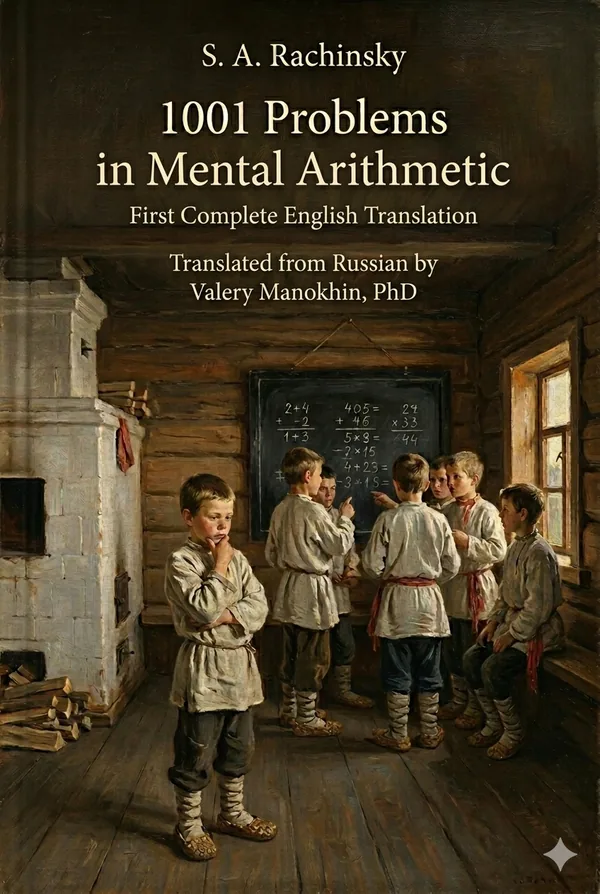
Rachinsky's 1001 Problems
by S. A. Rachinsky
US grades 4–8 · UK Years 5–9
1,001 carefully selected problems from the village schoolteacher whose students were depicted in Bogdanov-Belsky's famous 1895 painting "Mental Arithmetic."
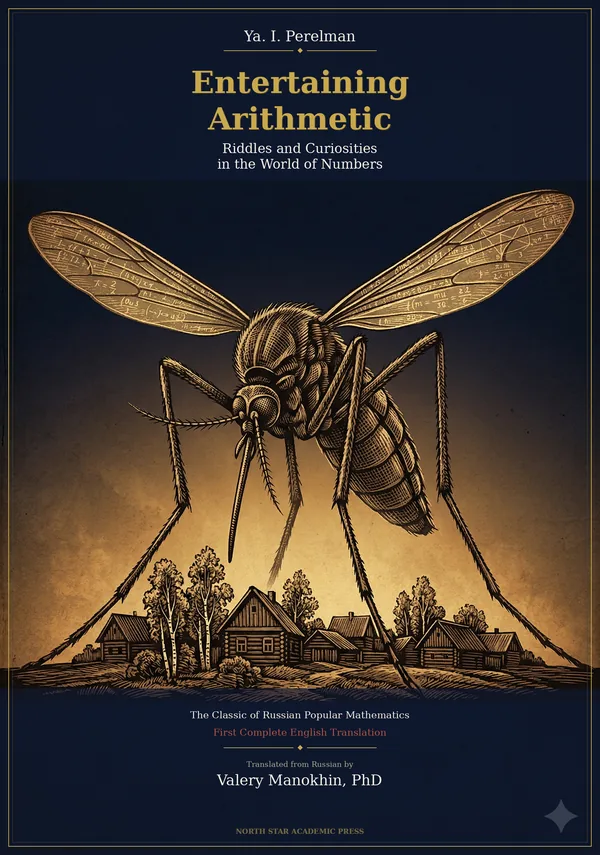
Perelman's Entertaining Arithmetic
by Ya. I. Perelman
US grades 4+ · UK Year 5+
The classic of Russian popular mathematics. Puzzles, riddles, and curiosities that make arithmetic genuinely entertaining.
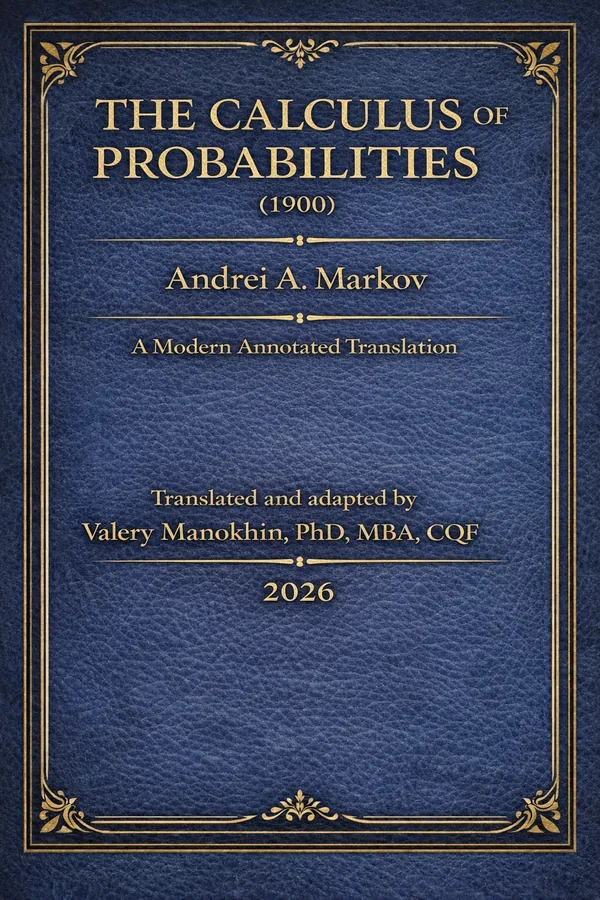
Markov: Probabilities
by Andrei A. Markov
US grades 12 and university · UK Year 13 and university
The foundational 1900 work on probability theory by the mathematician who gave us Markov chains. A modern annotated English translation.