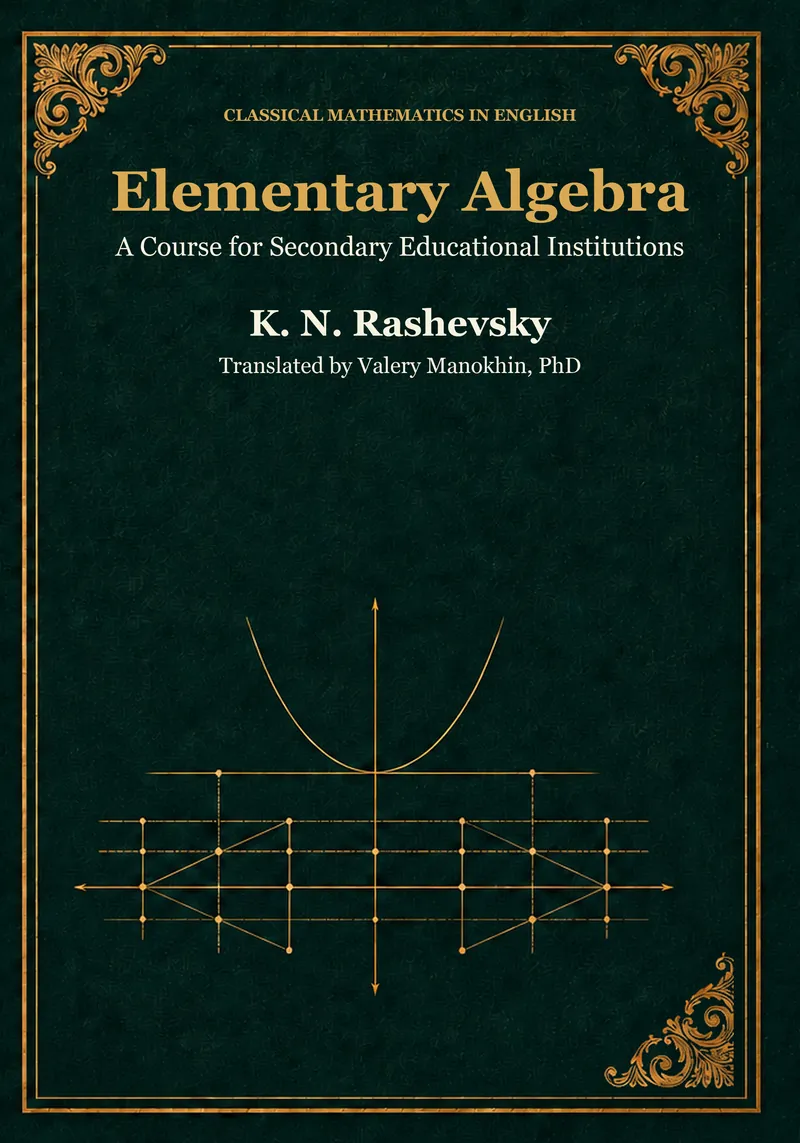
Elementary Algebra: A Course for Secondary Educational Institutions
by K. N. Rashevsky
Translated by Valery Manokhin, PhD
A complete course in school algebra, taught with the graph as a working instrument, in first faithful English translation from the original Russian edition. An Introduction and nineteen chapters, 308 numbered articles, run from the use of letters and signed numbers through operations on expressions, factoring, algebraic fractions, negative exponents and proportions; equations of the first degree in one and several unknowns and their investigation; functions of the first degree and their graphs; powers and roots, square roots of numbers, irrational numbers and expressions, and the generalized concept of a power; the quadratic equation, functions of the second degree and the graphical solution of quadratics; imaginary numbers and their representation on the plane; irrational and higher-degree equations and systems of the second degree; progressions; logarithms with the use of tables, exponential equations and compound interest; and groupings, Newton’s binomial and a short historical sketch of algebra. Forty-nine figures carry the graphical method from the first chapter on. Six short exercise sets are included, without answers.
19 chapters · 308 numbered articles · 272 pages
Where this fits in school — US, UK and Canada ↓ Adults and self-learners welcome — great mathematics has no age limit.
Where this fits in school
Full curriculum table — every book by school year →| United States | 8–11 | Algebra 1 and Algebra 2 in one volume, with linear and quadratic graphs |
|---|---|---|
| United Kingdom | Years 9–12 | KS3 → GCSE Higher → AS Pure |
| Canada | Ontario 8–11 | MTH1W → MPM2D → MCR3U · QC Secondary III–V SN |
Not covered in this book
graphs of the trigonometric functions and radian measure · statistics and data handling · probability
Source these strands elsewhere. They are missing from the book, not from this description.
How this book fits
See the whole sequence →Work through first
- Kiselev's Arithmetic$44.95
- Rashevsky's Arithmetic$39.95
Covers much of the same ground
- Elementary Algebra$69.95
Kiselev's single volume is 292 pages of exposition with no exercises and no graphs, and adds continued fractions and indeterminate equations, which this book does not treat. This book draws first- and second-degree functions as graphs in 49 figures over 272 pages.
Malinin and Burenin's runs to 458 pages with more than 3,300 numbered problems and 2,698 answers, and adds indeterminate equations, continued fractions and a chapter on series. It has no graphs and no function concept; this book has six short exercise sets and no answers.
- Davidov's Algebra$59.95
Davidov's is 509 pages and 478 numbered articles with full solutions to its problems, and adds indeterminate analysis, continued fractions and equations of the third and fourth degree. It has no functions or graphs, which this book uses from its first chapter.
- Kiselev's Algebra II$54.95
Part II is 248 pages and 187 articles for the second course alone, with answers to its exercises and a chapter on indeterminate equations, which this book lacks. Both teach functions through their graphs.
- Kiselev's Algebra I$44.95
Part I is the first-course half only — 152 pages, 126 articles — and brings 239 graded exercises with answers. This book covers that ground and the second course in one 272-page volume, but its exercise sets are short and unanswered.
These overlap heavily. Each note says what that book has which this one does not — the differences are what decide between them.
Problems to work alongside it
- Barsukov's Algebra$54.95
What comes next
- Kiselev's Calculus$54.95
- Rashevsky's Trigonometry$39.95
Table of contents
77 section headings — the printed contents page in full.
Translator's Preface
Introduction12 sections
- 1. The Use of Letters
- 2. Signs
- 3. Expression
- 4. Formula
- 5. Construction of Formulas
- 6. Power
- 7. Root
- 8. Remark
- 9. Coefficient
- 10. Evaluation of Algebraic Expressions
- 11. Subject of Algebra
- Exercises
Chapter I3 sections
- The Algebraic Method of Solving Problems
- The Graphical Method of Solving Problems
- Exercises
Chapter II9 sections
- Algebraic Numbers
- Addition of Algebraic Numbers
- Geometric Illustration of the Addition of Algebraic Numbers
- Subtraction of Algebraic Numbers
- The Negative Number as a Difference
- Multiplication of Algebraic Numbers
- Product of Several Factors
- Division of Algebraic Numbers
- Inequalities
Chapter III8 sections
- Operations with Algebraic Expressions
- Addition and Subtraction of Expressions
- Multiplication of Expressions
- Special Multiplication Formulas
- Geometric Representation of the Special Multiplication Formulas
- Division of Expressions
- Factoring Polynomials into Factors
- Greatest Common Divisor and Least Common Multiple
Chapter IV2 sections
- Algebraic Fractions
- Negative Exponents
Chapter V1 section
- Proportions
Chapter VI9 sections
- Equations
- Solving First-Degree Equations with One Unknown
- Forming First-Degree Equations with One Unknown
- Exercises
- First-Degree Equations with Two Unknowns
- Solving First-Degree Systems with Several Unknowns
- Investigation of a First-Degree Equation with One Unknown
- Investigation of Problems
- Investigation of a System of Two Equations with Two Unknowns
Chapter VII3 sections
- Functions of the First Degree and Their Graphical Representation
- Lines and Equations
- Exercises
Chapter VIII2 sections
- Powers and Roots
- Extraction of Roots from Monomials
Chapter IX2 sections
- Extraction of Square Roots from Numbers
- Approximate Square Root
Chapter X1 section
- Irrational Numbers
Chapter XI1 section
- Irrational Expressions
Chapter XII1 section
- Generalization of the Concept of a Power
Chapter XIII2 sections
- Quadratic Equation
- Investigation of the Quadratic Equation
Chapter XIV3 sections
- Functions of the Second Degree and Their Graphical Representation
- Graphical Solution of Equations of the Second Degree
- Exercises
Chapter XV2 sections
- Imaginary Numbers
- Geometric Representation of a Complex Number
Chapter XVI3 sections
- Irrational Equations
- Solving Equations of Higher Degree
- Systems of Equations of the Second Degree
Chapter XVII3 sections
- Progressions
- Arithmetic Progression
- Geometric Progression
Chapter XVIII6 sections
- Logarithms
- Exercises
- Decimal Logarithms
- Use of Tables
- Exponential and Logarithmic Equations
- Compound Interest
Chapter XIX4 sections
- Theory of Groupings
- Newton's Binomial
- Generalization of the Concept of Number
- A Brief Historical Sketch of the Development of Algebra
Formats and editions
| Format | Price | ISBN-13 | Where | Buy |
|---|---|---|---|---|
| Paperback | $64.95 | 978-1-919012-84-1 | Amazon | Buy → |
| Hardcover | $99.95 | 978-1-919012-85-8 | Amazon | Buy → |
Prices are the publisher list prices. Amazon sets the final price in each store.
Product details
- Publisher
- Northern Star Academic Press
- Language
- English
- Translator
- Valery Manokhin, PhD
- Print length
- 272 pages
- First published
- 2026-09-22
Published by Northern Star Academic Press · First faithful English translation from the original Russian edition
More in This Series
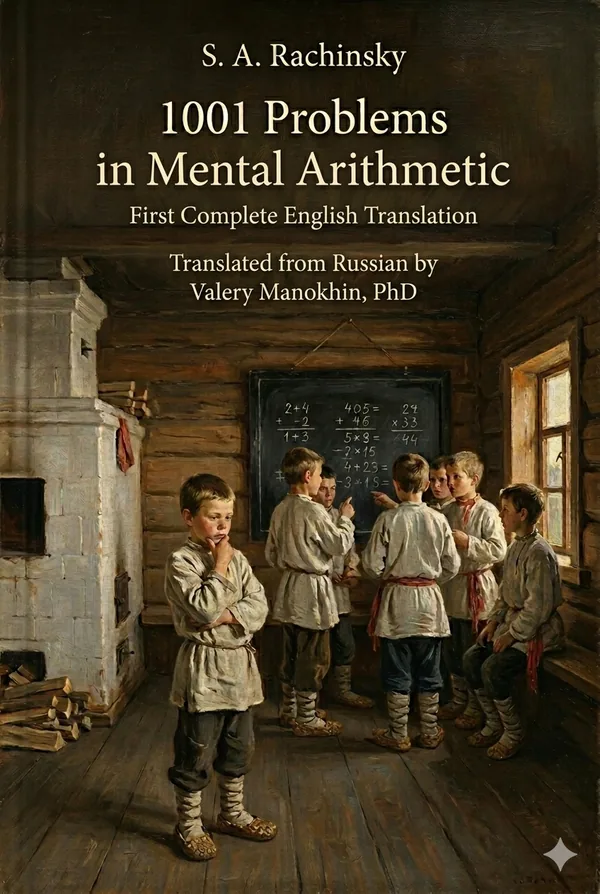
Rachinsky's 1001 Problems
by S. A. Rachinsky
US grades 4–8 · UK Years 5–9
1,001 carefully selected problems from the village schoolteacher whose students were depicted in Bogdanov-Belsky's famous 1895 painting "Mental Arithmetic."
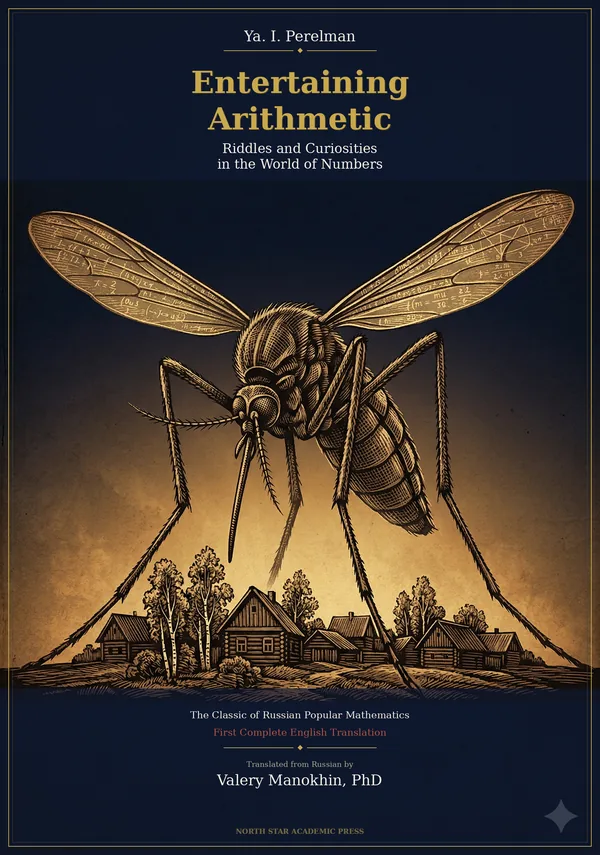
Perelman's Entertaining Arithmetic
by Ya. I. Perelman
US grades 4+ · UK Year 5+
The classic of Russian popular mathematics. Puzzles, riddles, and curiosities that make arithmetic genuinely entertaining.
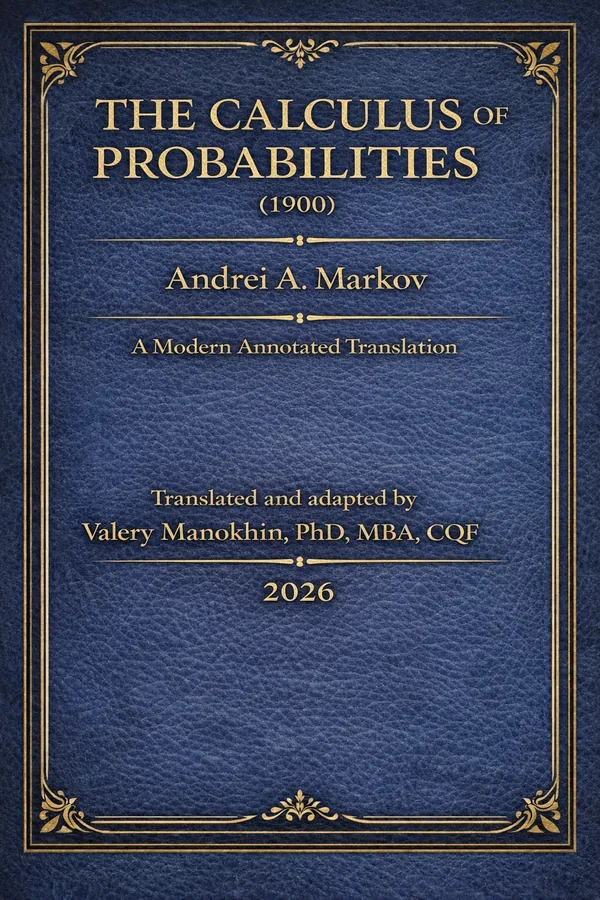
Markov: Probabilities
by Andrei A. Markov
US grades 12 and university · UK Year 13 and university
The foundational 1900 work on probability theory by the mathematician who gave us Markov chains. A modern annotated English translation.