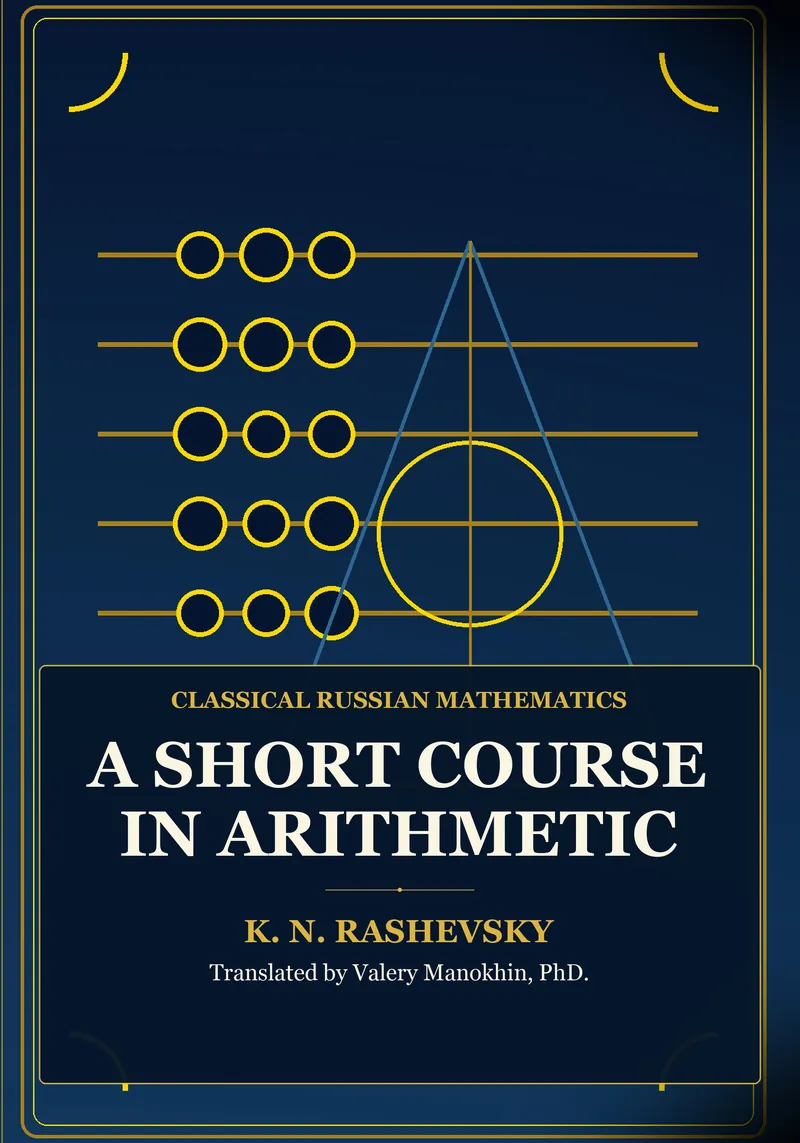
Rashevsky's Arithmetic
by K. N. Rashevsky
Translated by Valery Manokhin, PhD
A complete course in arithmetic in nine sections, in first faithful English translation from the original Russian edition. The four operations on whole numbers with the written methods set out in full; named and metric quantities; areas and volumes worked from drawings; tests for divisibility, primes, greatest common divisor and least common multiple; common and decimal fractions, including repeating decimals; ratio, proportion and proportional division; percentage and mixing problems; and plans, diagrams and graphs. Long divisions and column multiplications are printed digit under digit, so the reasoning stays visible on the page.
9 chapters · 95 pages
Where this fits in school — US, UK and Canada ↓ Adults and self-learners welcome — great mathematics has no age limit.
Where this fits in school
Full curriculum table — every book by school year →| United States | 5–8 | Grade 6–7 math → Pre-Algebra; also a complete adult refresher |
|---|---|---|
| United Kingdom | Years 6–9 | KS2 into KS3 · percentage work reaches GCSE Foundation |
| Canada | Ontario 5–8 | BC Math 5–8 · QC Elementary 5 – Secondary II |
Not covered in this book
negative numbers · statistics and data handling · probability
Source these strands elsewhere. They are missing from the book, not from this description.
How this book fits
See the whole sequence →Covers much of the same ground
The systematic course runs to 264 numbered articles over 207 pages and treats divisibility, ratio and proportion far more fully. This book covers the same ground in 95 pages and adds plans, diagrams and graphs, which the systematic course does not treat.
- Kiselev's Arithmetic$44.95
Kiselev's is the school course, six sections and 214 numbered articles, written for a child meeting arithmetic for the first time. This one is nine sections in 95 pages, written for a reader who wants the whole subject back in order, and it ends with plans, diagrams and graphs, which Kiselev's does not treat.
These overlap heavily. Each note says what that book has which this one does not — the differences are what decide between them.
Problems to work alongside it
What comes next
- Davidov's Algebra$59.95
- Kiselev's Algebra I$44.95
Table of contents
166 section headings — the printed contents page in full.
Translator's Preface
I. ELEMENTARY CONCEPTS3 sections
- 1. Definitions
- 2. Numeration table
- 3. Roman numeration
II. ARITHMETICAL OPERATIONS44 sections
- 4. Definitions
- ADDITION
- 5. Definitions
- 6. Property of the sum
- 7. Addition table
- 8. Placement of names
- 9. Uses of addition
- SUBTRACTION
- 10. Definitions
- 11. Uses of subtraction
- 12. Addition and subtraction
- 13. Placement of names
- 14. Examples of subtraction
- MULTIPLICATION
- 15. Definitions
- 16. Main property of the product
- 17. Special cases of multiplication
- 18. Multiplication table
- 19. Rule
- 20. Rule
- 21. Definitions
- 22. Use of multiplication
- 23.
- 24. Placement of names
- DIVISION
- 25. Definitions
- 26. Division with a remainder
- 27. Special cases of division
- 28.
- 29. Uses of division
- 30. Placement of names
- 31.
- CHECKING THE OPERATIONS
- 32.
- ARITHMETICAL EXPRESSIONS AND PARENTHESES
- 33.
- CHANGES IN THE SUM, DIFFERENCE, PRODUCT, AND QUOTIENT
- 34. Change in the sum
- 35. Change in the difference
- 36. Change in the product
- 37. Change in the quotient (division without a remainder)
- PROPERTIES OF THE OPERATIONS
- 38.
- 39. Special cases of the operations
III. NAMED NUMBERS21 sections
- 40. Definitions
- METRIC MEASURES
- 41. Measures of weight
- 42. Measures of length
- 43. Measures of area, or square measures
- 44. Measures of volume, or cubic measures
- 45. Measures of dry goods and liquids
- 46. Measures of paper
- 47. Money
- 48. Measures of time
- 49. The calendar
- 50. Symbols for metric measures
- 51. Converting larger measures into smaller ones
- 52. Converting smaller measures into larger ones
- 53. Addition and subtraction of compound named numbers
- 54. Problems in calculating time
- 55. Multiplication of compound named numbers
- 56. Division of compound named numbers
- DETERMINATION OF AREAS AND VOLUMES
- 57.
- 58.
IV. TESTS FOR DIVISIBILITY2 sections
- 59. Definition
- 60.
V. COMMON FRACTIONS, THEIR TRANSFORMATIONS, AND OPERATIONS ON THEM30 sections
- 61.
- 62. Rule
- 63. Rule
- 64. Comparing fractions
- 65. Rule
- 66. Main property of a fraction
- 67. Reducing fractions
- 68. Expressing fractions in other parts
- 69.
- 70. Remark
- 71. Example 1
- 72. Addition of fractions
- 73. Rule
- 74. Subtraction of fractions
- 75. Multiplication of fractions
- 76. Rule
- 77. Cancellation when multiplying fractions
- 78.
- 79.
- 80.
- 81. Division of fractions
- 82.
- 83. Definition
- 84. General rule of division
- 85.
- FINDING A PART OF A NUMBER AND A NUMBER FROM ITS PART
- 86.
- OPERATIONS WITH FRACTIONAL NAMED NUMBERS
- 87.
- 88. Remark
VI. DECIMAL FRACTIONS27 sections
- 89. Definition
- 90. Reading decimal fractions
- 91. Rule
- 92. Main property of a decimal fraction
- 93. Rule
- 94. Rule
- 95. Comparing decimal fractions
- 96. Rule
- 97. Addition and subtraction of decimal fractions
- 98. Multiplication of decimal fractions
- 99. Division of decimal fractions
- 100. Approximate quotient
- 101. Rule
- APPROXIMATE CALCULATIONS
- 102. Addition
- 103. Abbreviated multiplication
- 104. Abbreviated division
- 105. Converting common fractions to decimals
- 106. Definition
- 107. Theorem
- METRIC SYSTEM OF MEASUREMENT
- 108.
- 109.
- 110. Metric monetary units
- 111. Use of tables
- 112. Tables for converting Russian measures to metric measures
- 113. Advantages of the metric system
VII. DIVISORS AND MULTIPLES8 sections
- 114. Absolutely prime and composite numbers
- 115. Eratosthenes' sieve
- 116. Factoring numbers into prime factors
- 117. Greatest common divisor
- 118. Rule
- 119. Rule
- 120. Relatively prime numbers
- 121. Rule
VIII. PROPORTION. PROBLEMS ON PROPORTIONAL QUANTITIES23 sections
- 122. Ratio and proportion
- 123. Definition
- 124. Fundamental property of a proportion
- 125.
- 126. Definition
- 127. Proportional quantities
- PERCENTAGE CALCULATIONS
- 128. Definition
- 129. Definitions
- 130. Problem 1
- DISCOUNTING BILLS
- 131.
- 132. Problem
- PROPORTIONAL DIVISION
- 133. Problem
- 134. Problem
- 135. Problem
- 136. Problem
- MIXING PROBLEMS
- 137. Definition
- 138. Problem
- 139. Problem
- 140. Problem
IX. DRAWING PLANS, DIAGRAMS, AND GRAPHS8 sections
- 141. Plan
- 142. Diagrams
- 143. Percentage diagrams
- 144. Circular diagram
- GRAPHICAL METHOD FOR SOLVING PROBLEMS
- 145. Function
- 146. Graph
- 147. Problem 1
TABLE OF PRIME NUMBERS
Formats and editions
| Format | Price | ISBN-13 | Where | Buy |
|---|---|---|---|---|
| Paperback | $39.95 | 978-1-919012-86-5 | Amazon | Buy → |
Prices are the publisher list prices. Amazon sets the final price in each store.
Product details
- Publisher
- Northern Star Academic Press
- Language
- English
- Translator
- Valery Manokhin, PhD
- Print length
- 95 pages
- First published
- 2026-09-19
Published by Northern Star Academic Press · First faithful English translation from the original Russian edition
More in This Series
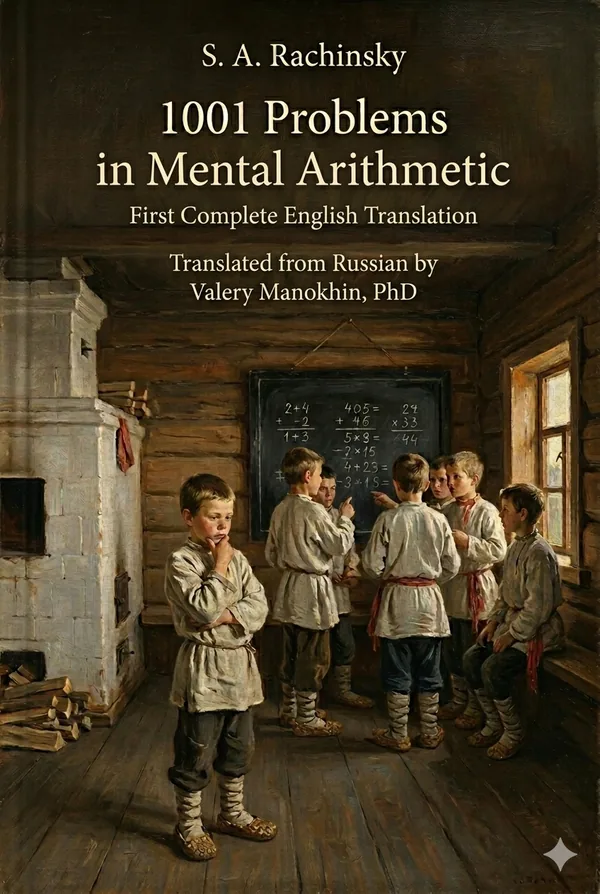
Rachinsky's 1001 Problems
by S. A. Rachinsky
US grades 4–8 · UK Years 5–9
1,001 carefully selected problems from the village schoolteacher whose students were depicted in Bogdanov-Belsky's famous 1895 painting "Mental Arithmetic."
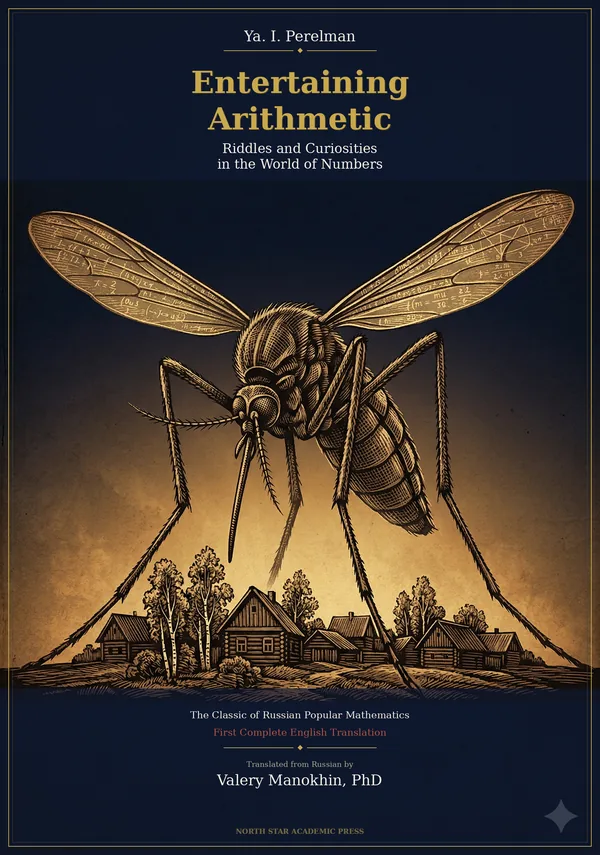
Perelman's Entertaining Arithmetic
by Ya. I. Perelman
US grades 4+ · UK Year 5+
The classic of Russian popular mathematics. Puzzles, riddles, and curiosities that make arithmetic genuinely entertaining.
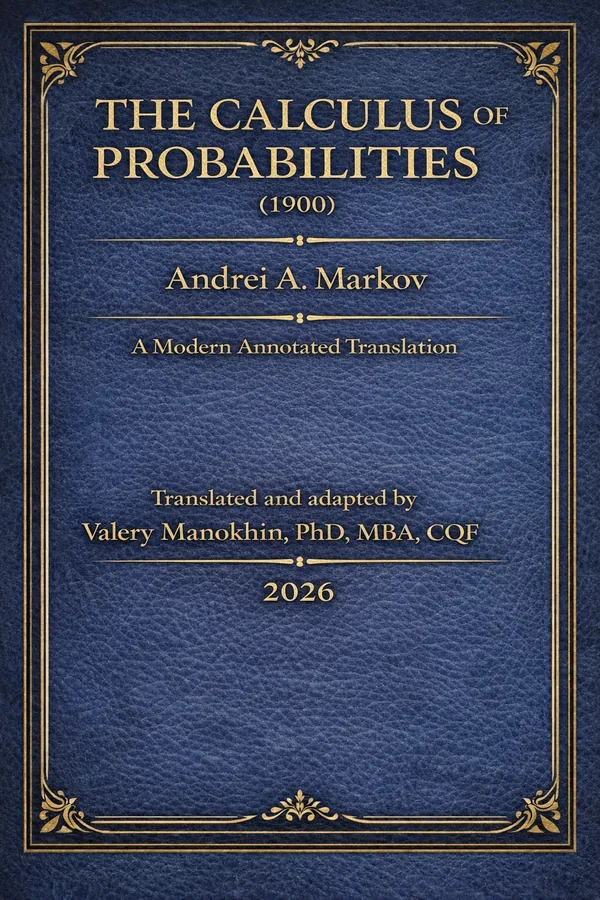
Markov: Probabilities
by Andrei A. Markov
US grades 12 and university · UK Year 13 and university
The foundational 1900 work on probability theory by the mathematician who gave us Markov chains. A modern annotated English translation.