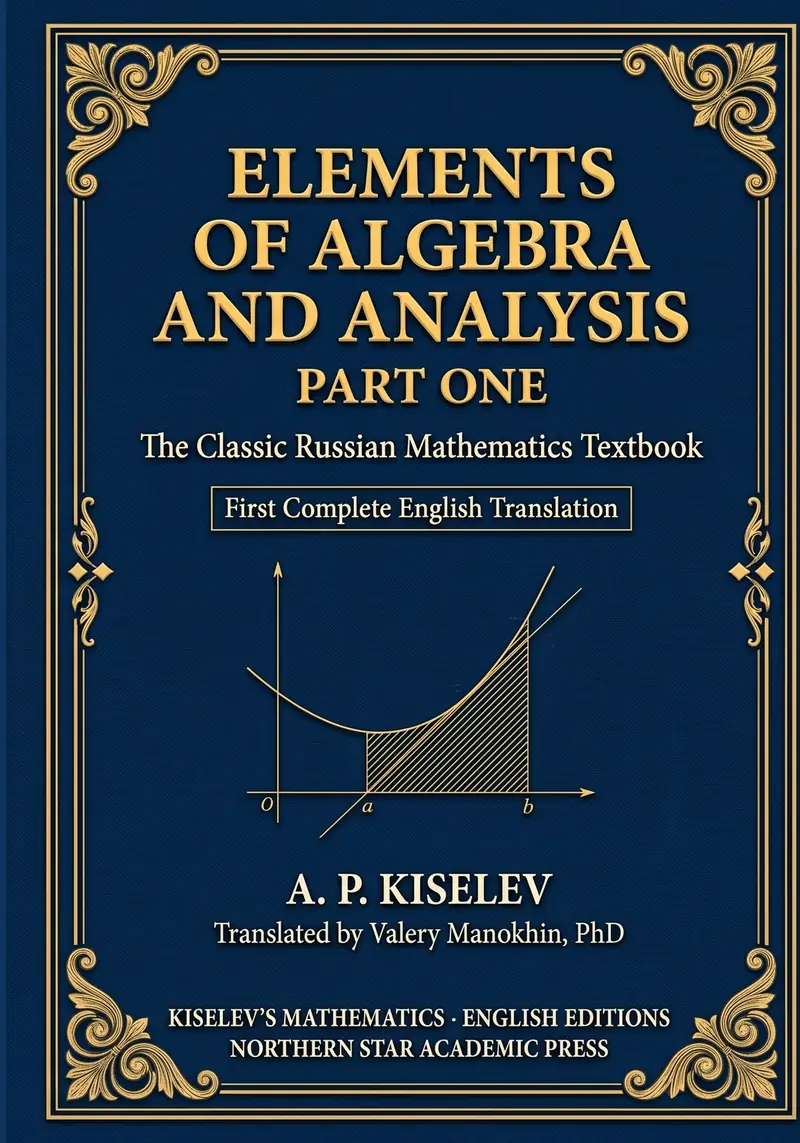
Elementos de Álgebra y Análisis de Kiselev, Parte Uno
por A. P. Kiselev
Traducido por Valery Manokhin, PhD
La Parte Uno construye una base conectada: notación y operaciones algebraicas, números con signo, identidades, ecuaciones e inecuaciones, polinomios, fracciones, razón y proporción, funciones, coordenadas y gráficas, potencias, raíces y números irracionales, progresiones, logaritmos con tablas de cuatro cifras, interés compuesto y el binomio de Newton.
· 313 páginas
Dónde encaja en el curso escolar — EE. UU., Reino Unido y Canadá ↓ Adultos y autodidactas bienvenidos — las grandes matemáticas no tienen límite de edad.
Dónde encaja en el curso escolar
Plan de estudios completo: todos los libros por curso →| Estados Unidos | 8–11 | Algebra 1 and Algebra 2 in one volume |
|---|---|---|
| Reino Unido | Years 9–12 | GCSE Foundation and Higher → AS Pure |
| Canadá | Ontario 9–11 | MTH1W → MPM2D → MCR3U |
No incluido en este libro
gráficas de las funciones trigonométricas y radianes · estadística y tratamiento de datos · probabilidad
Estos bloques habrá que cubrirlos con otro material. Faltan en el libro, no en esta descripción.
Dónde encaja este libro
Ver la secuencia completa →Estudiar antes
- Aritmética de Kiselev$44.95
Cubre gran parte del mismo temario
- Álgebra I de Kiselev$44.95
Se solapan en gran medida. Cada nota indica qué trae ese libro que este no — esas diferencias son las que deciden.
Problemas para trabajar en paralelo
Qué viene después
Índice
55 secciones — el índice completo del libro impreso.
Translator's Preface
Preliminary Concepts4 secciónes
- Algebraic Notation
- Properties of the First Four Arithmetic Operations
- Positive and Negative Numbers (Relative Numbers)
- The Concept of an Equation
Identical Transformations8 secciónes
- Polynomial and Monomial
- Algebraic Addition and Subtraction
- Algebraic Multiplication
- Algebraic Division
- Factorization
- Algebraic Fractions
- Ratio and Proportion
- Direct and Inverse Proportional Dependence
Graphical Representation of Functions3 secciónes
- The Concept of Function and Coordinates
- Graphs of Direct and Inverse Proportionality
- Graph of a First-Degree Binomial
Additional Information About Equations. Inequalities3 secciónes
- The Two Fundamental Properties of an Equation
- Positive, Negative, Zero, and Other Solutions
- First-Degree Inequalities
Systems of First-Degree Equations3 secciónes
- Two Equations with Two Unknowns
- Three Equations with Three Unknowns
- Special Cases of Systems of Equations
Powers and Roots6 secciónes
- Squaring Monomial Algebraic Expressions
- Squaring a Polynomial
- Graphs of y=x^2 and y=ax^2
- Raising Monomials to the Cube and Higher Powers
- Graphs of y=x^3 and y=ax^3
- Fundamental Properties of Extracting a Root
Extraction of the Square Root of Numbers3 secciónes
- Extraction of the Greatest Integer Square Root from a Given Integer
- Approximate Square Roots
- Graph of the Function y= x
Operations on Irrational Numbers and Expressions4 secciónes
- The Concept of an Irrational Number
- Irrational Values of Radicals
- Approximate Calculations
- Transformation of Irrational Expressions
Some Equations of Degree Higher Than the First5 secciónes
- Quadratic Equations
- The Quadratic Trinomial and Its Graph
- Biquadratic and Related Equations
- Irrational Equations
- Systems of Second-Degree Equations
Progressions3 secciónes
- Arithmetic Progression
- Geometric Progression
- Infinite Progressions
Generalization of the Concept of Exponents5 secciónes
- Integer Exponents
- Fractional Exponents
- Properties of Powers with Rational Exponents
- The Concept of an Irrational Exponent
- The Exponential Function
Logarithms5 secciónes
- General Properties of Logarithms
- Properties of Common Logarithms
- Construction and Use of Four-Digit Tables
- Exponential and Logarithmic Equations
- Compound Interest, Annuities, and Periodic Payments
Combinations and the Newton Binomial3 secciónes
- Combinations
- Newton's Binomial
- Applications of Newton's Binomial
Formatos y ediciones
| Formato | Precio | ISBN-13 | Dónde | Comprar |
|---|---|---|---|---|
| Kindle | $64.95 | — | Amazon | Comprar → |
| Tapa blanda | $59.95 | 978-1-919012-60-5 | Amazon | Comprar → |
| Tapa dura | $89.95 | 978-1-919012-61-2 | Amazon | Comprar → |
Los precios son los de lista del editor. Amazon fija el precio final en cada tienda.
Detalles del producto
- Editorial
- Northern Star Academic Press
- Idioma
- English
- Traductor
- Valery Manokhin, PhD
- Extensión
- 313 páginas
- Primera publicación
- 2026-08-29
Publicado por Northern Star Academic Press · Primera traducción fiel del original ruso
Más de Esta Serie
Aritmética de Kiselev
por A. P. Kiselev
Grados 4–7 (EE. UU.) · Years 5–8 (RU)
El libro de texto de aritmética fundamental utilizado en las escuelas rusas durante más de un siglo. 6 partes, 214 secciones.
Álgebra I de Kiselev
por A. P. Kiselev
Grados 7–9 (EE. UU.) · Years 8–10 (RU)
6 capítulos, 126 secciones, 239 ejercicios. Desde números relativos y polinomios hasta ecuaciones de primer grado, potencias, raíces y cuadráticas.
Álgebra II de Kiselev
por A. P. Kiselev
Grados 9–12 (EE. UU.) · Years 10–13 (RU)
12 capítulos más Suplementos, 187 secciones. Funciones, sistemas cuadráticos, desigualdades, logaritmos, progresiones, números complejos, el teorema del binomio y fracciones continuas.