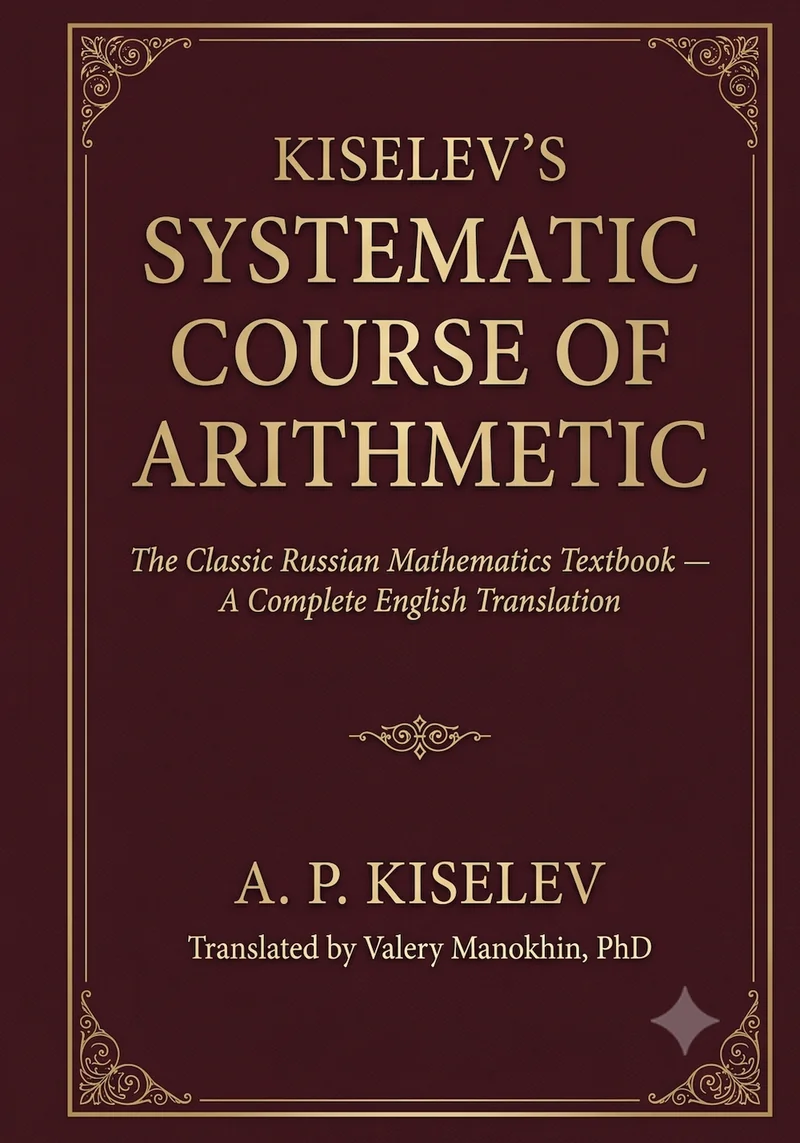
Kiselev's Systematic Course of Arithmetic
by A. P. Kiselev
Translated by Valery Manokhin, PhD
Kiselev's definitive systematic arithmetic — the expanded companion to his classic arithmetic textbook. 207 pages, 264 numbered articles across seven divisions: whole numbers; concrete (denominate) numbers and the metric system; divisibility, primes, and factorisation; common fractions; decimal fractions with limits and repeating decimals; ratio and proportion; and a full course of word problems on proportional quantities. Includes elementary treatments most textbooks leave out — Euclid's proof of the infinitude of primes and the concept of a limit used to prove that 0.999… equals 1.
· 264 numbered articles · 207 pages
Where this fits in school — US, UK and Canada ↓ Adults and self-learners welcome — great mathematics has no age limit.
Where this fits in school
Full curriculum table — every book by school year →| United States | 5–8 | Grade 6–7 math → Pre-Algebra |
|---|---|---|
| United Kingdom | Years 6–9 | KS2 into KS3 · interest work reaches GCSE Foundation |
| Canada | Ontario 5–8 | BC Math 5–8 · QC Elementary 5 – Secondary II |
Not covered in this book
negative numbers · coordinate geometry · statistics and data handling · probability
Source these strands elsewhere. They are missing from the book, not from this description.
How this book fits
See the whole sequence →Covers much of the same ground
- Kiselev's Arithmetic$44.95
- Rashevsky's Arithmetic$39.95
Rashevsky's covers the same ground in 95 pages against 207, with far less on divisibility and proportion, but it ends with plans, diagrams and graphs, which this book does not treat.
These overlap heavily. Each note says what that book has which this one does not — the differences are what decide between them.
Problems to work alongside it
What comes next
- Elementary Algebra$69.95
- Kiselev's Algebra I$44.95
Further reading
A historical text to read beside the course, not a substitute for it.
Table of contents
37 section headings — the printed contents page in full.
Translator's Preface
Abstract Whole Numbers9 sections
- Numeration
- Addition
- Subtraction
- Slavic and Roman Numeration
- Change of sum and remainder
- Signs of the operations, parentheses, formulas
- Multiplication
- Division
- Change in the Product and the Quotient
Concrete Whole Numbers4 sections
- The Concept of Measuring Quantities
- Transformation of a concrete number
- Operations on concrete numbers
- Problems on the calculation of time
Divisibility of Numbers5 sections
- Tests of divisibility
- Prime and Composite Numbers
- On the divisors of a composite number
- Greatest common divisor
- Least Common Multiple
Common Fractions5 sections
- Reduction of Fractions
- Reduction of fractions to the least common denominator
- Finding a Fraction of a Given Number and the Reverse Problem
- Operations on Abstract Fractions
- Operations on concrete fractions
Decimal Fractions5 sections
- Principal properties of decimal
- Operations on Decimal Fractions
- Conversion of common fractions into decimals
- Conversion of repeating decimals into common fractions
- Metric System of Measures
Ratio and Proportion2 sections
- Ratio
- Proportion
Problems on Proportional Quantities7 sections
- The simple rule of three
- Compound rule of three
- Problems on Percentages
- Problems on the discounting of bills
- Chain Rule
- Problems on proportional division
- Problems on mixtures and alloys
Appendix: Approximate Calculations
Table of Prime Numbers Not Exceeding 6000
Appendix: Russian Units of Measure
Formats and editions
| Format | Price | ISBN-13 | Where | Buy |
|---|---|---|---|---|
| $49.95 | — | Gumroad · Instant download | Buy → | |
| Kindle | $54.95 | — | Amazon | Buy → |
| Paperback | $54.95 | 978-1-919012-07-0 | Amazon | Buy → |
| Hardcover | $84.95 | 978-1-919012-08-7 | Amazon | Buy → |
Prices are the publisher list prices. Amazon sets the final price in each store.
Product details
- Publisher
- Northern Star Academic Press
- Language
- English
- Translator
- Valery Manokhin, PhD
- Print length
- 207 pages
- First published
- 2026-07-14
Published by Northern Star Academic Press · First faithful English translation from the original Russian edition
More in This Series
Kiselev's Arithmetic
by A. P. Kiselev
US grades 4–7 · UK Years 5–8
The foundational arithmetic textbook used in Russian schools for over a century. 6 parts, 214 sections. Whole numbers through proportional quantities, with mathematical proofs for every operation.
Kiselev's Algebra I
by A. P. Kiselev
US grades 7–9 · UK Years 8–10
6 chapters, 126 sections, 239 exercises. From relative numbers and polynomials through first-degree equations, powers, roots, and quadratics.
Kiselev's Algebra II
by A. P. Kiselev
US grades 9–12 · UK Years 10–13
12 chapters plus Supplements, 187 sections. Functions, quadratic systems, inequalities, logarithms, progressions, complex numbers, the binomial theorem, and continued fractions.