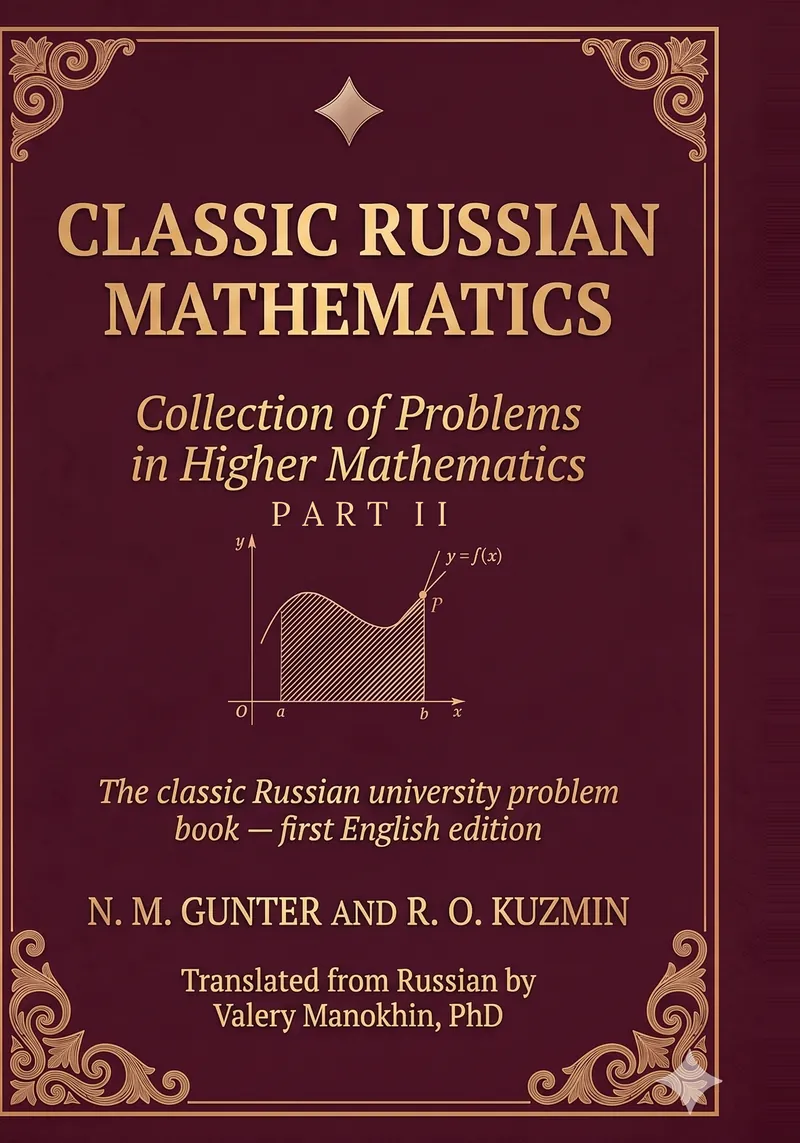
Gunter and Kuzmin: Collection of Problems in Higher Mathematics, Part II
by N. M. Gunter & R. O. Kuzmin
Translated by Valery Manokhin, PhD
The second half completes the collection: multiple, curvilinear and surface integrals, field and potential theory, ordinary and partial differential equations, improper integrals and special functions, series and Fourier series, approximate computation, functions of a complex variable, mathematical physics, the calculus of variations and probability. 379 pages.
· 379 pages
Where this fits in school — US, UK and Canada ↓ Adults and self-learners welcome — great mathematics has no age limit.
Where this fits in school
Full curriculum table — every book by school year →| United States | University 2–4 | ODEs, PDEs, Complex Analysis, Numerical Analysis, Probability |
|---|---|---|
| United Kingdom | Undergraduate 2–3 | undergraduate |
| Canada | University 2–4 |
How this book fits
See the whole sequence →Work through first
- Gunter & Kuzmin, Part I$64.95
Covers much of the same ground
- Gunter & Kuzmin$99.95
Parts I and II bound together in one 814-page volume.
These overlap heavily. Each note says what that book has which this one does not — the differences are what decide between them.
What comes next
- Markov: Probabilities$59.95
Table of contents
71 section headings — the printed contents page in full.
Translator's Preface
Ordinary and Partial Differential Equations19 sections
- Forming Differential Equations From Their Given Integrals
- Finding Functions From Their Total Differential
- Integration Of Complete Differentials
- Equations With Separable Variables
- Homogeneous Equations And Those Reducible To Them
- Linear Equations And Those Reducible To Them
- The Riccati Equation
- The Jacobi Equation
- Integrating Factor
- Euler Equations
- Equations
- Singular Solutions Of Equations
- Problems On Trajectories
- Miscellaneous Problems
- Higher-Order Equations Admitting Reduction Of Order
- Linear Equations With Constant Coefficients And Equations Reducible To Them
- Linear Equations. Miscellaneous Problems
- Systems Of Differential Equations
- Linear Equations In Partial Derivatives Of The First Order
Improper Integrals, Beta/Gamma, Special Functions, Fourier Integrals9 sections
- The Definite Integral As The Limit Of A Sum
- Mean-Value Theorems. Improper Integrals
- Evaluation Of Definite Integrals By Integration And Substitutions
- Evaluation Of Integrals By Means Of Reduction Formulas
- Integration By Means Of Series
- Differentiation And Integration Under The Integral Sign
- Eulerian Integrals
- Miscellaneous Problems
- Fourier Series And Related Questions
Series and Fourier Series4 sections
- Investigation Of The Convergence Of Series
- Direct Summation Of Finite Sums And Infinite Series
- Finding Sums Of Series By Differentiation; Some Series Expansions
- Miscellaneous Problems
Approximate Computation7 sections
- Interpolation. Theory Of Errors
- Approximate Evaluation Of Integrals
- The Euler—Maclaurin Formula And Similar Methods
- Acceleration Of The Convergence Of Series
- Evaluation Of Integrals By Means Of Series
- Solution Of Numerical Equations
- Approximate Integration Of Differential Equations
Functions of a Complex Variable11 sections
- The Cauchy—Riemann Equations
- Singular Points Of A Function. The Taylor And Maclaurin Series
- Residues And Their Applications
- Distribution Of The Zeros Of The Function
- Expansion Of Functions Into Partial Fractions
- Other Expansions In Series
- Generating Functions And Special Polynomials
- Conformal Mappings
- The Maximum Modulus Principle
- Differential Equations For A Complex Variable
- Applications To Problems Of Mathematical Physics
Mathematical Physics — Partial Differential Equations8 sections
- Is Introductory In Character To The Principal Methods: The Method Of Characteristics And The Fourier Method, To Which § 15.3 And § 15.5 Are Devoted.
- —Integral Equations—Relates Chiefly To The Theory Of Linear Equations Of Fredholm Type.
- Formation Of Second-Order Partial Differential Equations
- Reduction Of Linear Equations Of The Second Order To Canonical Form
- The Method Of Characteristics
- Riemann’S Method
- Fourier Method
- Integral Equations
Calculus of Variations8 sections
- Euler—Lagrange Equations
- Necessary And Sufficient Conditions For The Simplest Problem Of The Calculus Of Variations
- Parametric Form Of Integrals, Transversality
- The Hamilton—Jacobi Equation
- Integrals Depending On Higher-Order Derivatives Or On Several Functions
- Discontinuous Solutions. One-Sided Variation
- Multiple Integrals
- Isoperimetric Problems
Probability Theory5 sections
- Is Devoted To Problems On The Calculation Of Geometric Probabilities. In This Paragraph Attention Is Paid To The Construction Of Distribution Curves, And Examples Are Given Of The Calculation Of The Characteristic Function.
- Application Of The Basic Theorems. Bayes'S Formula
- Mathematical Expectations. The Method Of Finite Differences And Generating Functions
- Bernoulli'S Theorem. Chebyshev'S Inequalities
- Laplace'S And Lyapunov—Markov'S Theorems
Answers
Formats and editions
| Format | Price | ISBN-13 | Where | Buy |
|---|---|---|---|---|
| Paperback | $54.95 | 978-1-919012-35-3 | Amazon | Buy → |
| Hardcover | $89.95 | 978-1-919012-36-0 | Amazon | Buy → |
Prices are the publisher list prices. Amazon sets the final price in each store.
Product details
- Publisher
- Northern Star Academic Press
- Language
- English
- Translator
- Valery Manokhin, PhD
- Print length
- 379 pages
- First published
- 2026-08-25
Published by Northern Star Academic Press · First faithful English translation from the original Russian edition
More in This Series
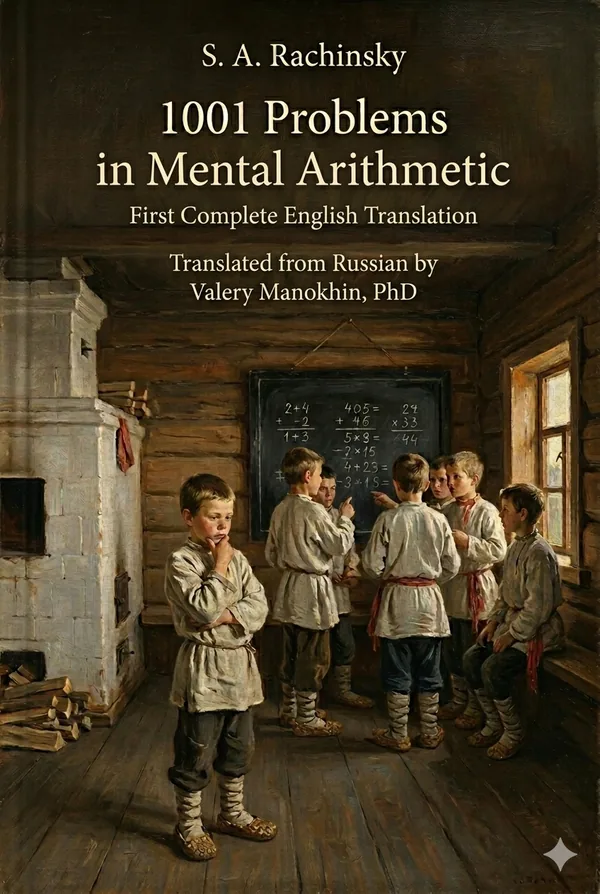
Rachinsky's 1001 Problems
by S. A. Rachinsky
US grades 4–8 · UK Years 5–9
1,001 carefully selected problems from the village schoolteacher whose students were depicted in Bogdanov-Belsky's famous 1895 painting "Mental Arithmetic."
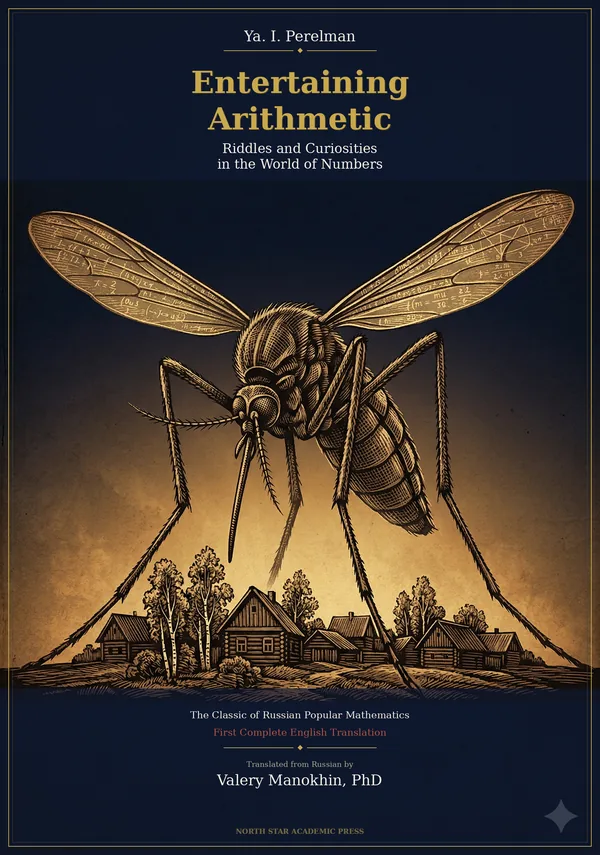
Perelman's Entertaining Arithmetic
by Ya. I. Perelman
US grades 4+ · UK Year 5+
The classic of Russian popular mathematics. Puzzles, riddles, and curiosities that make arithmetic genuinely entertaining.
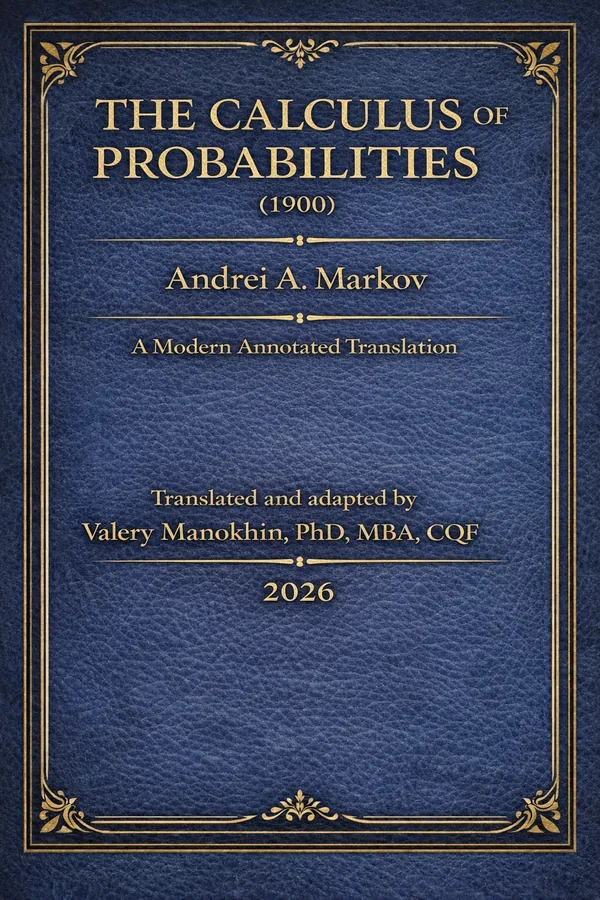
Markov: Probabilities
by Andrei A. Markov
US grades 12 and university · UK Year 13 and university
The foundational 1900 work on probability theory by the mathematician who gave us Markov chains. A modern annotated English translation.