Northern Star Academic Press
Classic Russian mathematics textbooks, now in faithful English.
First faithful English translations from original Russian editions. The classical Russian school sequence in full — arithmetic through trigonometry, calculus and analysis — for families, schools, tutors, and serious independent study.
Not sure which book?
These books are a sequence, not a shelf. Three ways to find your place in it.
Where to start
Two questions — the student’s age, and what they have already worked through — and you land on the right rung of an eight-stage ladder from arithmetic to calculus.
Curriculum: which book, which year
Every title placed against the US, UK and Canadian school years, with what each one leaves out — and, where two volumes overlap, the counted differences that decide between them.
Search every contents page
The full table of contents of every book, searchable at once. Find which volume treats logarithms, or continued fractions, and exactly which chapter.
First faithful English translations from original Russian editions.
Arithmetic, algebra, geometry, and trigonometry in one coherent sequence.
Secure checkout through Gumroad. Print editions on Amazon.
Why Russian Mathematics?
Russia and the Soviet Union built one of the most formidable mathematical traditions in history. These are the textbooks that built it — now available in English and Spanish for the first time.
Proof-Based Progression
Kiselev builds each topic from definitions, examples, and worked reasoning instead of detached rules.
A Coherent School Sequence
Arithmetic, algebra, and geometry connect naturally, so each subject prepares the ground for the next.
Understanding, Not Memorisation
Every rule is derived, not dictated. Every operation is proven, not memorised. Kiselev teaches you why something works — not just that it works.
First Complete Translations
First faithful English translations from the original Russian editions, with structure and explanations preserved.
The Core Curriculum
Russian Math Classics
The textbooks that defined Russian mathematics education for over a century. Arithmetic, algebra, geometry, trigonometry, and calculus.
Elementary Algebra
by A. P. Kiselev
US grades 7–11 · UK Years 8–12
The single-volume algebra course, covering in one book essentially what Algebra Part I and Part II cover between them. Concepts arrive in a deliberate order, rules are tied to the operations that justify them, and proof is treated as part of elementary education rather than an ornament. Keeps hand extraction of cube roots, indeterminate multipliers and compound interest; omits the functions-and-graphs material of the two-part course.
Elementary Geometry
by A. P. Kiselev
US grades 8–11 · UK Years 8–13
The complete geometry course — five books of plane geometry and three of solid geometry — in one English volume. Definitions are precise, theorems are proved, constructions are justified, and each idea is prepared by the one before it. 380 pages and 450 figures.
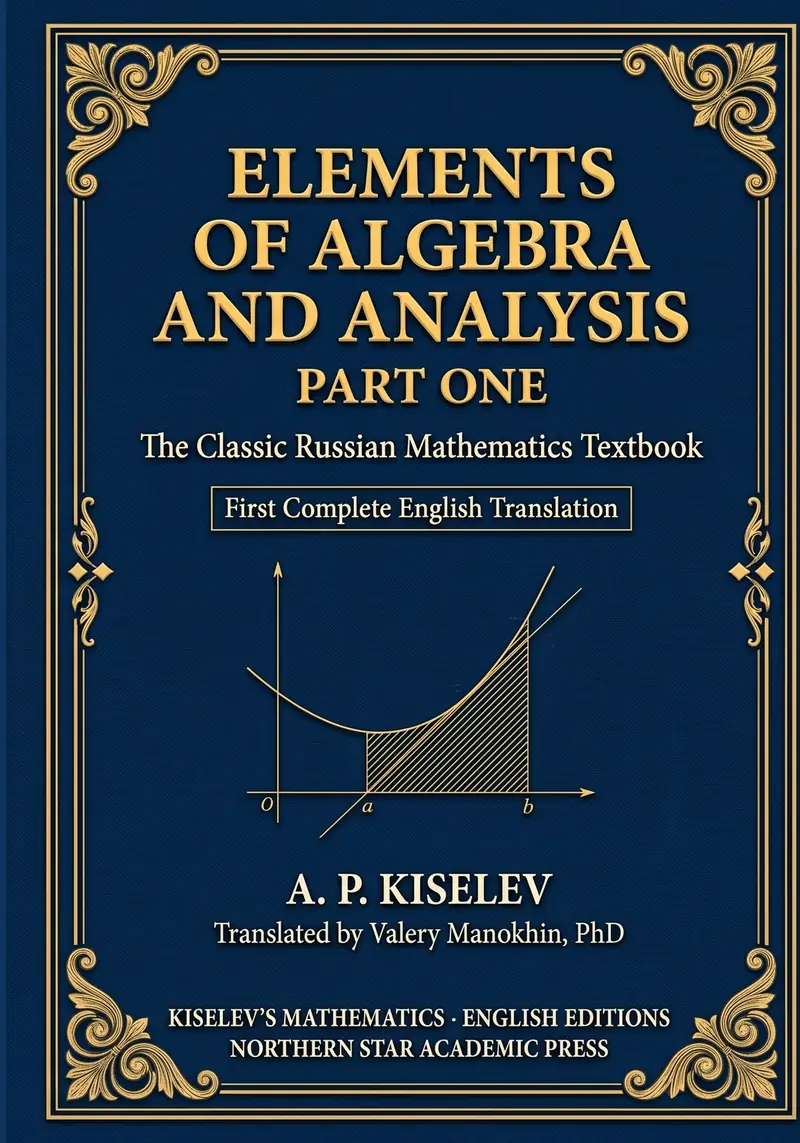
Elements of Algebra & Analysis I
by A. P. Kiselev
US grades 8–11 · UK Years 9–12
Part One builds a connected foundation: algebraic notation and operations, signed numbers, identities, equations and inequalities, polynomials, fractions, ratio and proportion, functions, coordinates and graphs, powers, roots and irrational numbers, progressions, logarithms with four-figure tables, compound interest and the binomial theorem. A distinct work from the 1888 Elementary Algebra.
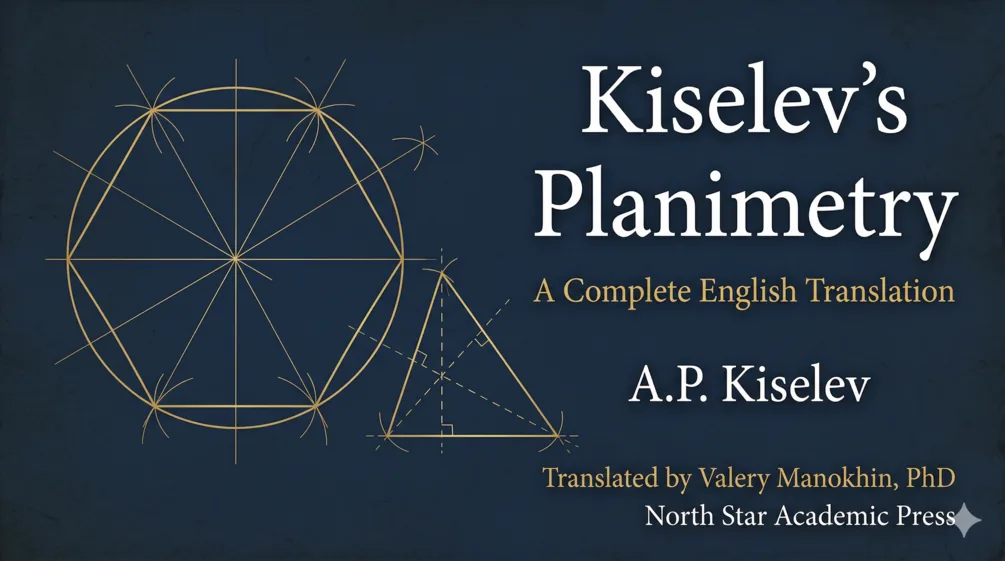
Kiselev's Planimetry
by A. P. Kiselev
US grades 8–10 · UK Years 8–11
The first complete English translation of Kiselev's proof-based Euclidean geometry. 269 sections across 6 chapters: basic concepts, triangles, circles, similarity, regular polygons, and areas. PDF, paperback, and hardcover.
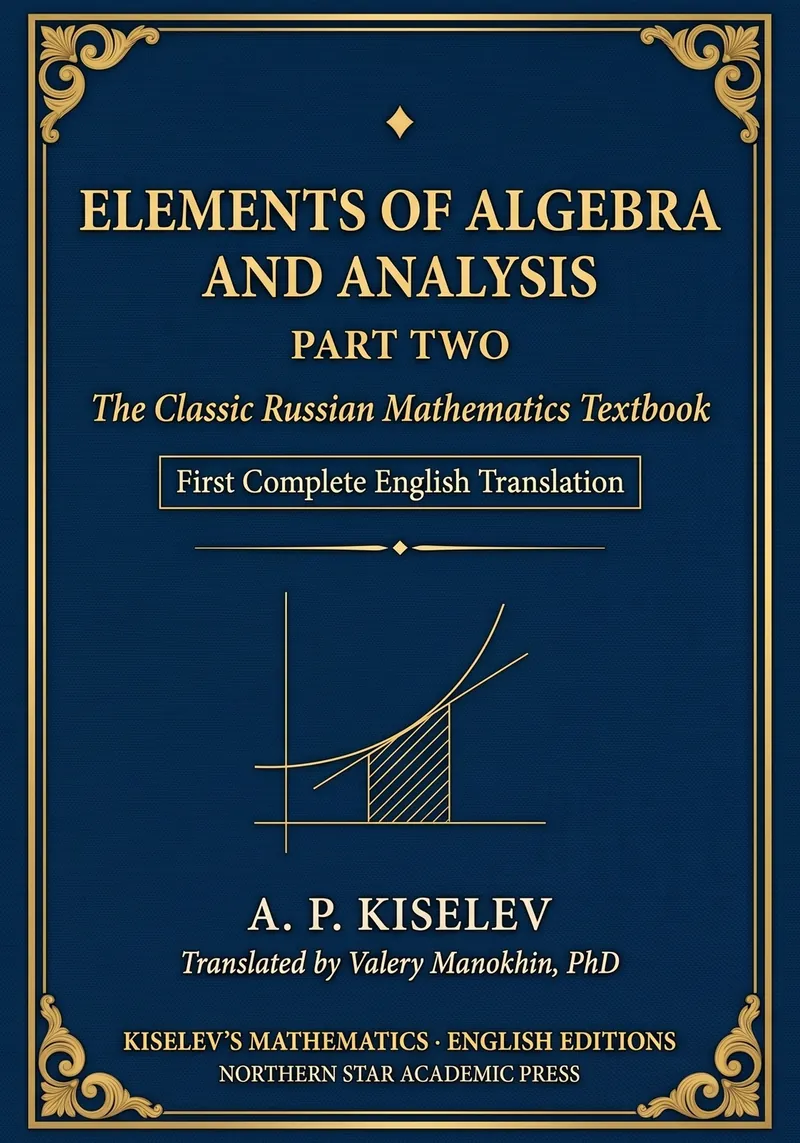
Elements of Algebra & Analysis II
by A. P. Kiselev
US grades 11–12 · UK Years 12–13
Part Two carries the numbering of Part One forward into analysis: the theory of limits and its applications to elementary geometry, derivative functions, slopes of straight lines and curves, increasing and decreasing functions, and maxima and minima.
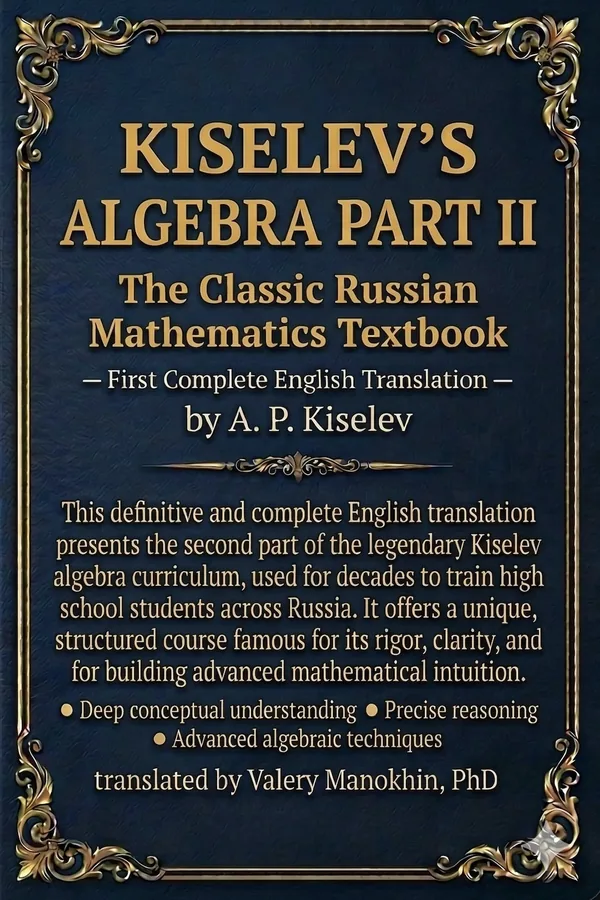
Kiselev's Algebra II
by A. P. Kiselev
US grades 9–12 · UK Years 10–13
12 chapters plus Supplements, 187 sections. Functions, quadratic systems, inequalities, logarithms, progressions, complex numbers, the binomial theorem, and continued fractions.
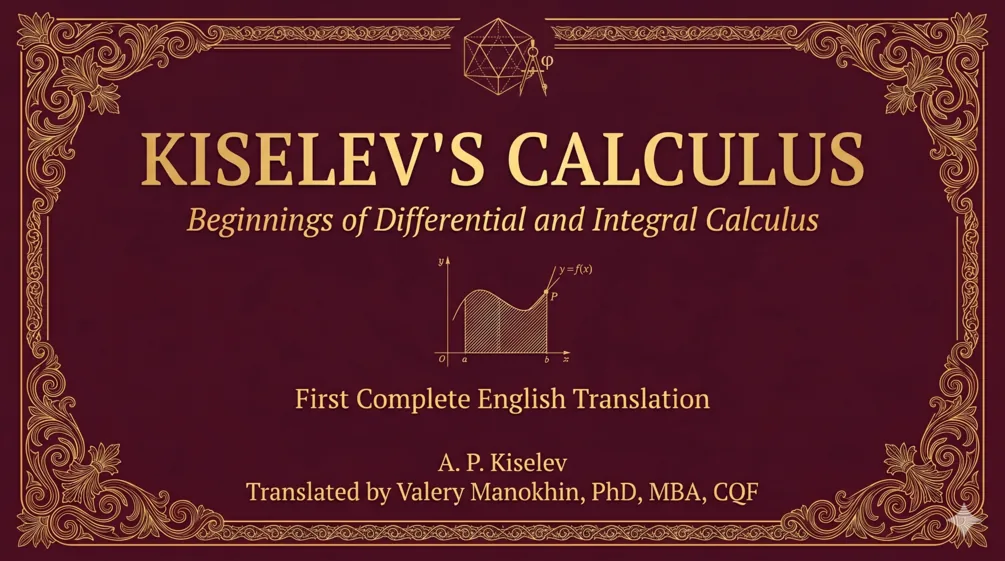
Kiselev's Calculus
by A. P. Kiselev
US grades 11–12 · UK Years 12–13
The first complete English translation of Kiselev's calculus — the final volume in his school course. Single-variable differential and integral calculus, proof-based, with classical applications to mechanics and physics. The bridge from Algebra II into the analysis tradition that produced Markov's probability theory.
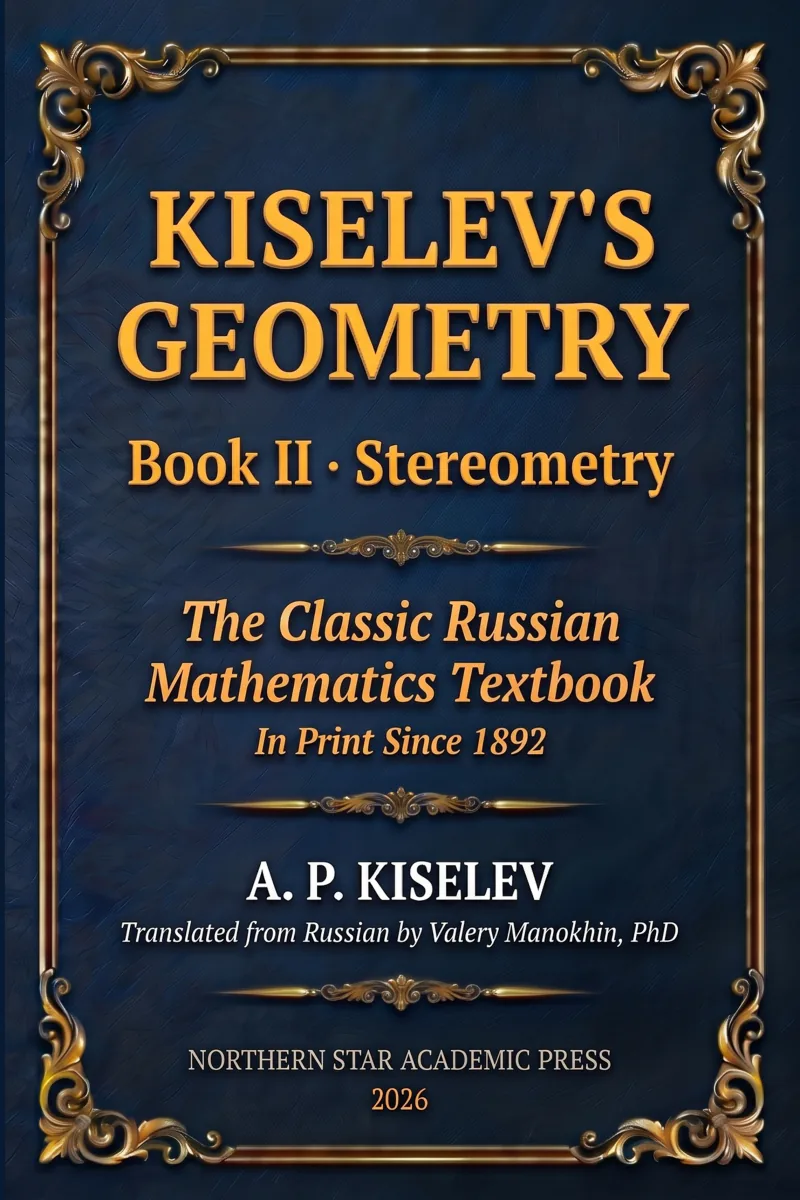
Kiselev's Stereometry
by A. P. Kiselev
US grades 9–11 · UK Years 10–13
Kiselev's three-dimensional geometry text — the first complete English translation. Polyhedra, the five Platonic solids, cylinders, cones, the ball, and Cavalieri's principle.
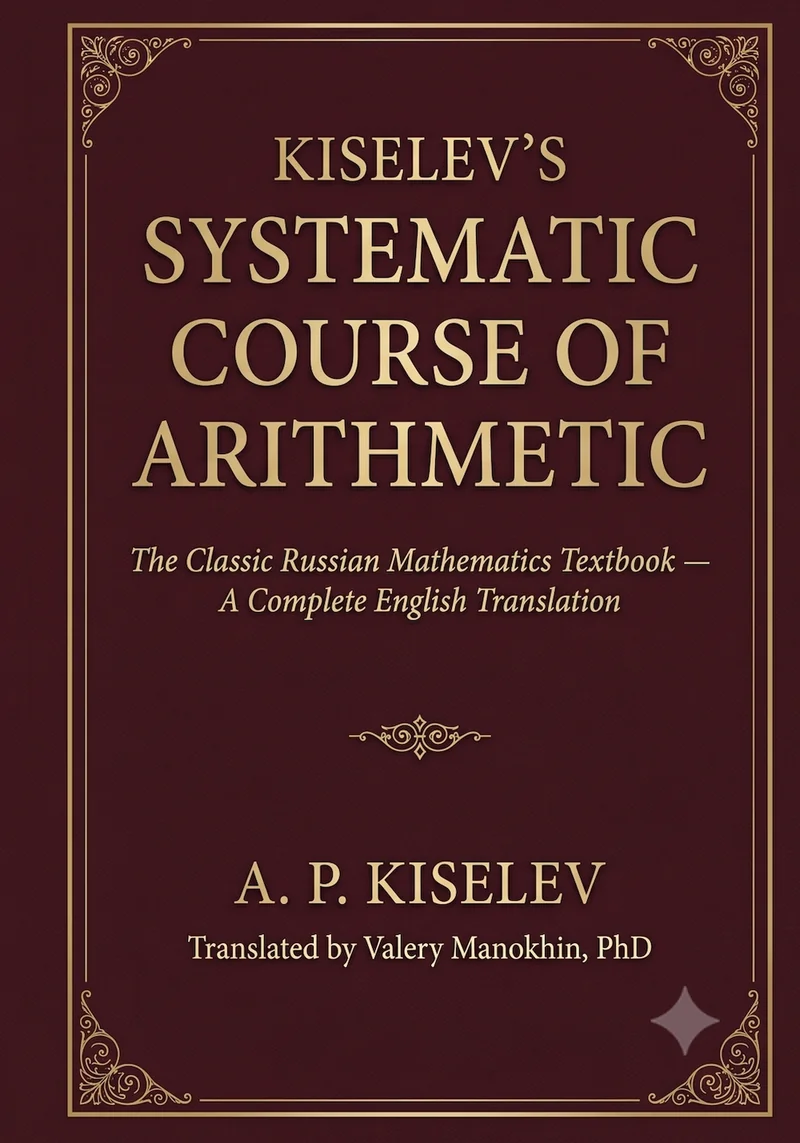
Kiselev's Systematic Arithmetic
by A. P. Kiselev
US grades 5–8 · UK Years 6–9
Kiselev's definitive systematic arithmetic — the expanded companion to his classic arithmetic textbook. 207 pages, 264 numbered articles across seven divisions: whole numbers; concrete (denominate) numbers and the metric system; divisibility, primes, and factorisation; common fractions; decimal fractions with limits and repeating decimals; ratio and proportion; and a full course of word problems on proportional quantities. Includes elementary treatments most textbooks leave out — Euclid's proof of the infinitude of primes and the concept of a limit used to prove that 0.999… equals 1.
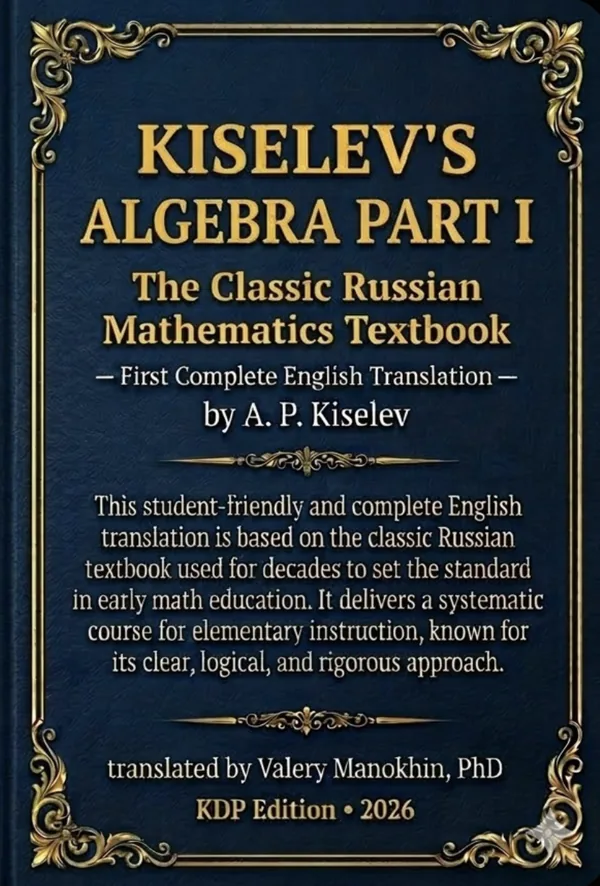
Kiselev's Algebra I
by A. P. Kiselev
US grades 7–9 · UK Years 8–10
6 chapters, 126 sections, 239 exercises. From relative numbers and polynomials through first-degree equations, powers, roots, and quadratics.
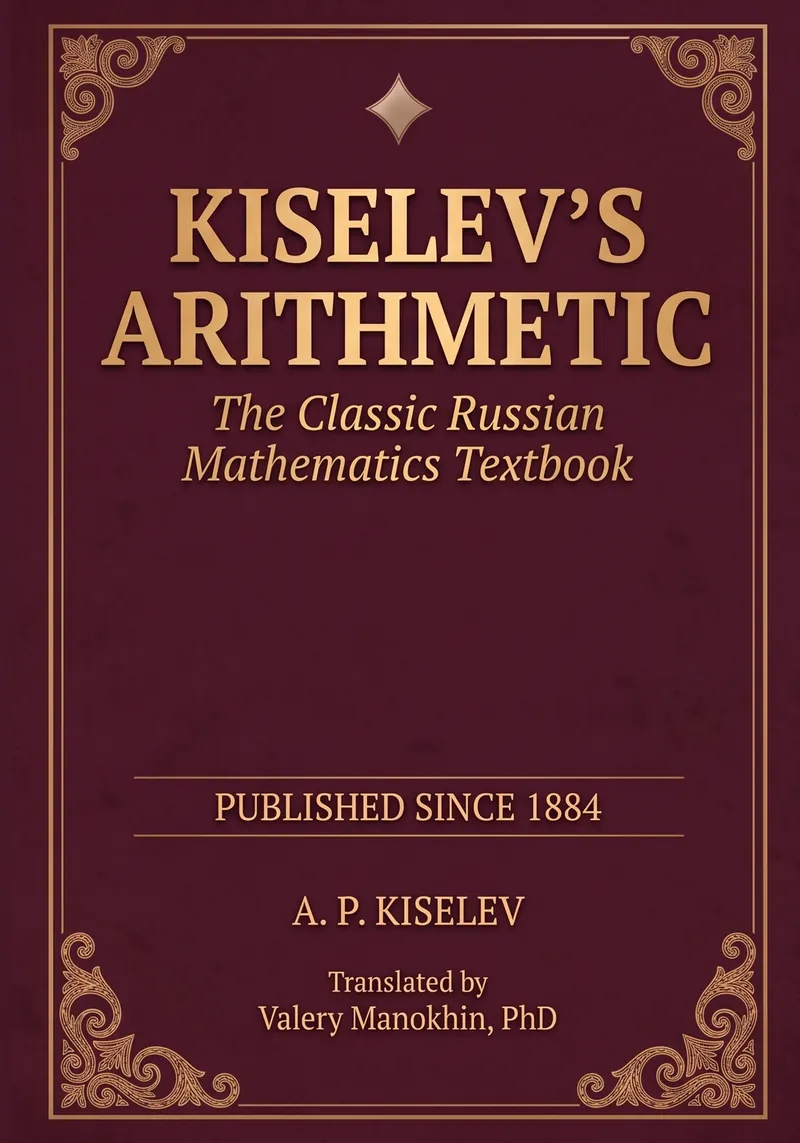
Kiselev's Arithmetic
by A. P. Kiselev
US grades 4–7 · UK Years 5–8
The foundational arithmetic textbook used in Russian schools for over a century. 6 parts, 214 sections. Whole numbers through proportional quantities, with mathematical proofs for every operation.
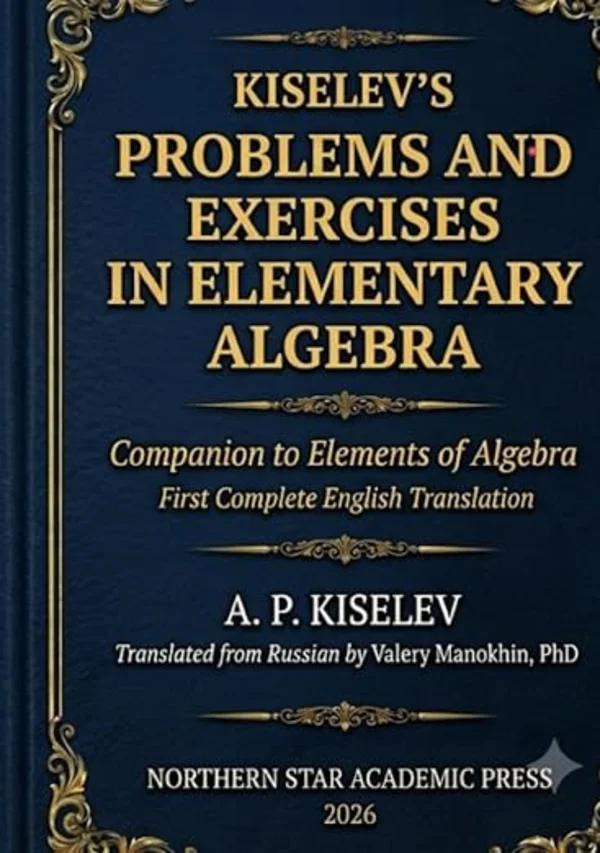
Kiselev's Algebra Problems
by A. P. Kiselev
US grades 7–11 · UK Years 8–12
The companion problem collection to Kiselev's Algebra. Hundreds of carefully sequenced problems and exercises that mirror the chapter structure of Algebra Part I and Part II — the same problem set Russian students worked through alongside Kiselev's algebra textbooks for over a century.
Beyond Kiselev
Classic Russian Mathematics
Problem collections, recreational mathematics, and foundational probability theory from Russia's greatest mathematical minds.
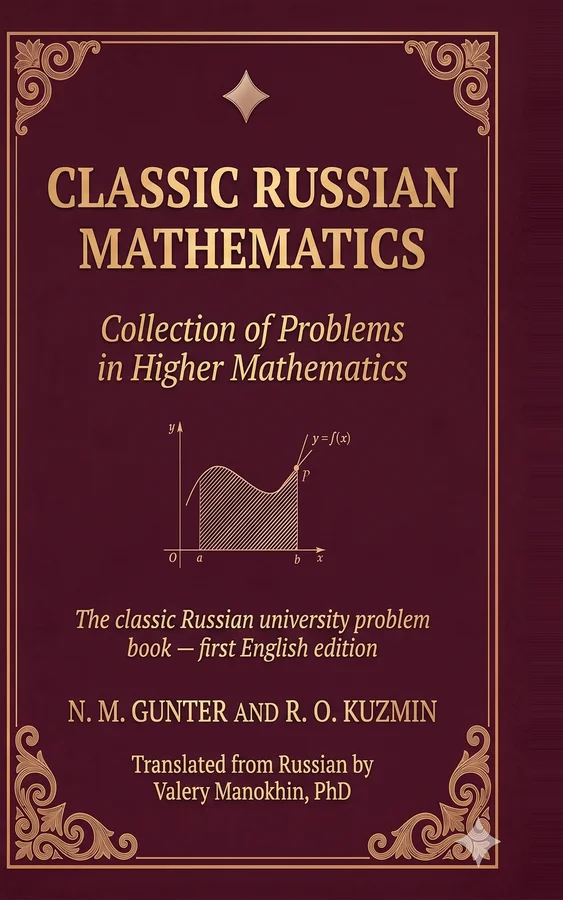
Gunter & Kuzmin
by N. M. Gunter & R. O. Kuzmin
US grades University 1–4 · UK Undergraduate
The standard Russian problem collection for higher mathematics — the book used across Soviet technical universities. 814 pages spanning mathematical analysis, differential and integral calculus, series, differential equations, and probability theory, in the first complete English translation.
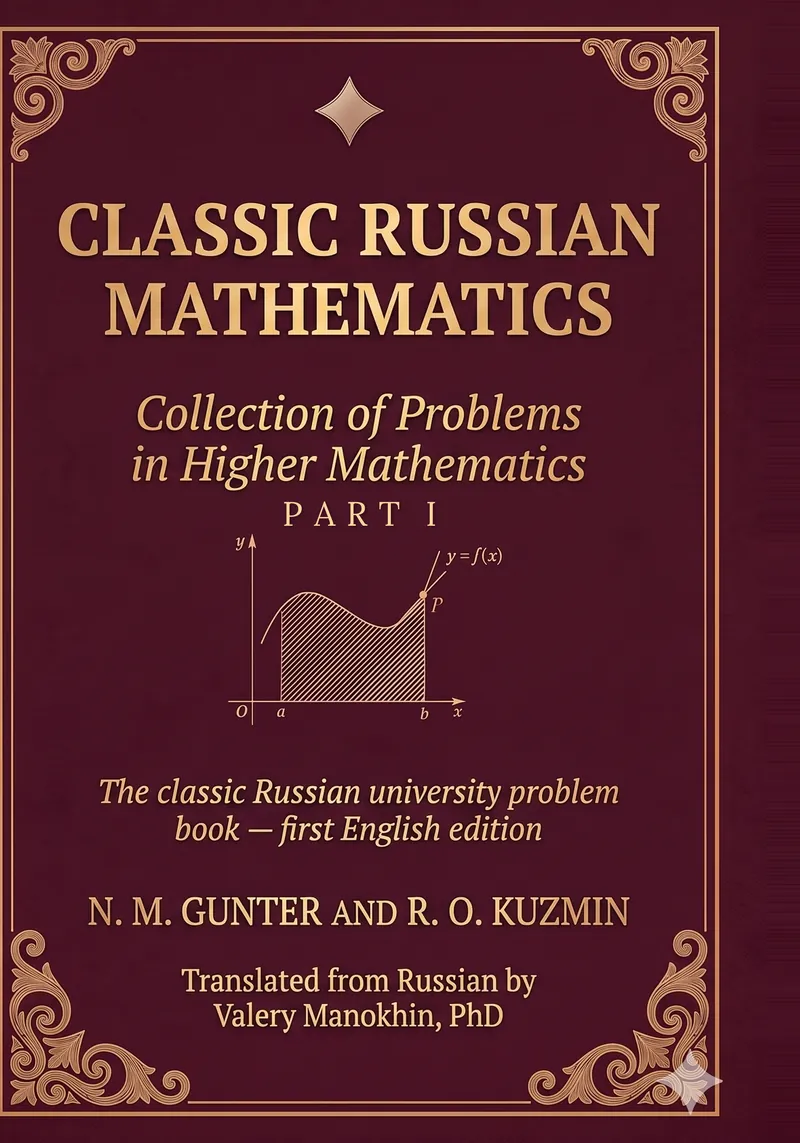
Gunter & Kuzmin, Part I
by N. M. Gunter & R. O. Kuzmin
US grades University 1–2 · UK Undergraduate
The first half of the standard Russian problem book for higher mathematics, as a volume on its own: analytic geometry in the plane and in space, differential calculus and its applications including differential geometry, higher algebra, and indefinite and definite integration. 448 pages.
Davidov's Algebra
by A. Yu. Davidov
US grades 8–12 · UK Years 9–13
The algebra course written by the founding president of the Moscow Mathematical Society, in first faithful English translation from the original Russian edition. Five divisions and 478 numbered articles run from algebraic signs and the fundamental operations through polynomials, the greatest common divisor, algebraic and continued fractions, ratio and proportion; equations of the first degree in one, two and several unknowns; powers and roots, irrational and incommensurable quantities, Newton’s binomial, quadratic equations and their investigation, imaginary quantities and equations of the third and fourth degree; indeterminate analysis; and progressions, series, logarithms and compound interest. Full solutions to the problems are included.
Markov: Probabilities
by Andrei A. Markov
US grades 12 and university · UK Year 13 and university
The foundational 1900 work on probability theory by the mathematician who gave us Markov chains. A modern annotated English translation.
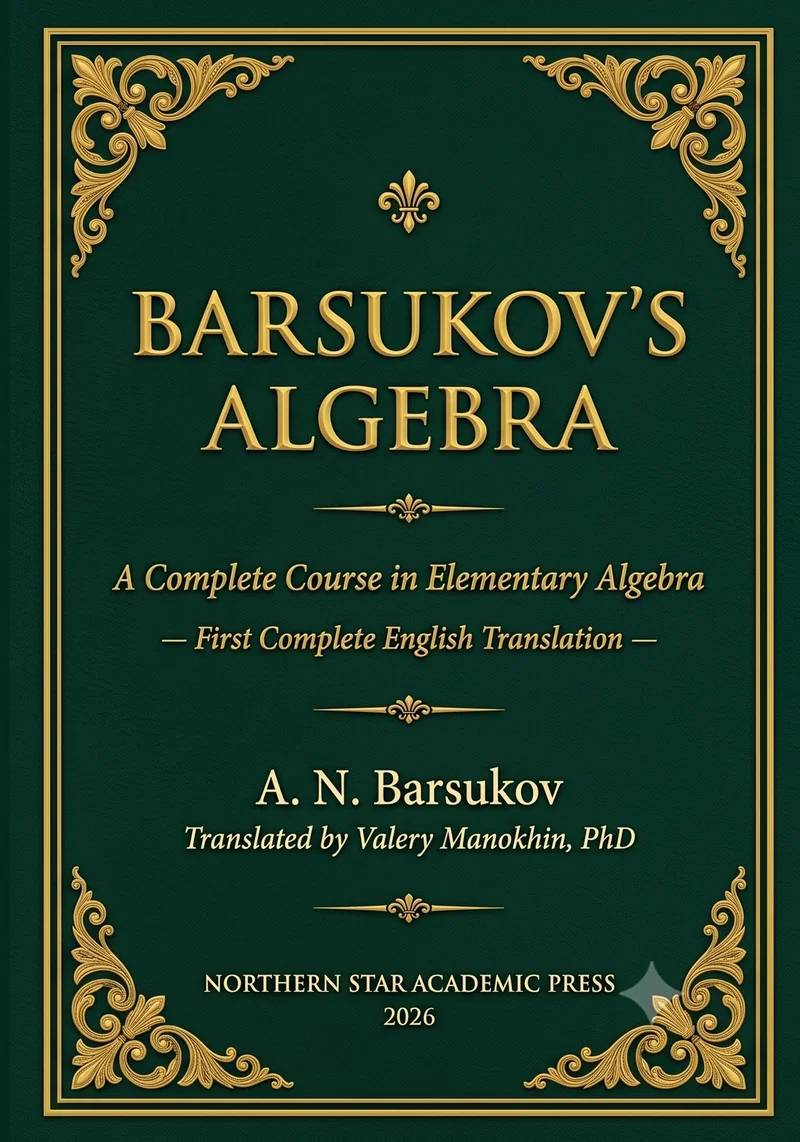
Barsukov's Algebra
by A. N. Barsukov
US grades 8–10 · UK Years 9–11
The Soviet school's standard algebra textbook — ten editions, roughly ten million copies. The first complete, faithful English translation of Barsukov's course, prepared from the original Russian and typeset to modern standards with source-exact section numbering. Twelve chapters, 130 numbered sections: from algebraic expressions and rational numbers through factoring, algebraic fractions, coordinates and graphs, systems of equations, the square root worked digit-by-digit, quadratic equations, and functions and graphs. Includes a full chapter on the slide rule — a subject once central to technical education, almost never found in a modern Western algebra text.
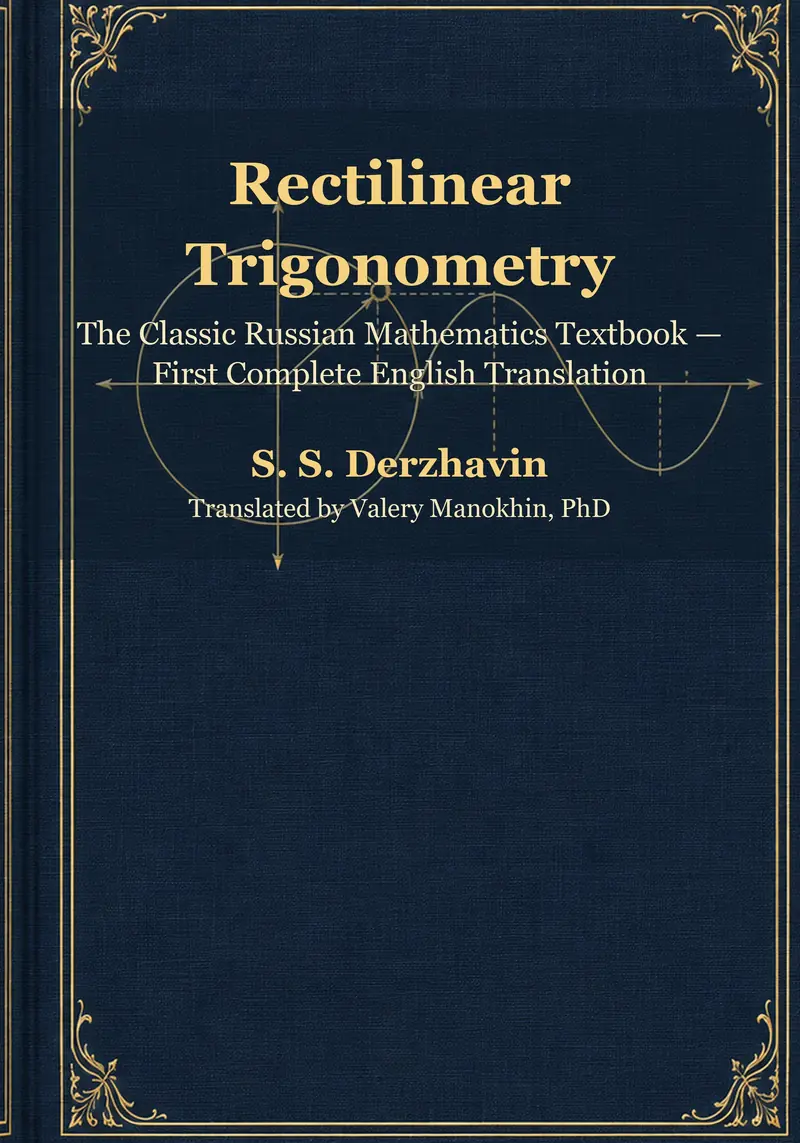
Derzhavin's Trigonometry
by S. S. Derzhavin
US grades 10–12 · UK Years 10–13
A complete classical course in plane trigonometry, in first complete English translation. Eight divisions and 86 numbered sections run from the function concept and radian measure through the trigonometric functions traced quadrant by quadrant, the addition and reduction formulas, the construction and use of logarithmic tables, the solution of oblique triangles by the laws of sines and cosines and by Mollweide’s formulas, measurement in the field and triangulation, the computation of π, and trigonometric equations. Sixty-eight figures and Tables I–V.
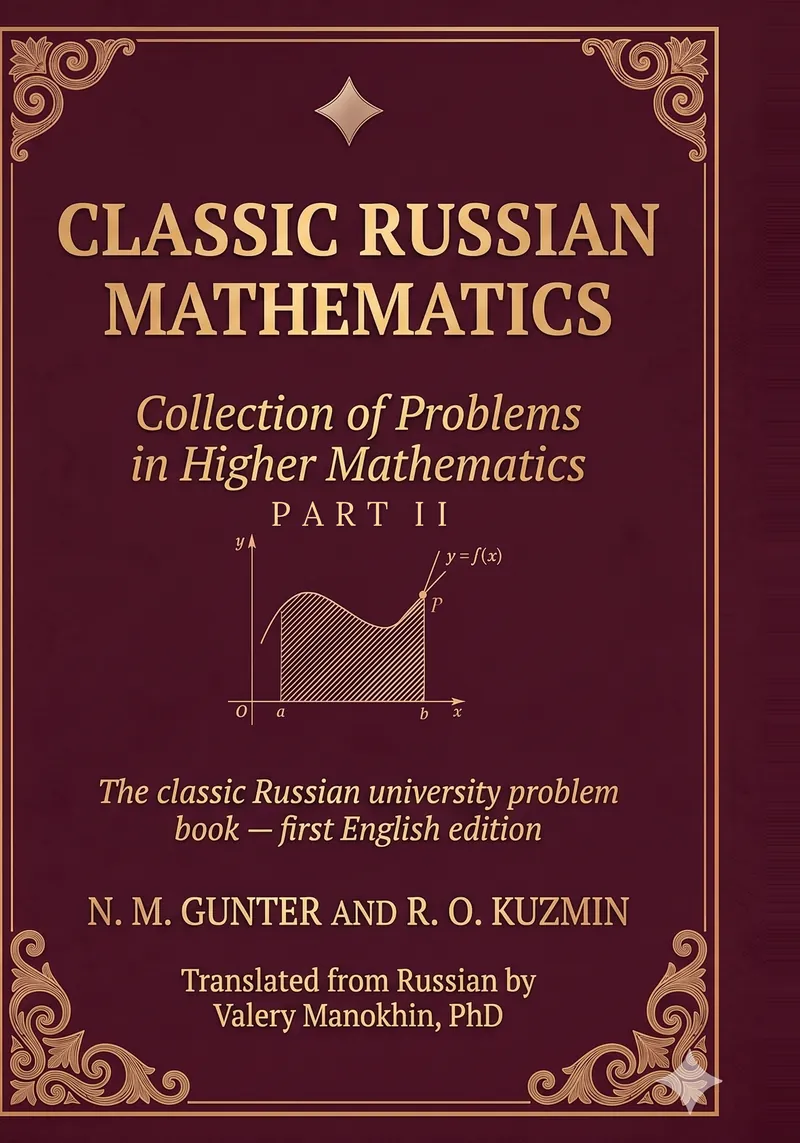
Gunter & Kuzmin, Part II
by N. M. Gunter & R. O. Kuzmin
US grades University 2–4 · UK Undergraduate 2–3
The second half completes the collection: multiple, curvilinear and surface integrals, field and potential theory, ordinary and partial differential equations, improper integrals and special functions, series and Fourier series, approximate computation, functions of a complex variable, mathematical physics, the calculus of variations and probability. 379 pages.
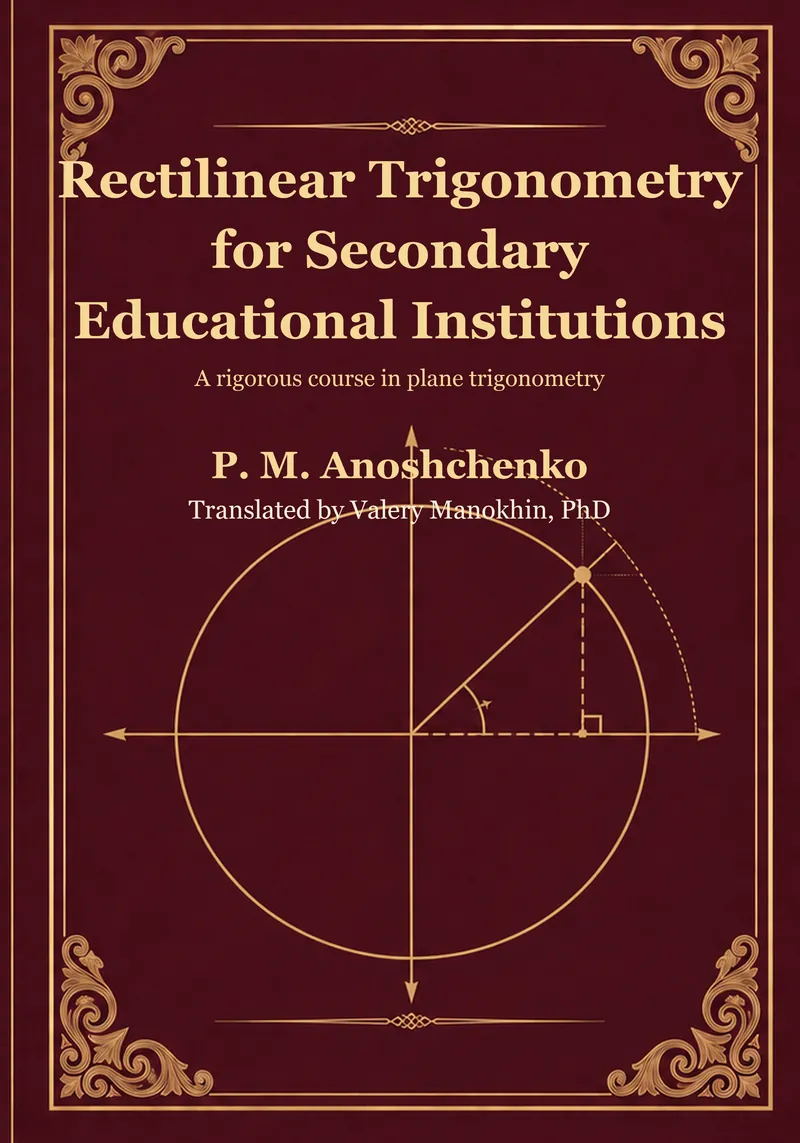
Anoshchenko's Trigonometry
by P. M. Anoshchenko
US grades 10–12 · UK Years 10–13
The 1905 secondary-school course in plane trigonometry, in first faithful English translation from the original Russian edition. Three parts: goniometry builds the measurement of angles and the trigonometric quantities from first principles across twelve chapters; rectilinear trigonometry proper solves the right triangle and then the oblique triangle, and closes with a full chapter on field triangulation; supplementary articles take up trigonometric equations, inverse trigonometric quantities, and maxima and minima. Sixty-three figures on eight plates.
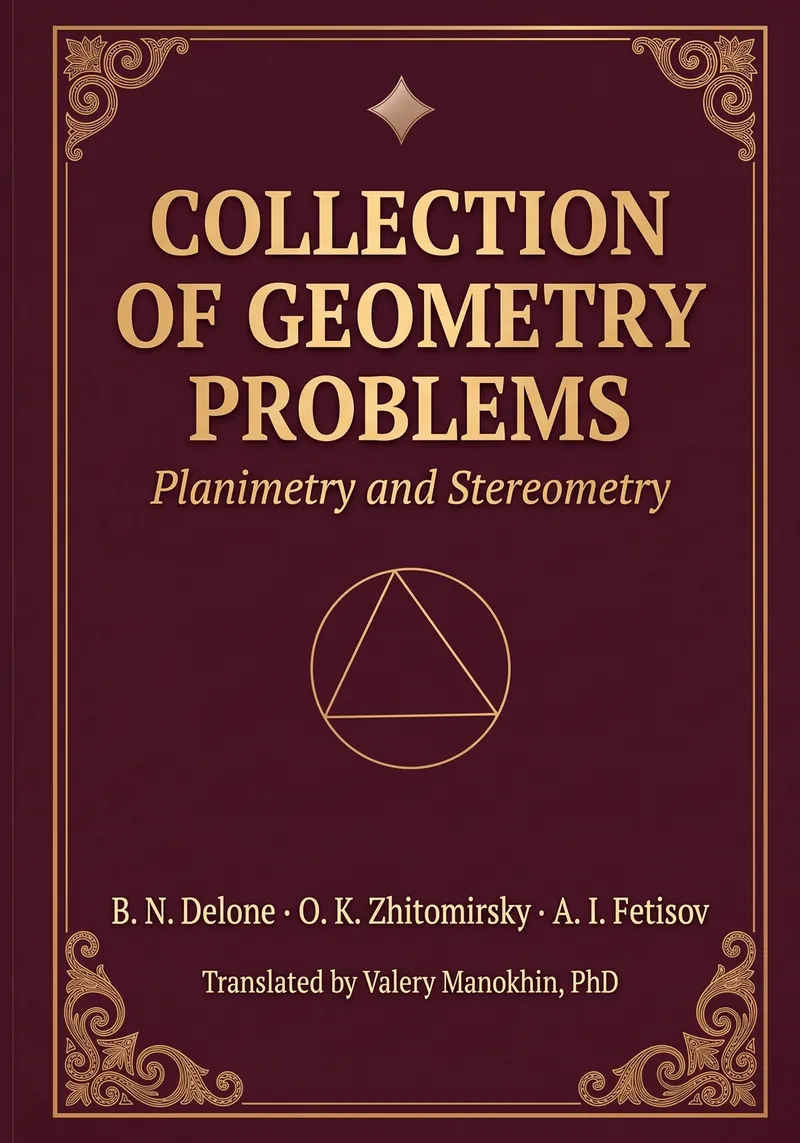
Delone: Geometry Problems
by B. N. Delone, O. K. Zhitomirsky & A. I. Fetisov
US grades 10–12 + · UK Years 11–13
85 problems with full solutions, from three mathematicians who wrote for students who wanted to be stretched. Construction, loci, congruence, similarity, areas and geometry in space — with each solution showing how to analyse a construction, carry it out, prove it correct and establish when it exists. Includes the Simson line, homothety, regular polyhedra, and the common part of a cube and a rotated copy of itself. 75 figures.
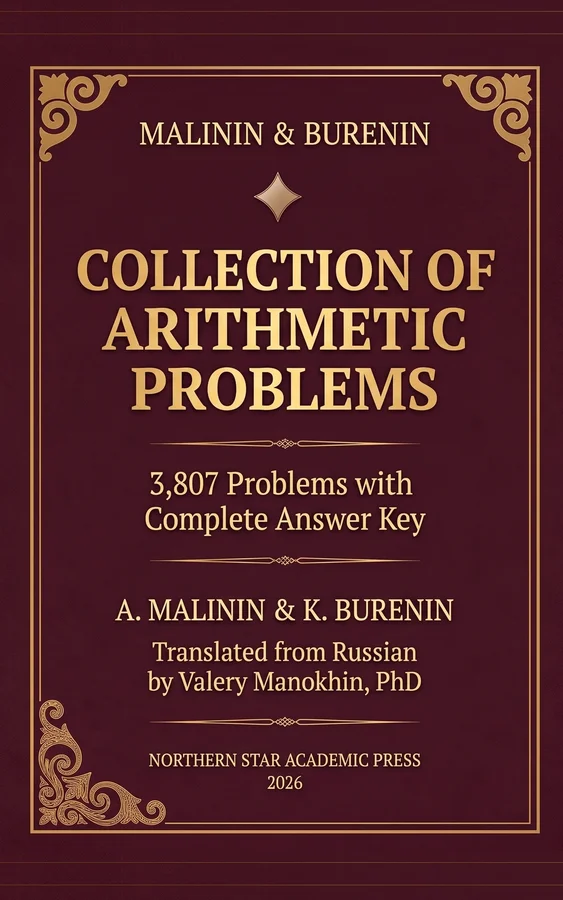
Malinin & Burenin Problems
by A. Malinin & K. Burenin
US grades 5–8 · UK Years 6–9
3,807 problems with a complete answer key — the problem collection that accompanies Malinin and Burenin's arithmetic textbook, and the exercises Imperial Russian students worked through alongside the theory. First complete English translation from the original Russian edition.
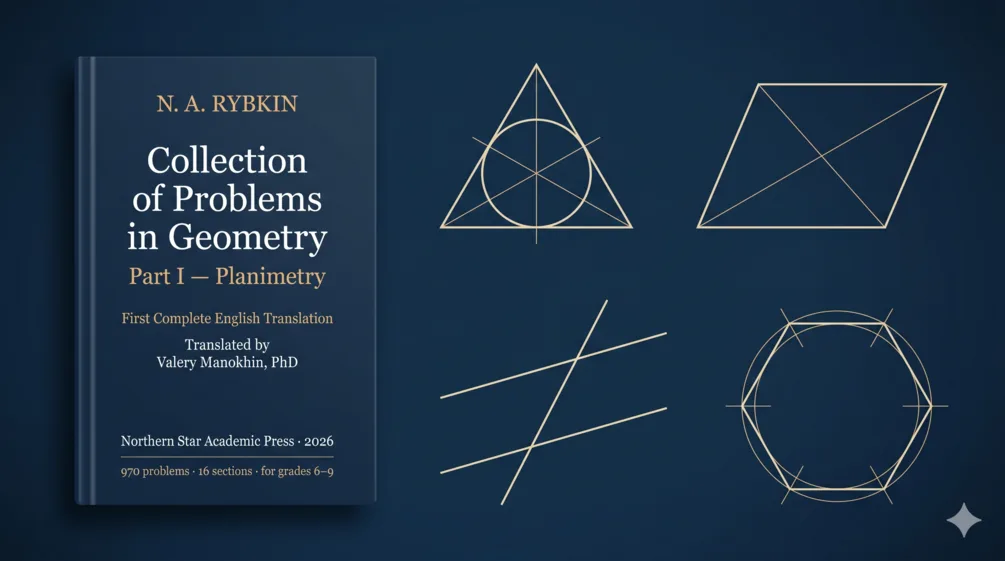
Rybkin's Planimetry Problems
by N. A. Rybkin
US grades 8–11 · UK Years 9–12
The companion problem collection to Kiselev's classical Russian geometry — now in English for the first time. Rybkin's Planimetry Problems is the set Russian students worked through alongside Kiselev's geometry textbook for over a century. Kiselev gives the definitions, theorems, and proofs; Rybkin gives the problems that turn those proofs into geometric intuition. 970 problems across 16 sections, organised chapter-by-chapter to mirror Kiselev's Planimetry — from preliminary concepts and lines through triangles, quadrilaterals, similar figures, the circle, regular polygons, and the measurement of areas. Worked solutions for the harder problems, hints for the rest.
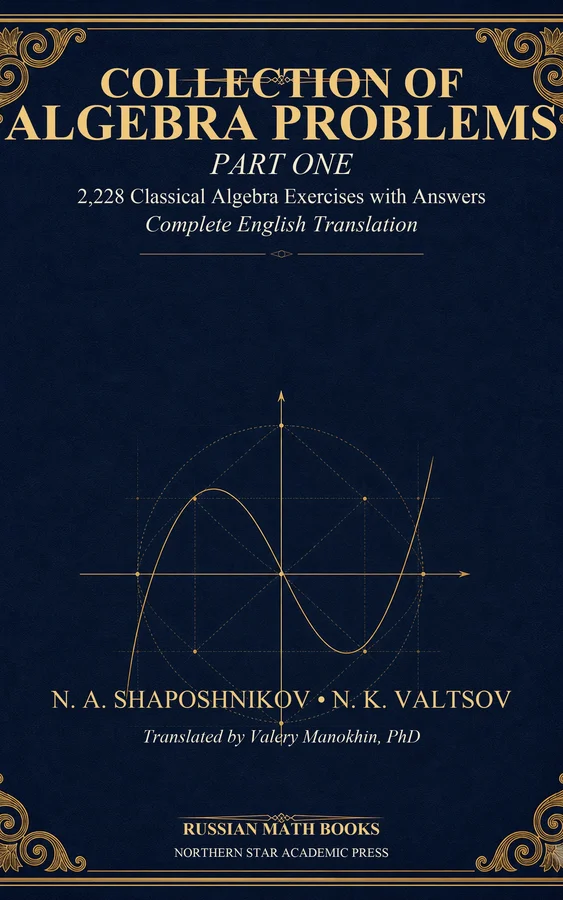
Shaposhnikov & Valtsov, Part I
by N. A. Shaposhnikov & N. K. Valtsov
US grades 7–10 · UK Years 8–11
2,228 classical algebra exercises with answers, in the first complete English translation. First published 1887–1890 and reissued in more than 50 editions, this is the problem collection that trained generations of Russian students alongside Kiselev. 9 chapters, sequenced from elementary operations through quadratic equations, with an answer key covering more than 1,300 entries.
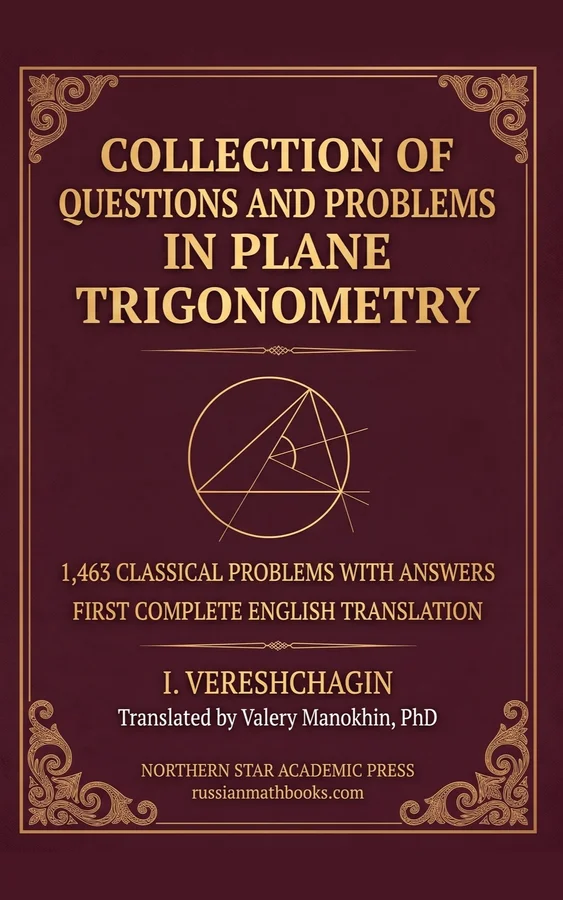
Vereshchagin's Plane Trigonometry
by I. P. Vereshchagin
US grades 10–12 · UK Years 11–13
A classical Russian problem book in plane trigonometry, in English for the first time. Questions and problems organised to carry a student from the definitions of the trigonometric functions through identities, equations, and the solution of triangles — the problem-solving companion to a classical trigonometry course.
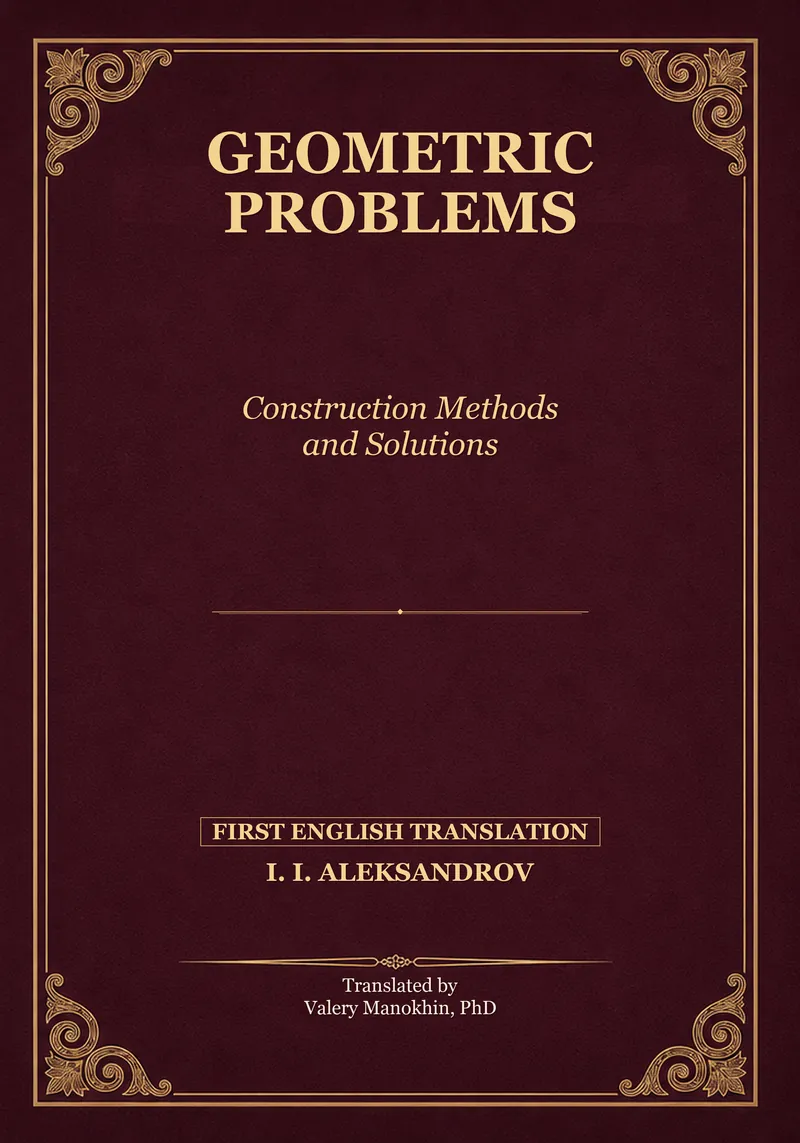
Aleksandrov's Geometric Problems
by I. I. Aleksandrov
US grades 10–12 + · UK Years 11–13
A course in geometric construction organised by the idea that solves the problem, not by topic: direct constructions, geometric loci, similarity, symmetry, parallel translation, inversion, rotation and algebraic methods. Every problem is treated through analysis, construction, proof and discussion.
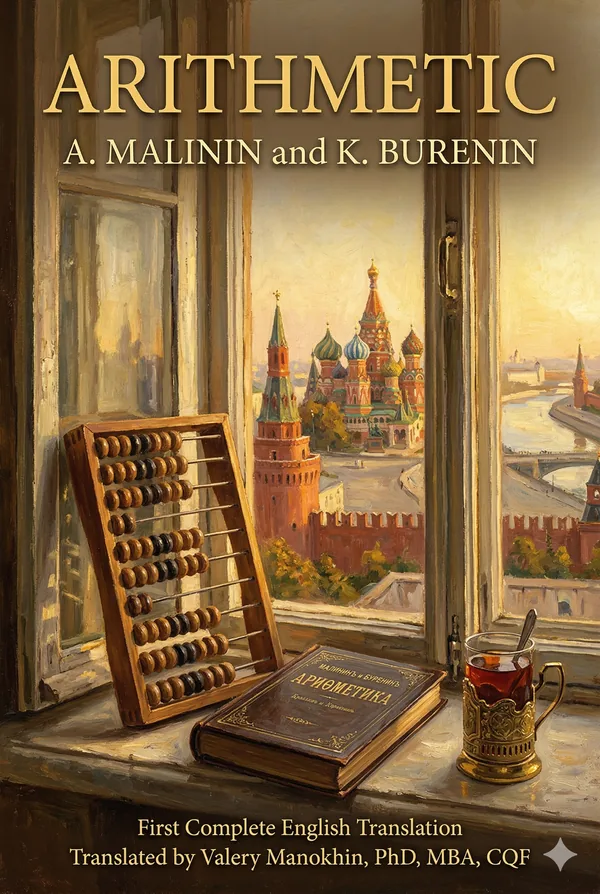
Malinin & Burenin
by A. Malinin & K. Burenin
US grades 5–8 · UK Years 6–9
A complete English translation of Malinin and Burenin's Imperial Russian arithmetic textbook. 11 chapters, 301 sections. Covers numeration, operations on whole numbers, divisibility, fractions, ratios, proportions, percentage, interest, and Diophantine problems.
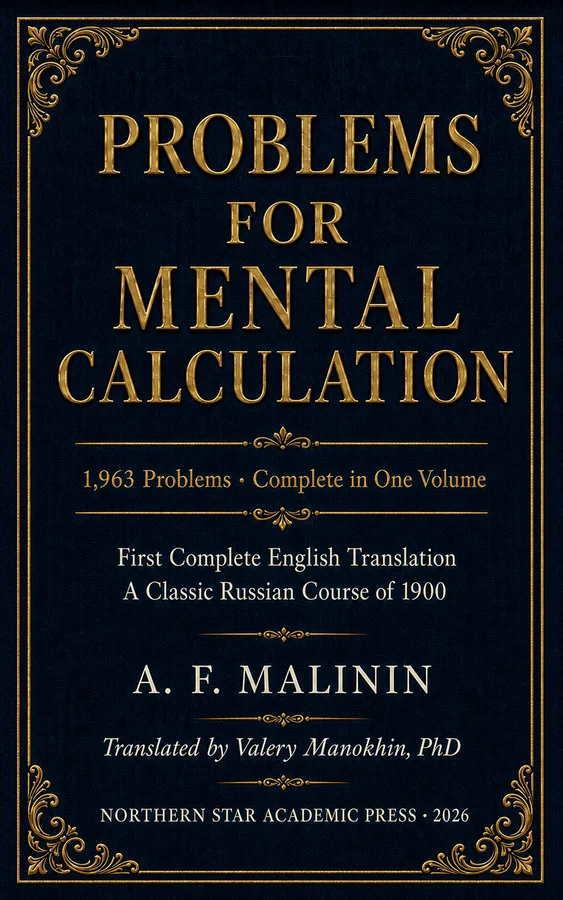
Malinin's Mental Calculation
by A. F. Malinin
US grades 2–7 · UK Years 3–8
First faithful English translation from the original Russian edition. 1,963 problems arranged from short numerical exercises to demanding multi-step work with fractions, money, weights, measures, and proportions. Preserves Malinin's original numbering and five-part progression.
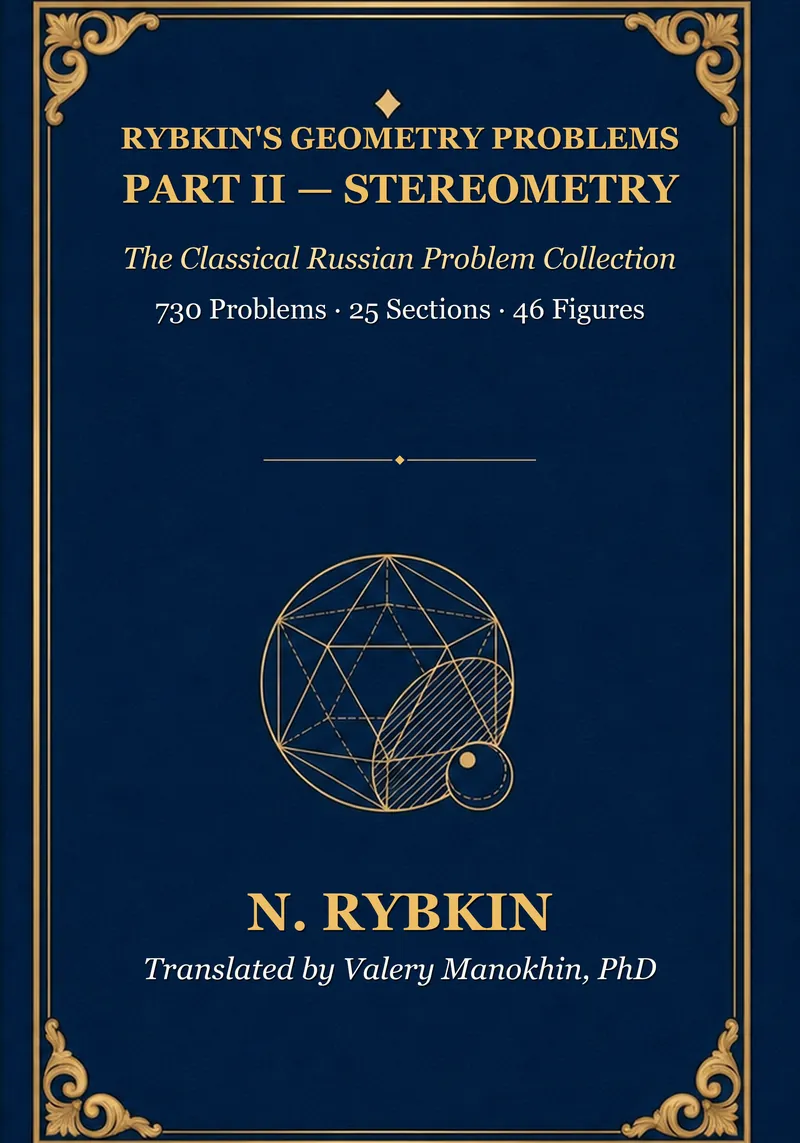
Rybkin's Stereometry Problems
by N. Rybkin
US grades 10–12 · UK Years 11–13
The problem set Russian students worked through alongside Kiselev's geometry. 730 problems across 25 sections: perpendiculars and oblique lines to a plane, parallel lines and planes, dihedral and polyhedral angles, regular polyhedra, prisms, pyramids and frustums, cylinders, cones and the sphere, volumes and surface areas. Original numbering and all 46 figures retained.
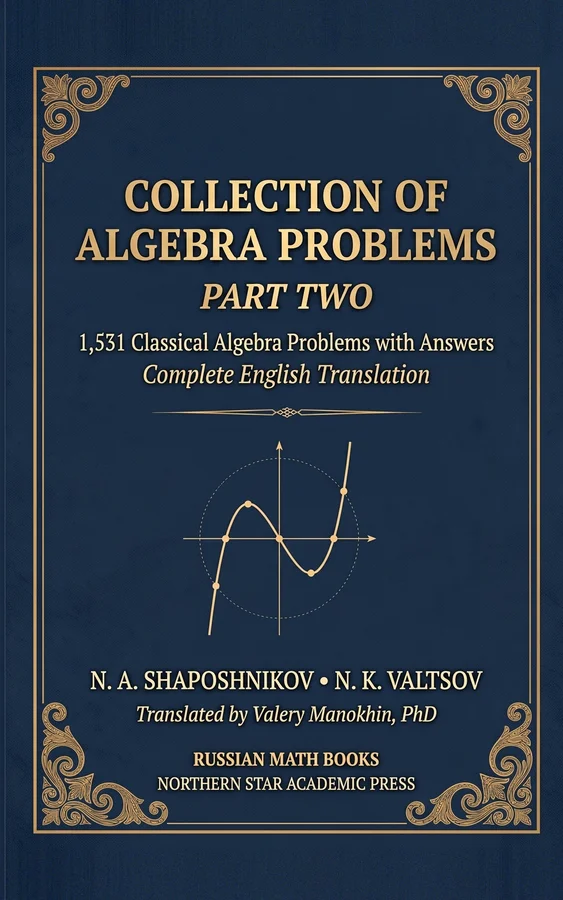
Shaposhnikov & Valtsov, Part II
by N. A. Shaposhnikov & N. K. Valtsov
US grades 9–12 · UK Years 10–13
1,531 classical algebra problems with answers, in the first complete English translation. Part II continues the sequence begun in Part I, carrying the student through the advanced topics of the classical Russian algebra course — the problem collection that trained generations of students alongside Kiselev.
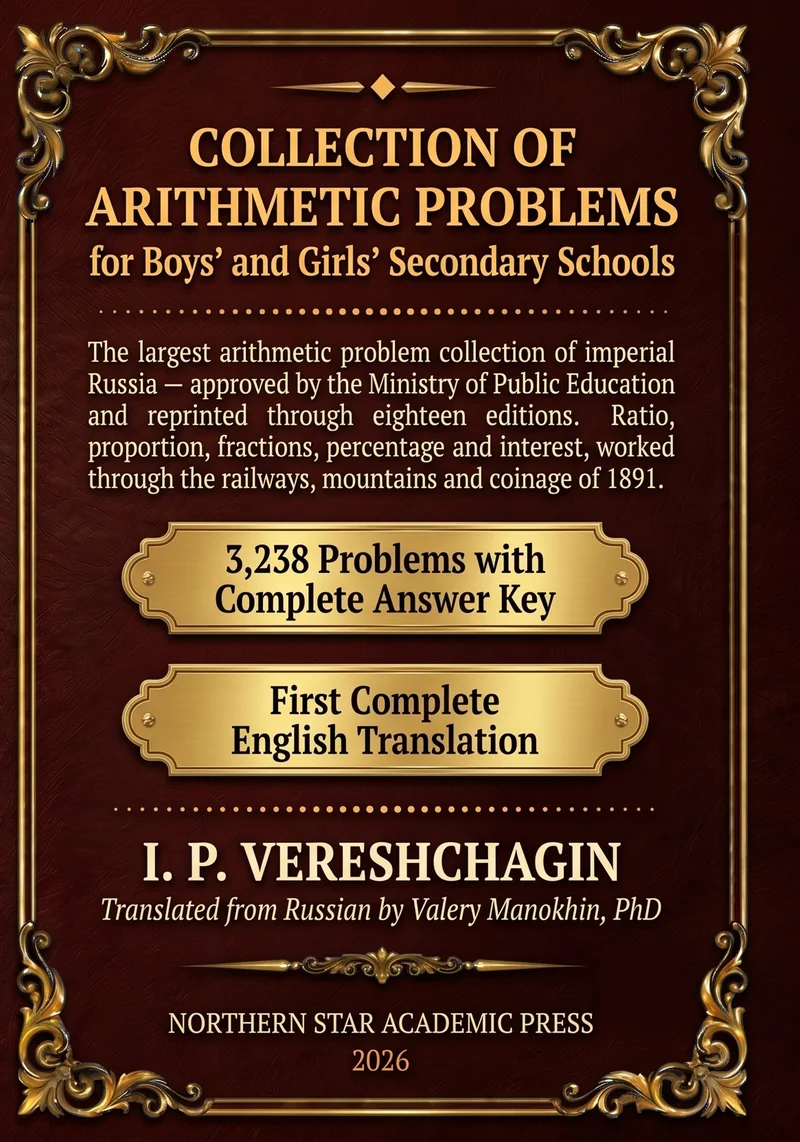
Vereshchagin's Arithmetic Problems
by I. P. Vereshchagin
US grades 4–8 · UK Years 5–9
The largest arithmetic problem collection of imperial Russia — 3,238 problems with the complete answer key, in English for the first time. Approved by the Ministry of Public Education for the Empire's secondary schools and teachers' seminaries, and separately for the girls' gymnasia of the Empress Maria department, it ran to eighteen editions. Three Parts and fifty-seven sections cover whole numbers and compound named numbers; divisibility; common and decimal fractions; the metric system; ratio and proportion; and the commercial rules — the rule of three, percentage, interest, discount, partnership and alligation. Vereshchagin insisted his data be real, so the problems run on railway timetables, the heights of Elbrus and Everest, the assay of the new silver ruble, and Eratosthenes measuring the earth between Syene and Alexandria. Translated from the seventh edition of 1891, with source-exact problem numbering.
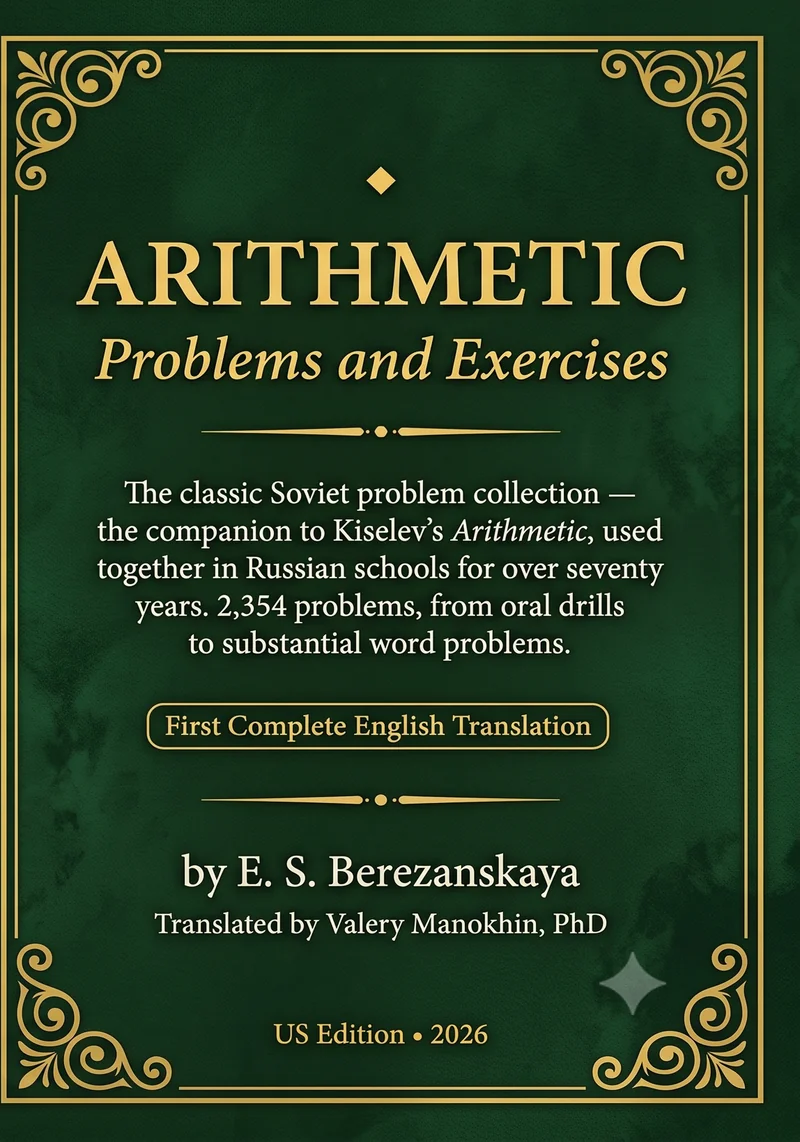
Berezanskaya's Arithmetic Problems
by E. S. Berezanskaya
US grades 4–7 · UK Years 5–8
The iconic companion to Kiselev's Arithmetic — the problem collection Russian classrooms used side-by-side with Kiselev for over 70 years. 2,354 problems across eight chapters in the canonical order: numeration; the four operations on whole numbers; divisibility; common fractions; decimal fractions; ratio and proportion; percentages; and a concluding chapter of mixed problems drawing on everything before. Oral drills, written exercises, and word problems of real substance, sequenced from easy to demanding. The first complete, faithful English translation, with source-exact problem numbering.
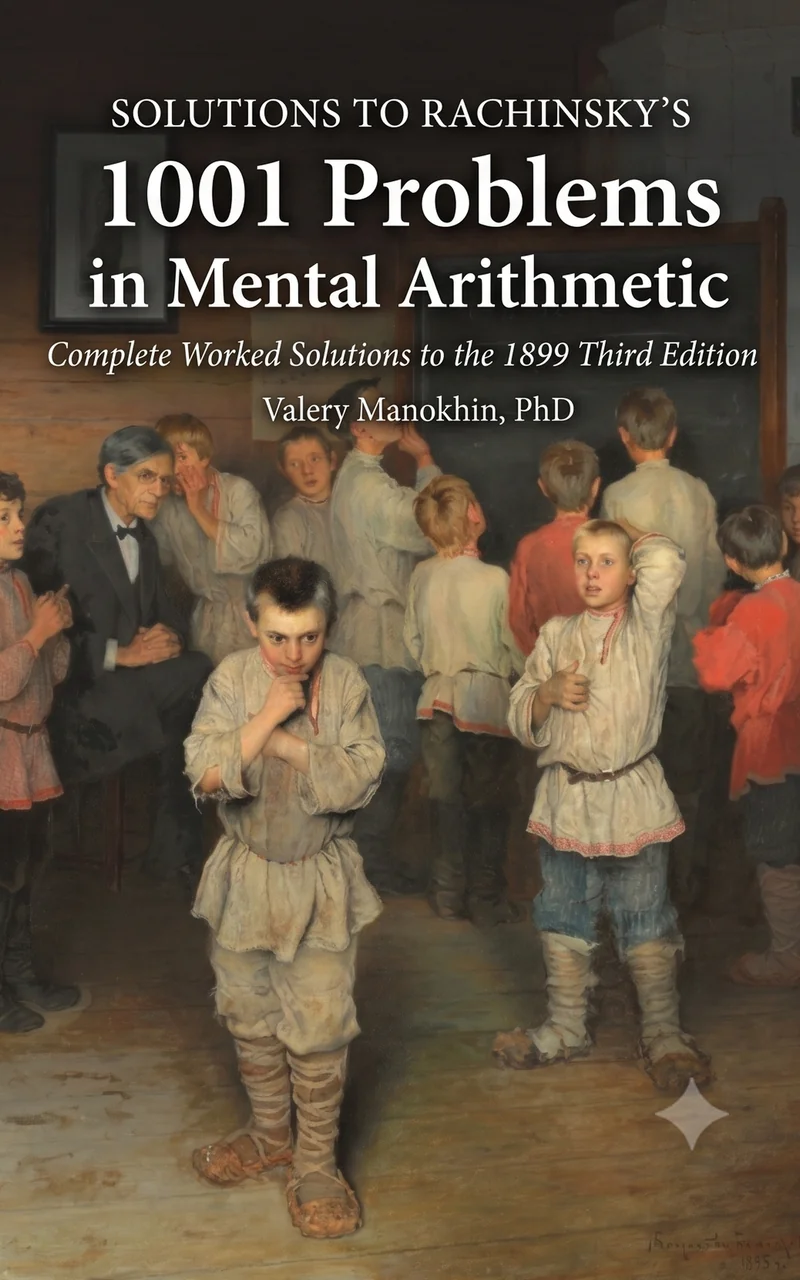
Rachinsky Solutions
by Valery Manokhin
US grades 4–8 · UK Years 5–9
The essential companion to Rachinsky's 1001 Problems — every problem solved, every error corrected. Step-by-step arithmetic reasoning for all 1,001 problems in the 1899 collection, with 12 errata corrections to misprints in the original answer key (problems #188, #410, #454, #468, #519, #563, #705, #779, #796, #836, #889, #892 — independently verified). Includes a complete conversion table for pre-revolutionary Russian units (puds, funts, zolotniks, sazhens, arshins, vershoks, desyatinas, chetveriks). 257 pages, professionally typeset. Solutions organised by problem number to match the companion problem book exactly.
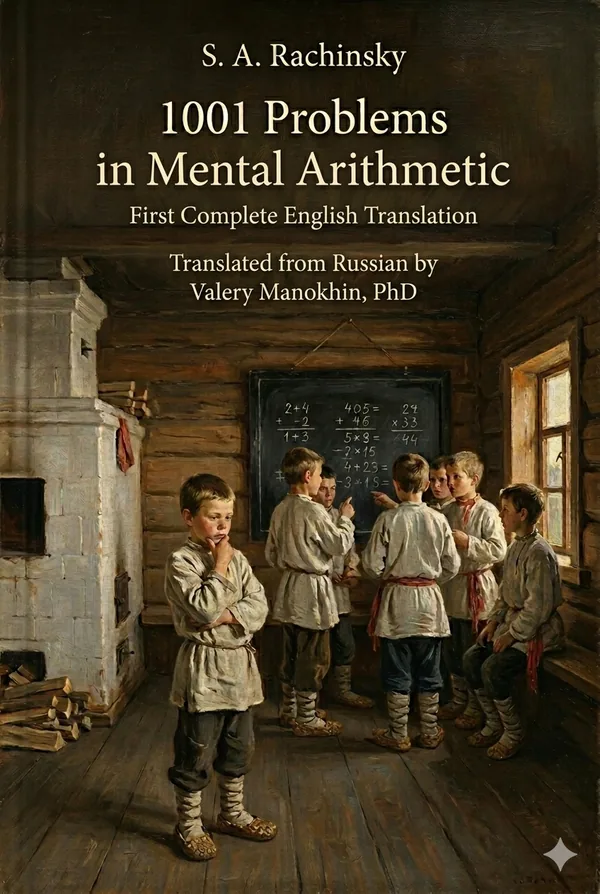
Rachinsky's 1001 Problems
by S. A. Rachinsky
US grades 4–8 · UK Years 5–9
1,001 carefully selected problems from the village schoolteacher whose students were depicted in Bogdanov-Belsky's famous 1895 painting "Mental Arithmetic."
Rashevsky's Arithmetic
by K. N. Rashevsky
US grades 5–8 · UK Years 6–9
A complete course in arithmetic in nine sections, in first faithful English translation from the original Russian edition. The four operations on whole numbers with the written methods set out in full; named and metric quantities; areas and volumes worked from drawings; tests for divisibility, primes, greatest common divisor and least common multiple; common and decimal fractions, including repeating decimals; ratio, proportion and proportional division; percentage and mixing problems; and plans, diagrams and graphs. Long divisions and column multiplications are printed digit under digit, so the reasoning stays visible on the page.
Rashevsky's Trigonometry
by K. N. Rashevsky
US grades 10–12 · UK Years 10–13
A faithful English edition of the classical Russian trigonometry textbook. A complete course in plane trigonometry — the trigonometric functions, radian measure and the unit circle, identities, equations, and the solution of triangles — built the way the Russian school tradition built it: define, prove, apply.
Raykovsky: Foundations of Geometry
by Stepan Raykovsky
US grades 9–12 · UK Years 10–13
A systematic course in plane and solid geometry, never before published in English. Definitions, axioms and postulates first; then 310 numbered articles building from the straight line to the sphere, each proposition proved and each construction carried out in full. Four divisions: straight lines in a plane, the line and the circle, measurement of plane figures, and the geometry of solids. All 157 figures reproduced from the five engraved plates.
Perelman's Entertaining Arithmetic
by Ya. I. Perelman
US grades 4+ · UK Year 5+
The classic of Russian popular mathematics. Puzzles, riddles, and curiosities that make arithmetic genuinely entertaining.
Berman's Calculation Techniques
by G. N. Berman
US grades 6–10 · UK Years 7–11
Three parts covering mental calculation, written calculation, and approximate calculation — the practical arithmetic skills the Russian school tradition treated as foundational. A short, dense book on how to compute well without a calculator.
Save with Bundles
Curriculum Bundles
Build a complete classical mathematics library. Every bundle saves you more than buying individually.
The Kiselev Six-Book Curriculum
Save 22%Arithmetic + Algebra I + Algebra II + Planimetry + Stereometry + Calculus — the complete Kiselev arc from arithmetic through calculus, the Russian classical secondary-school sequence in full
Kiselev's Complete School Mathematics
Save 23%Arithmetic + Algebra I + Algebra II + Planimetry + Stereometry
Classical Mathematics Complete
Save 22%Arithmetic + Algebra I + Algebra II + Markov + Rachinsky — all 5 classical mathematics titles
The Kiselev Math Curriculum
Save 20%Arithmetic + Algebra I + Algebra II
Arithmetic Masters Collection
Save 26%Kiselev's Arithmetic + Malinin & Burenin's Arithmetic + Rachinsky's 1001 Problems
Arithmetic Problem-Solving Library
Save 20%Malinin & Burenin's Arithmetic + Rachinsky's 1001 Problems + Perelman's Entertaining Arithmetic
The Complete Kiselev Algebra
Save 19%Algebra Part I + Part II
Math Bundle
Save 23%Kiselev's Arithmetic + Markov's Calculus of Probabilities
The Kiselev Foundation
Save 22%Arithmetic + Algebra Part I
Russian Arithmetic Duo
Save 22%Kiselev's Arithmetic + Malinin & Burenin's Arithmetic
Rachinsky Complete Bundle
Save 37%Rachinsky's 1001 Problems + Rachinsky's 1001 Solutions — the complete problem-and-solution pair for classical Russian mental arithmetic
About the Translator
Valery Manokhin, PhD
PhD in Machine Learning (Royal Holloway, University of London). MBA (Warwick). MSc (UCL). Certificate in Quantitative Finance (CQF). Author of 7 technical books and 9 translations across machine learning, forecasting, conformal prediction, and classical mathematics.
The Russian mathematical tradition produced unusually clear, rigorous textbooks. Every translation is faithful to the original Russian editions, preserving the structure and explanations that made these books durable.
Curriculum: which book, which year
Every title placed against the US, UK and Canadian school years, with what each one leaves out — and, where two volumes overlap, the counted differences that decide between them.